


Introduction
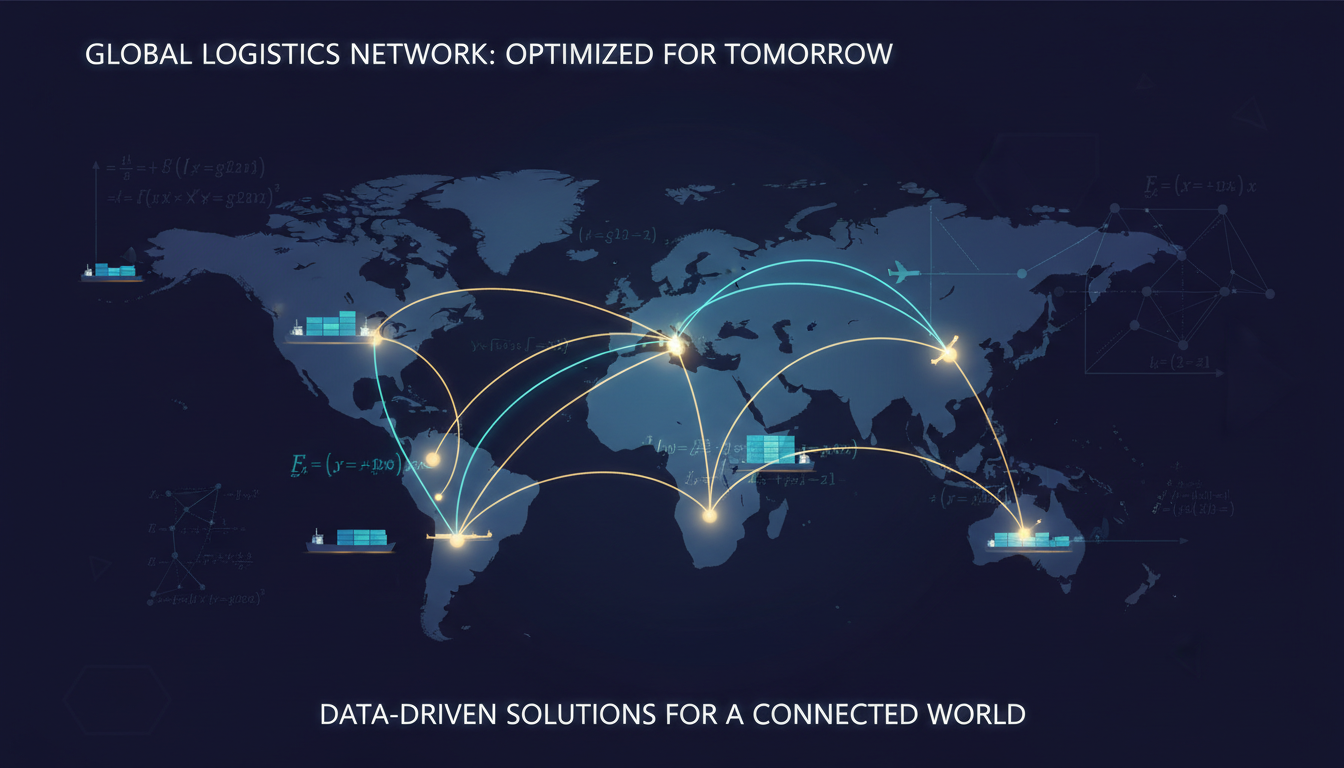
The global logistics industry manages over $9.6 trillion in annual freight movements, and within that enormous figure, high-value cargo — pharmaceuticals, semiconductors, luxury goods, and precision equipment — represents the segment where every inefficiency carries a disproportionately large cost. Consequently, organizations have turned to operations research to engineer mathematically rigorous routing solutions. Moreover, this is not merely an academic exercise; rather, it is a commercial imperative that directly influences profit margins, delivery reliability, and competitive positioning.
In addition, the complexity of modern supply chains has outgrown the capacity of human intuition alone. Therefore, mathematical optimization provides the structured framework that transforms sprawling networks of nodes and arcs into solvable — and increasingly, real-time-solvable — decision models 1 . As a result, leading logistics operators now embed optimization engines at the core of their planning systems.
“The world is not going to be saved by legislation. It is going to be saved by the intelligent use of mathematics and science.”— George Dantzig, pioneer of linear programming
This article explores, in depth, how operational research methodologies — from classical linear programming to cutting-edge metaheuristic algorithms — are being applied to the mathematical optimization of global routing networks. Furthermore, we examine the quantitative strategies that drive measurable gains in cost reduction, transit-time reliability, and asset utilization. Ultimately, the goal is to demonstrate why operations research is not an optional enhancement; instead, it is the foundation of competitive logistics strategy.
How does mathematical optimization reduce costs in global logistics routing networks?
Route Efficiency Calculator
1,600
km / period
$2,670
unoptimized
19.3%
projected savings
$26,842
est. per year
Methodology: Simplified Clarke-Wright savings algorithm (18–22% based on density). Actual gains depend on network topology, time windows, and traffic conditions.
1. Linear Programming and Network Flow Models: The Quantitative Backbone of Route Optimization
At the foundation of logistics optimization lies linear programming (LP), the technique that George Dantzig formalized in 1947 and that remains, to this day, the workhorse of quantitative supply chain planning. In essence, LP models define an objective function — typically cost minimization or throughput maximization — subject to constraints that mirror real-world limits: truck capacities, warehouse throughput, driver hours, and contractual service-level agreements.
Furthermore, when the logistics network is represented as a directed graph, the problem naturally takes the form of a minimum-cost network flow. Each arc carries a unit cost and a capacity bound; each node enforces supply-demand balance. Therefore, the simplex method — or its more modern interior-point counterpart — can identify the globally optimal flow in polynomial time for continuous relaxations 2 . In practice, this means that a global shipper can compute the least-cost allocation of thousands of containers across dozens of ports in under a second.
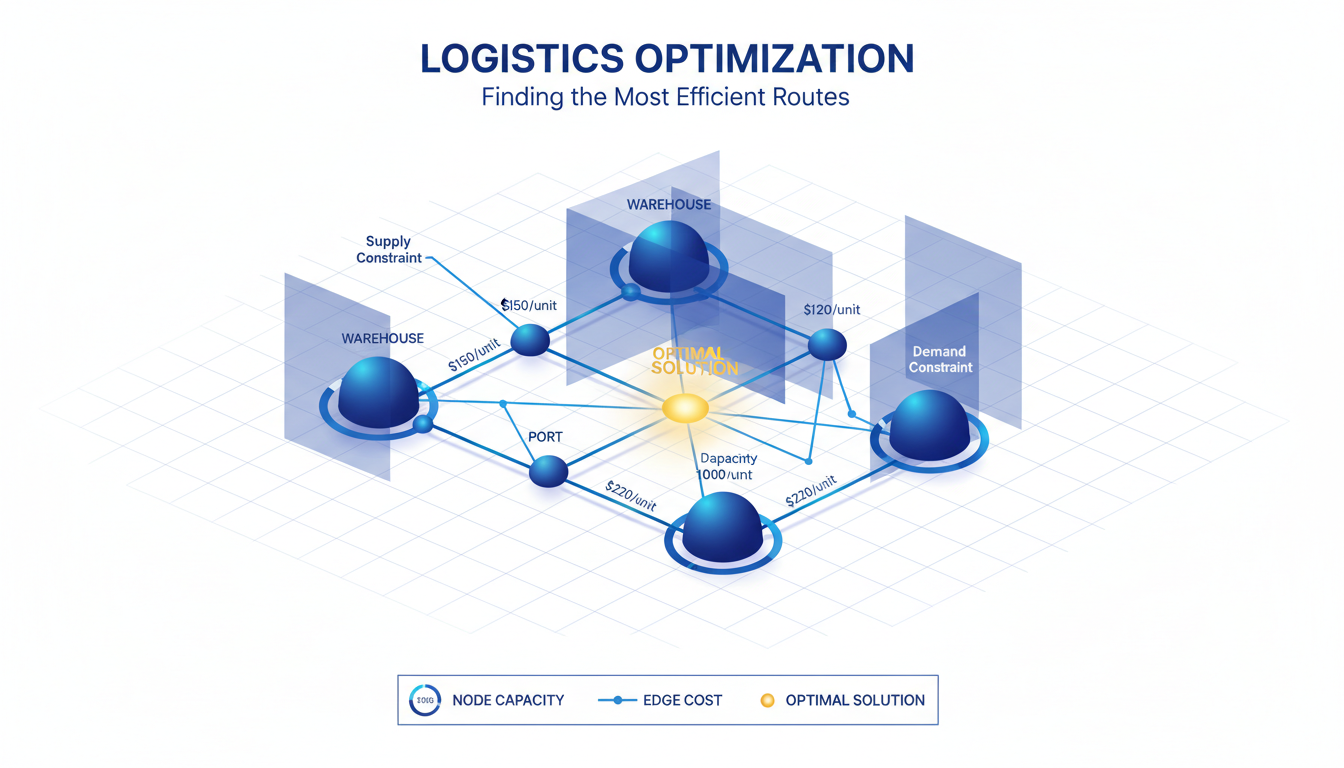
However, real logistics networks rarely involve purely continuous decisions. Accordingly, the field extends into mixed-integer linear programming (MILP), where binary variables capture discrete choices — whether to open a facility, assign a vehicle to a route, or activate a cross-docking lane. Although MILP problems are NP-hard in general, modern solvers such as Gurobi and CPLEX exploit sophisticated branch-and-bound strategies to close optimality gaps within practical time budgets 3 . As a result, companies like DHL and Maersk routinely solve MILP models containing millions of variables as part of their weekly planning cycles.
“The essence of operations research is the construction of a mathematical model that abstracts the essential elements of a strategic problem, so that a solution relevant to the decision-maker’s goals can be obtained.”— Frederick Hillier & Gerald Lieberman, Introduction to Operations Research
In my view, the most underappreciated aspect of LP-based routing is its transparency. Unlike black-box algorithms, a linear program produces dual variables — shadow prices — that tell planners precisely how much one additional unit of a scarce resource (a truck, a warehouse slot, a customs clearance window) would be worth. This dual information, therefore, transforms optimization from a one-time computation into a continuous strategic dialogue between the model and the decision-maker.
2. The Vehicle Routing Problem and Metaheuristic Frontiers in High-Value Distribution
While network flow models excel at strategic allocation, the operational layer of logistics — the “last mile” and inter-hub transport — requires a different class of optimization: the vehicle routing problem (VRP). The VRP, first formalized by Dantzig and Ramser in 1959, asks a deceptively simple question: what is the optimal set of routes for a fleet of vehicles to service a set of customers? Yet this simplicity masks NP-hard combinatorial complexity that grows explosively with the number of stops.
For high-value logistics in particular, the VRP acquires additional dimensions. Specifically, time windows become hard constraints (a pharmaceutical shipment that arrives outside its cold-chain window is worthless), vehicle compartments may require temperature zoning, and insurance mandates may limit the total cargo value per vehicle. Accordingly, the industry works with rich VRP variants: VRPTW (time windows), VRPPD (pickup and delivery), and HFVRP (heterogeneous fleet).
Since exact methods struggle with instances beyond a few hundred nodes, metaheuristic algorithms have emerged as the practical frontier. In particular, adaptive large neighborhood search (ALNS), genetic algorithms, and ant colony optimization have demonstrated consistently strong performance on benchmark instances. Moreover, hybrid approaches — where a metaheuristic generates promising solution neighborhoods and an LP solver polishes them — represent the current state of the art 4 .
“With four parameters I can fit an elephant, and with five I can make him wiggle his trunk. The point is not complexity — it is the right kind of simplicity.”— John von Neumann, mathematician and polymath
Furthermore, real-time dynamic routing is transforming the field. Thanks to IoT sensors, GPS telemetry, and cloud computing, it is now feasible to re-optimize routes continuously as conditions change — traffic congestion, port delays, or sudden demand spikes. Consequently, the mathematical optimization of global routing networks is shifting from a batch planning exercise to a living, adaptive computation that responds to the world as it unfolds. This is, in my opinion, the most exciting development in operations research today.
Additionally, the integration of machine learning with classical OR methods is producing remarkable results. Specifically, reinforcement learning agents can learn dispatching policies that outperform hand-crafted heuristics, while graph neural networks can predict solution structures that accelerate the search process by orders of magnitude. Nevertheless, the mathematical rigor of operations research ensures that these data-driven approaches are guided by provable bounds and feasibility guarantees — a critical requirement when routing high-value goods.
3. Stochastic Optimization and Risk-Quantified Routing for Fragile Supply Chains
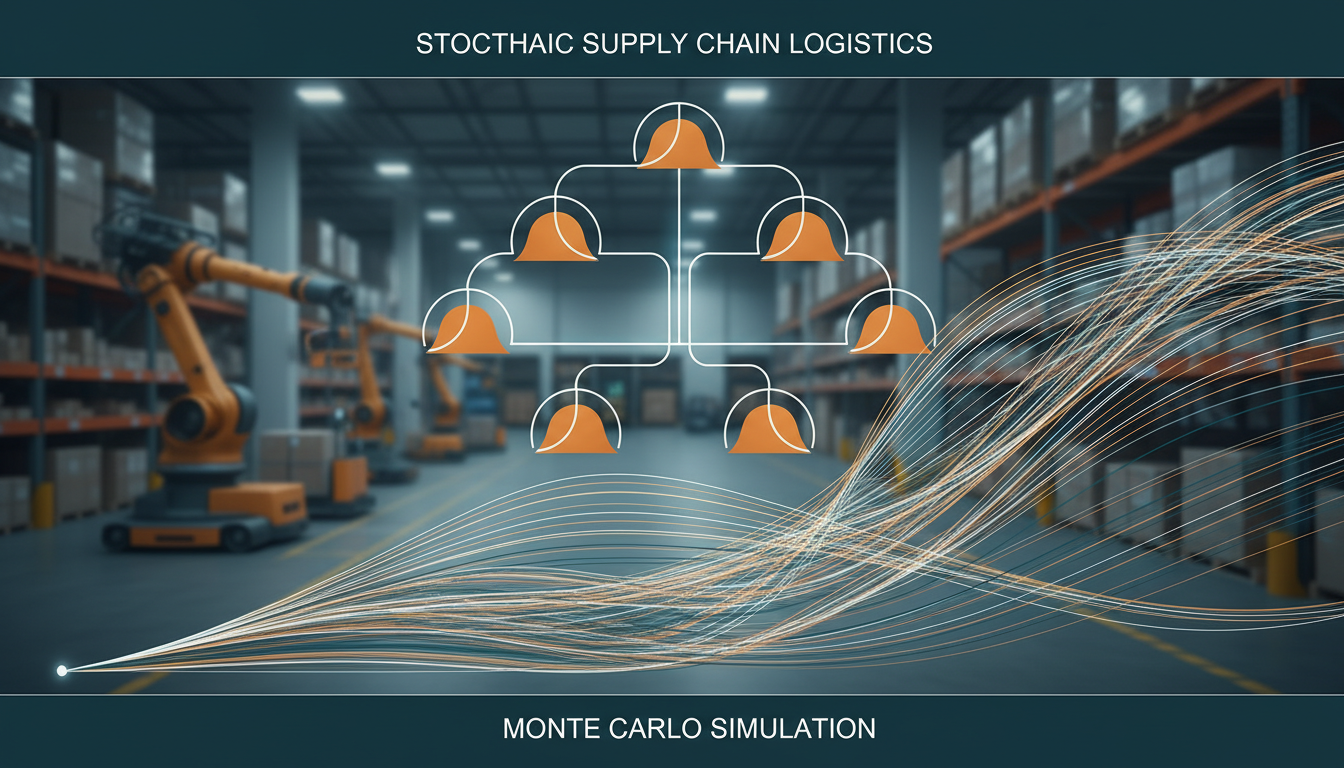
Deterministic models assume that all parameters — demands, transit times, costs — are known with certainty. However, in global logistics, uncertainty is not the exception; it is the rule. Therefore, stochastic optimization models have become essential tools for planners who must hedge against disruptions while still pursuing cost efficiency. In particular, two-stage stochastic programs allow the decision-maker to commit to first-stage decisions (fleet deployment, warehouse stocking) before uncertainty is revealed, and then to optimize recourse actions (re-routing, expedited shipping) once actual conditions materialize.
Moreover, robust optimization offers a complementary philosophy. Instead of modeling probability distributions, it protects against all scenarios within a defined uncertainty set. As a result, solutions from robust models tend to be more conservative but also more resilient — a trade-off that is often worth making when the cargo is irreplaceable. For instance, routing strategies for semiconductor wafer shipments frequently employ robust formulations because a single lot can represent tens of millions of dollars in value.
Furthermore, scenario-based planning combines the strengths of both approaches. Planners generate a finite set of plausible futures — each characterized by specific demand levels, fuel prices, geopolitical conditions, and weather patterns — and then optimize across the entire scenario tree. Consequently, the resulting strategy performs well on average while avoiding catastrophic outcomes in worst-case scenarios. This balance between optimality and resilience is, in my professional opinion, the hallmark of mature logistics optimization.
“The problem is not making a mistake; the problem is not positioning yourself to survive the mistake. Fragility is the penalty for not having mathematical rigor in your planning.”— Nassim Nicholas Taleb, author of The Black Swan
Additionally, value-at-risk (VaR) and conditional value-at-risk (CVaR) metrics, originally developed for financial portfolio theory, are now being applied to logistics network design. These measures quantify the tail risk of routing decisions — the cost exposure in the worst 5% of scenarios — and thereby allow planners to construct networks that are not merely optimal in expectation but also defensible under stress. This cross-pollination between financial mathematics and logistics OR is an area that deserves far more attention from practitioners and researchers alike.
Conclusion: The Strategic Imperative of Mathematical Optimization in Logistics
In conclusion, the evidence is unambiguous: organizations that embed mathematical optimization into their logistics operations achieve measurably superior outcomes — lower costs, faster deliveries, higher asset utilization, and greater resilience to disruptions. Moreover, as global trade volumes continue to grow and supply chain complexity intensifies, the gap between optimized and non-optimized operators will only widen. Therefore, investing in operations research capability is not merely a technical decision; it is a strategic one.
Furthermore, the frontier is advancing rapidly. Quantum computing promises to solve integer programs that are currently intractable. Digital twins — real-time simulation replicas of physical supply chains — are enabling continuous what-if analysis at unprecedented scale. In addition, the convergence of operations research with artificial intelligence is producing hybrid systems that combine the rigor of mathematical programming with the adaptability of machine learning. As a result, the mathematical optimization of global routing networks is entering its most transformative era.
Ultimately, the discipline of operations research offers something rare in business: the ability to prove, mathematically, that a decision is optimal or near-optimal. In a world flooded with data but starved of insight, this capacity for rigorous, quantifiable decision-making is extraordinarily valuable. Logistics leaders who recognize this — and who invest accordingly in the models, algorithms, and talent that make it possible — will define the next generation of global supply chain excellence.
“Without data, you’re just another person with an opinion. With the right model, you become the architect of outcomes.”— W. Edwards Deming, statistician and quality management pioneer
References
Disclaimer: This article is published for informational and educational purposes. The views expressed are those of the editorial team and do not constitute professional consulting advice. All referenced regulations and standards should be verified with their issuing authorities.