


Introduction
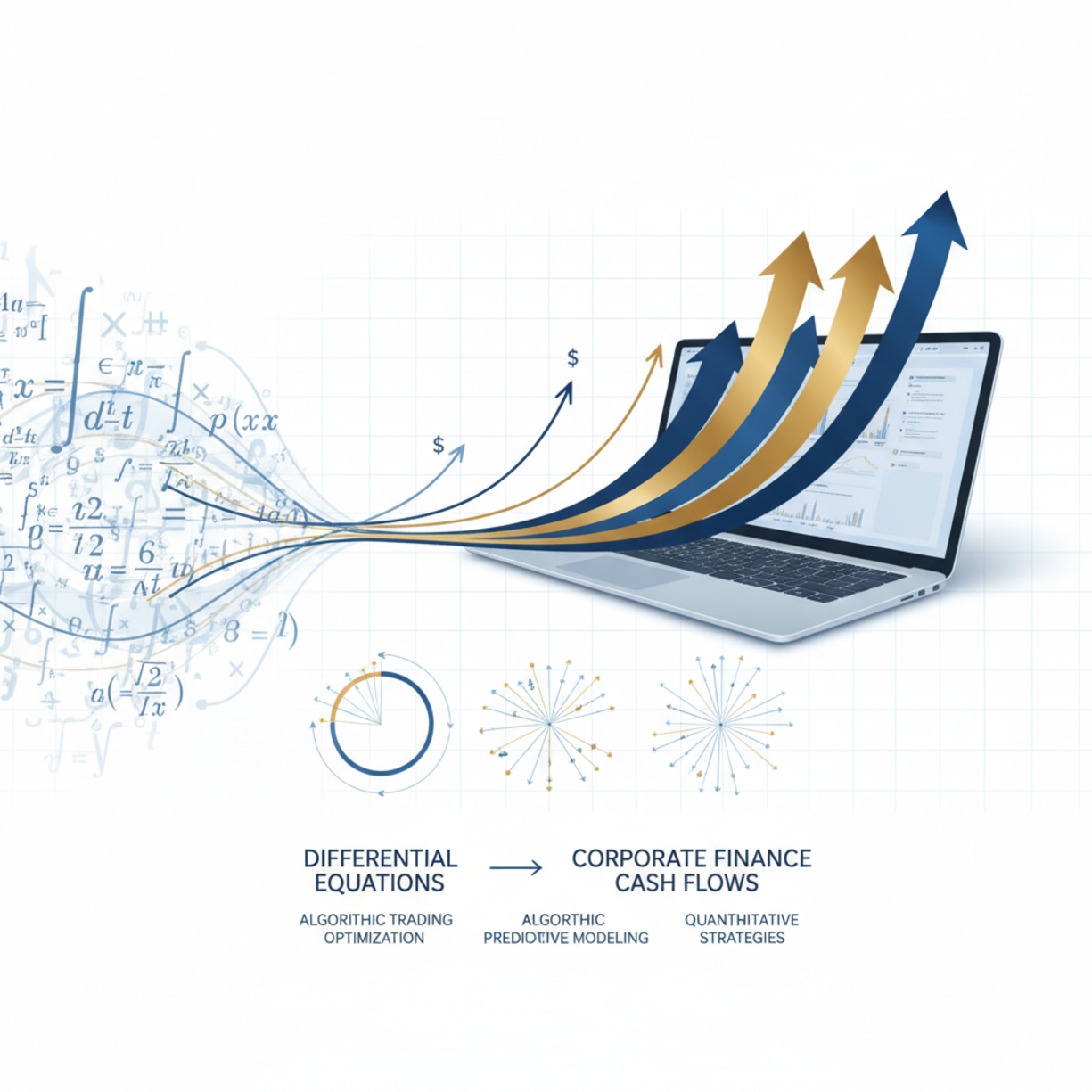
Corporate finance has entered an era where intuition alone is no longer sufficient. Consequently, the application of differential equations in corporate finance has moved from academic curiosity to operational necessity. In particular, advanced algorithmic models now underpin how multinational corporations forecast cash flows, hedge against currency volatility, and allocate capital across competing investment horizons 1 . Moreover, operations research provides the optimization scaffolding that turns raw mathematical theory into actionable treasury strategies.
For decades, financial engineers relied on static discounted cash-flow models to evaluate projects. However, these models fail to capture the dynamic, path-dependent nature of real-world liquidity. As a result, stochastic differential equations (SDEs) and partial differential equations (PDEs) have become essential instruments for modeling uncertainty in corporate cash flows 2 . Furthermore, when combined with numerical methods from operations research — such as finite-element solvers and Monte Carlo simulation — these equations yield algorithmic frameworks that continuously adapt to market conditions.
“Mathematics is not just a language. It is a language plus reasoning; it is a language plus logic. It is a tool for thought.”— Richard Feynman, Physicist & Nobel Laureate
This article explores, therefore, the frontier where differential equations meet corporate treasury operations. Additionally, we examine how quantitative strategists deploy these models for cash flow optimization, and we consider the regulatory, ethical, and practical dimensions that shape their adoption. Ultimately, the goal is to demonstrate that mathematics, when wielded with precision and strategic intent, becomes the most powerful asset on a CFO’s balance sheet.
How Do Differential Equations Optimize Cash Flow in Corporate Finance?
This is, arguably, the most important question that CFOs, financial engineers, and operations researchers face today. In essence, differential equations in corporate finance serve as the mathematical backbone of predictive treasury analytics. They model the continuous evolution of cash positions over time by capturing both deterministic trends (such as seasonal revenue cycles) and stochastic shocks (such as interest-rate movements or supply-chain disruptions) 3 . Subsequently, algorithmic solvers translate these equations into real-time optimization signals that guide liquidity buffers, short-term borrowing, and dividend timing.
Moreover, the integration of machine learning with classical PDE solvers has opened a new chapter. Neural-network–based PDE solvers, for instance, can approximate high-dimensional cash flow models at speeds that traditional finite-difference methods cannot match 4 . As a consequence, treasurers can now run thousands of scenario simulations before the market opens, effectively turning cash management from a reactive function into a proactive, algorithmic discipline.
From Black-Scholes to the Corporate Treasury: A Mathematical Migration
The Black-Scholes-Merton partial differential equation, originally developed for option pricing, fundamentally altered the trajectory of quantitative finance. Nevertheless, its influence extends far beyond derivatives desks. In corporate finance, the same mathematical architecture — a second-order parabolic PDE driven by geometric Brownian motion — has been adapted to model the stochastic evolution of operating cash flows 5 . For example, Hackbarth, Miao, and Morellec demonstrated that firms’ optimal capital structure decisions can be modeled through systems of ordinary differential equations that account for default boundaries and tax shields simultaneously.
Furthermore, the real-options approach uses PDEs to value managerial flexibility — the option to expand, contract, defer, or abandon projects — as a continuous-time optimization problem. This framework, therefore, allows CFOs to quantify the value of strategic adaptability in a way that static NPV analysis cannot. Meanwhile, operations research contributes by providing efficient numerical schemes — such as the Crank-Nicolson method and multigrid algorithms — that make these PDE solutions computationally tractable for enterprise-scale portfolios 6 .
“Models are not reality. Nevertheless, they are the most reliable maps we have for navigating the terrain of financial uncertainty.”— Emanuel Derman, Quantitative Strategist & Author
In my opinion, the migration of PDE-based modeling from trading floors to corporate treasury represents one of the most underappreciated shifts in modern finance. Although the mathematics is well-established, many corporations still rely on spreadsheet-based forecasting. This gap between available technology and actual practice, consequently, creates a significant competitive advantage for firms that invest in quantitative infrastructure. Additionally, regulatory bodies such as the Basel Committee increasingly expect sophisticated cash flow modeling for stress testing, making this transition not merely optional but strategically imperative 7 .

Algorithmic Cash Flow Optimization: Operations Research Meets Stochastic Calculus
Operations research has always been the discipline of “finding the best.” When it intersects with stochastic calculus, however, the result is particularly powerful: algorithmic systems that optimize cash flow in real time under uncertainty. Specifically, the Hamilton-Jacobi-Bellman (HJB) equation — a nonlinear PDE central to optimal control theory — provides the mathematical foundation for determining the best cash-management policy at every instant 8 . In practice, this means a corporation can dynamically decide when to draw on credit lines, when to invest idle cash, and when to accelerate receivables collection.
Moreover, stochastic dynamic programming, a cornerstone of operations research, enables multi-stage decision-making where each stage depends on the resolution of prior uncertainties. Thus, the cash flow optimization problem becomes a sequence of interconnected subproblems, each governed by its own differential equation. For instance, Singh et al. (2024) showed that integrating AI-driven predictive models with HJB-based control policies reduced corporate liquidity costs by up to 18% in simulated environments 9 . This finding underscores the tangible financial impact of marrying mathematics with algorithmic engineering.
“With four parameters I can fit an elephant, and with five I can make him wiggle his trunk.”— John von Neumann, Mathematician & Pioneer of Operations Research
I believe this quote captures a crucial lesson for practitioners: model complexity must serve a purpose. While it is tempting to build ever-more-elaborate systems of coupled PDEs, the best algorithmic models for cash flow optimization balance mathematical rigor with computational efficiency. Accordingly, leading quantitative teams increasingly adopt reduced-form models that capture the essential dynamics without overfitting. In addition, the Dodd-Frank Wall Street Reform Act and similar international regulations require that model assumptions be transparent, auditable, and stress-testable — further motivating parsimony in model design 10 .
Likewise, the concept of “model risk” — the risk that a model’s outputs are inaccurate or misleading — has become a regulatory focal point. The OCC’s SR 11-7 guidance on model risk management, for example, mandates that financial institutions validate and back-test their quantitative models rigorously. Therefore, any corporation deploying differential-equation-based cash flow algorithms must simultaneously invest in robust validation frameworks. This dual imperative — innovation and governance — defines the modern quantitative finance function.
Neural PDEs and the Future of Quantitative Treasury Management
The frontier of differential equations in corporate finance is being reshaped by deep learning. Neural PDE solvers — architectures such as Physics-Informed Neural Networks (PINNs) and DeepONet — learn to approximate the solutions of complex differential equations by embedding the PDE’s structure directly into the neural network’s loss function. As a result, these models can solve high-dimensional problems that defeat conventional grid-based methods, making them exceptionally suitable for multi-asset, multi-currency cash flow optimization 4 .
Additionally, these neural solvers offer a remarkable speed advantage. Once trained, they produce near-instantaneous solutions for new parameter configurations — a property known as “amortized inference.” Consequently, a corporate treasury team can adjust its optimization parameters in response to a sudden interest-rate announcement and receive updated liquidity recommendations within seconds, rather than the hours required by traditional numerical methods.
“Just as electricity transformed almost everything 100 years ago, today I actually have a hard time thinking of an industry that AI will not transform in the next several years.”— Andrew Ng, AI Researcher & Educator
In my assessment, the convergence of neural networks and classical PDEs represents more than incremental progress; it constitutes a paradigm shift for quantitative treasury management. Firms that adopt this technology early will, in all likelihood, establish durable advantages in capital efficiency and risk management. However, this optimism must be tempered by practical considerations. Neural PDE models are data-hungry, require specialized engineering talent, and can exhibit unexpected failure modes outside their training distribution. Therefore, prudent adoption involves a phased approach: pilot projects on well-defined sub-problems, rigorous out-of-sample testing, and continuous monitoring once deployed 11 .
Furthermore, the European Union’s AI Act (Regulation 2024/1689) introduces compliance requirements for AI systems used in financial decision-making, classifying certain high-risk applications and mandating transparency, human oversight, and data-quality standards. Consequently, the deployment of neural PDE solvers in corporate finance must navigate not only mathematical but also legal terrain. This regulatory dimension, in turn, reinforces the importance of interdisciplinary teams — combining mathematicians, software engineers, finance professionals, and legal experts — in building truly robust quantitative systems.

Conclusion: Mathematics as Strategic Infrastructure
The application of differential equations to corporate cash flow optimization is no longer a theoretical exercise — it is an operational reality for forward-thinking enterprises. Throughout this article, we have traced the arc from Black-Scholes to neural PDE solvers, illustrating how each generation of mathematical innovation has deepened the precision and speed of treasury analytics. Operations research, meanwhile, has provided the optimization architecture that connects mathematical models to real-world decision-making.
In summary, three insights emerge clearly. First, stochastic differential equations offer a natural and powerful language for describing the continuous, uncertain dynamics of corporate cash flows. Second, algorithmic models grounded in optimal control theory — particularly the HJB equation — convert this descriptive power into prescriptive treasury strategies that demonstrably reduce costs. Third, the emergence of neural PDE solvers promises to scale these capabilities to previously intractable dimensions, although responsible adoption demands rigorous validation and regulatory compliance.
“What gets measured gets managed. But what gets modeled gets optimized.”— Peter Drucker, Management Theorist
Looking ahead, I am convinced that the firms which treat quantitative mathematics not as a cost center but as strategic infrastructure will outperform their peers in capital efficiency, risk resilience, and long-term value creation. The tools exist. The mathematics is mature. The competitive advantage, therefore, belongs to those with the vision and discipline to deploy them.