



The history of commercial aviation is defined by a relentless pursuit of passenger safety. Yet, despite extraordinary advancements in turbine reliability, predictive avionics, and composite structural integrity, one radical concept remains firmly grounded: the detachable passenger rescue capsule.
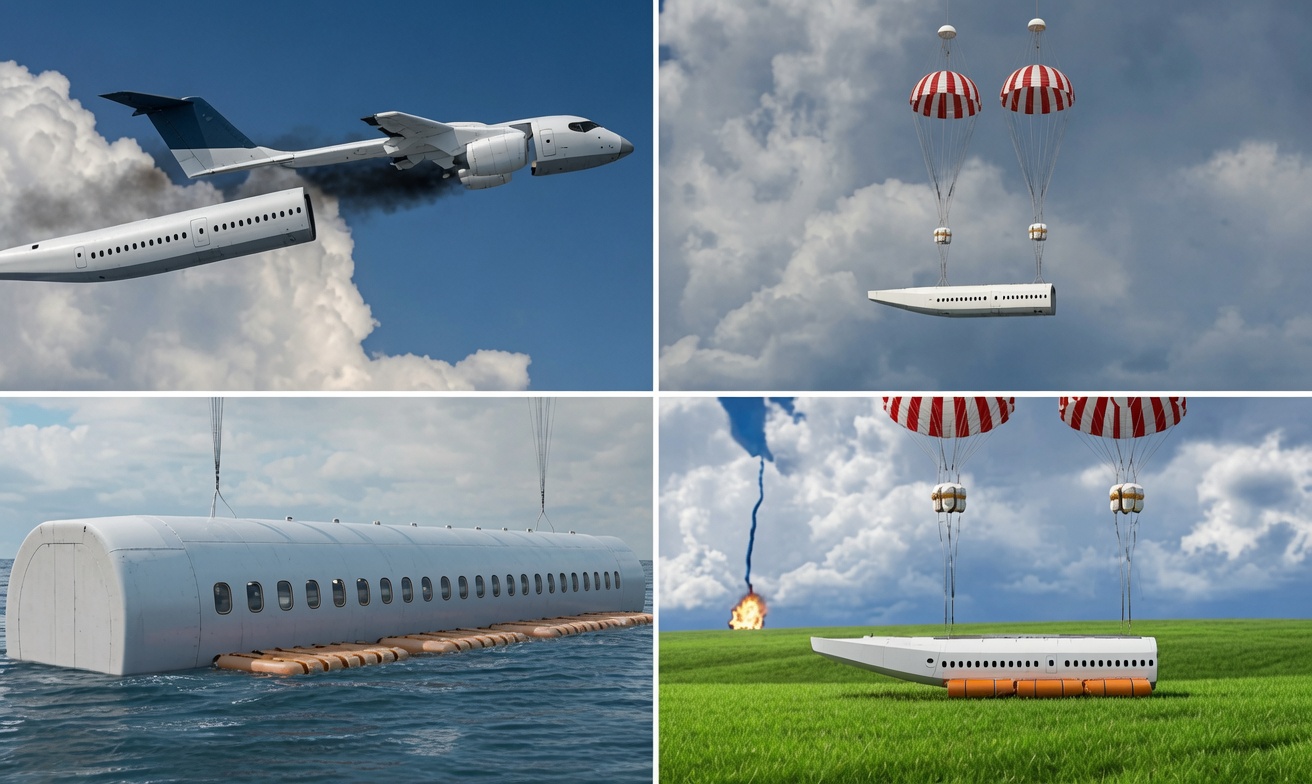
For decades, aerospace engineers like Vladimir Tatarenko have proposed modular aircraft architectures where the entire passenger cabin can sever from the fuselage during a catastrophic mid-air emergency, descending safely to earth via integrated heavy-duty ballistic parachute arrays and pneumatic landing buffers. While the life-saving potential is undeniable, commercial air carriers and aerospace manufacturers have categorically rejected these designs.
The primary hurdle is not mechanical feasibility, but rather the staggering aviation rescue capsule economics that airlines refuse to bear alone. The structural reinforcement required for modular detachment introduces severe weight penalties, altering aircraft thermodynamics and kinematics in ways that devastate fuel efficiency. However, sacrificing a revolutionary safety paradigm purely due to legacy procurement models is a failure of imagination. By shifting from corporate capital expenditure to passenger-led micro-funding, the aerospace industry could bridge the multi-billion-dollar R&D gap and make commercial aviation survivable even in catastrophic airborne failures.
Why Don’t Commercial Airplanes Have Parachutes or Detachable Cabins for Passengers?
When disaster strikes at 35,000 feet, the public inevitably asks why modern airliners lack military-style ejection systems or whole-airframe parachute recovery systems (like the Cirrus Airframe Parachute System used in light general aviation). In commercial transport, the answer lies at the intersection of flight kinematics, structural thermodynamics, and airline unit economics.
In conventional tube-and-wing aircraft, the fuselage is a continuous monocoque or semi-monocoque pressure vessel designed to disperse aerodynamic stresses, cabin pressurization loads, and wing-root bending moments across a unified structure. Introducing a detachable cabin requires slicing this unified vessel into discrete modules: a carrier frame (wings, cockpit, empennage, and engines) and a removable payload canister (the passenger cabin) 5 .

To prevent catastrophic structural failure during routine flight, the mating interfaces between these two modules require heavy structural bulkheads, redundant mechanical latching rings, and explosive pyrotechnic separation bolts. This adds massive structural deadweight (From the dispassionate perspective of aerospace mechanics, every added kilogram of empty weight $(W_{\text{empty}})$ initiates a cascading penalty known to aircraft designers as the weight growth factor.
The Tatarenko Paradigm: Thermodynamics, Flight Kinematics, and Operational Cost
To understand why airlines rejected Tatarenko’s prototype, we must evaluate the aircraft’s thermodynamic engine cycle and flight kinematics. In steady, unaccelerated cruise flight, an aircraft must maintain an exact dynamic equilibrium where aerodynamic lift () equals total aircraft weight (), and engine thrust () equals aerodynamic drag ():
$$\large L = W = \frac{1}{2} \rho v^2 S C_L$$
$$\large T = D = \frac{1}{2} \rho v^2 S C_D$$
Where is atmospheric density, is true airspeed, is wing reference area, and and are the coefficients of lift and drag.
The Breguet Range Equation And Weight
When a detachable cabin system increases structural weight by an estimated to 1 , the wing must generate proportionally more lift to maintain altitude. Achieving this requires either increasing airspeed () or flying at a higher angle of attack (), both of which substantially increase induced drag $\large (D_i = \frac{2L^2}{\rho v^2 \pi b^2 e})$. To overcome this elevated drag, the high-bypass turbofan engines must operate at higher throttle settings, increasing the core turbine inlet temperature () and accelerating kerosene consumption.
We can quantify the exact relationship between weight penalties and fuel efficiency using the Breguet Range Equation, which dictates the maximum flight distance () for a jet aircraft:
Where is cruise speed, is thrust specific fuel consumption (TSFC, or rate of fuel burn per unit of thrust), $W_{\text{Initial}}$ is takeoff weight, and $W_{\text{final}}$ is landing weight (zero-fuel weight plus reserves).
If structural modifications increase the zero-fuel weight by , the ratio $\frac{W_{\text{initial}}}{W_{\text{final}}}$ shrinks dramatically unless additional fuel is loaded. But loading more fuel increases $W_{\text{Initial}}$even further, requiring even more thrust and burning additional kerosene simply to carry the weight of the extra fuel—a diminishing thermodynamic return.
Cumulative Fuel Consumption
The cumulative fuel mass consumed $(M_{\text{fuel}})$ over a flight duration is expressed via the integral of the instantaneous fuel burn rate $(\dot{m}_{\text{fuel}})$:
Because required thrust $T_{thrust}(t)$ scales directly with total weight $, any permanent increase in dry structural weight permanently elevates the integral curve. Independent kinematic simulations indicate that a structural weight increase degrades fuel efficiency by roughly on long-haul routes 1 .
In an industry where commercial net profit margins average between and , this operational penalty turns profitable routes into chronic financial losses. To maintain fleet viability while exploring modular safety, carriers must rely on aggressive data strategies like ROI predictive maintenance in aviation economics to trim costs elsewhere. However, efficiency gains in maintenance alone cannot offset a fuel penalty.
“A designer knows he has achieved perfection not when there is nothing left to add, but when there is nothing left to take away.”— Antoine de Saint-Exupéry, Author and Aviator
Ironically, commercial aviation has “taken away” the escape capsule to preserve the economic bottom line. But when short-term cost accounting blocks revolutionary safety engineering, the funding model itself must be engineered.
The Crowdfunding Catalyst: Democratizing Aviation Safety and ROI
If commercial air carriers cannot absorb the multi-billion-dollar R&D and operational costs of modular rescue cabins, the capital must be sourced from the ultimate beneficiaries of the technology: the passengers.
By integrating modern fintech micro-transactions into global airline booking systems, we can establish a Safety Micro-Levy model. Prior to macroeconomic disruptions, global commercial aviation recorded over 4 billion passenger departures annually 2 . If a standardized, transparent micro-contribution of just $\$5.00$ per ticket were allocated to an independent Aerospace Safety Escrow Fund, the system would generate $\$20$ billion annually without burdening airline balance sheets.
This participatory capital model transforms passenger psychology. Instead of acting as passive consumers assuming inherent flight risk, travelers become direct equity shareholders in their own physical survival. This distributed financing structure is explored extensively within broader aviation economics, demonstrating how decentralized capital can derisk high-capex aerospace engineering.
“It is not from the benevolence of the butcher, the brewer, or the baker, that we expect our dinner, but from their regard to their own interest.”— Adam Smith, The Wealth of Nations (1776)
Aligning human self-interest—the biological drive for survival—with aerospace procurement creates a self-sustaining financial flywheel. If funds raised via passenger contributions exceed the baseline amortization and maintenance costs of the capsule system, the surplus capital is automatically reinvested into an upgrade fund for next-generation composite materials, lighter ballistic parachutes, and automated ejection avionics.
Interactive Simulation & Financial Calculator: Academic Laboratory Experience
To model the economic feasibility and mechanical dynamics of passenger-crowdfunded rescue capsules, we have developed an interactive academic laboratory simulation. The tool below models both the real-time physical activation of an emergency escape cabin during an inflight catastrophe and the macroeconomic equations governing the passenger-funded capital pool.
Mathematical Framework of the Calculator
The financial simulation operates on two primary mathematical expressions: a discrete algebraic summation for baseline cost allocation and an integral formula modeling cumulative funds raised over operational flight time.
1. Non-Integral Effective Passenger Contribution Rate ($\lambda_{eff}$)
To ensure equitable burden sharing without penalizing regional feeder routes, flights carrying fewer than 50 passengers ($P_{flight} < 50$) are legally exempt from the surcharge. For eligible flights, the total project target cost ($C_{total}$) is split between the airline carrier and the passenger pool based on an adjustable cost-sharing ratio ($\gamma_{p}$, representing the passenger percentage, e.g., $50\%, 40\%, \text{or } 70\%$).
The hourly per-passenger contribution rate ($\lambda$) required to amortize the project across a active passenger pool ($P_{active}$) over a standard operational baseline ($H_{base} = 1000 \text{ hrs}$) is:
2. Integral Calculation of Cumulative Funds Raised ($\Phi(t)$)
Once deployed across global airspace (where $500,000$ simultaneous passengers equates to roughly $2,500$ airborne aircraft at any given second), capital accumulation scales linearly with aggregate flight hours ($t$). The total capital pool $\Phi(t)$ generated from hour $t_0 = 1$ to any future hour $T$ is expressed via the definite integral:
If the accumulated fund $\Phi(T)$ exceeds the passenger-share investment threshold ($C_{total} \cdot \gamma_p$), the differential surplus ($S_{up}$) is swept into the capsule maintenance and technology upgrade fund:
Laboratory Simulation
Capsule Economics Simulator
How the Simulation Helps People
To develop the Aviation Rescue Capsule Economics Simulator, To develop the Aviation Rescue Capsule Economics Simulator, the global commercial aviation carries an average of 13.7 to 14.2 million passengers per day (with annual projections exceeding 5.2 billion passengers) 10 . This continuous flow results in about 100,000 to 104,000 scheduled commercial flights every 24-hour period 10 .
This daily activity involves approximately 100,000 to 104,000 scheduled commercial flights every 24 hours.
The Ratio per Hour of Travel
Since the question of “how many hours of travel per day” can be analyzed from various operational aviation perspectives, we present below the three metrics that explain how this volume is distributed over time:
| Metrics | Quantity | Practical Significance |
| Hourly Shipments | ~580.000 a 600.000 | Average number of passengers taking off every hour of the day in the world |
| People in the Air for Instant | ~1.0 to 1.5 million | Population that is literally flying simultaneously at any time |
| Average Duration per Flight | ~2 to 2.5 hours | Average time a commercial airplane spends in the air per route |
| Cumulative Flight Hours/Day | ~220,000 to 250,000 hours | Sum of all hours flown by commercial aircraft in a single day |
The Aviation Rescue Capsule Economics Simulator provides a transparent, interactive framework for crowdsourcing high-capital aerospace safety infrastructure. By distributing the multi-billion-dollar cost of emergency rescue capsules across millions of active passenger journeys via a micro-levy, it makes large-scale safety innovation financially viable without relying solely on corporate debt or government subsidies.
Passengers and stakeholders benefit through:
-
Micro-Contributions: Translating multi-billion-dollar budgets into fractional, accessible hourly levies per passenger seat.
-
Dynamic Transparency: Real-time visibility into how passenger volume changes affect capital targets, funding duration, and surplus generation for secondary upgrades.
-
Scenario Planning: Comparing structural feasibility across land deployments (airbag-cushioned landings) and sea deployments (parachute-chuted water descents).
Mathematical Formulations
1. Standard Equations
The core financial metrics are governed by the following algebraic relationships:
-
Passenger Target Share ($S$):
$$S = C \cdot r$$Where $C$ is the Total Project Cost and $r$ is the Cost-Sharing Rate ($Pax / Company$).
-
Hourly Levy per Passenger ($L$):
$$L = 50.00 \cdot \left(\frac{10,000,000}{P}\right)$$Where $P$ is the number of active simultaneous daily passengers, scaling inversely against a 10-million passenger baseline.
-
Total Funds Raised ($F$):
$$F = P \cdot L \cdot H_d \cdot D$$Alternatively expressed as daily revenue multiplied by simulation days ($D$), where $H_d$ represents daily flight operation hours.
2. Integration Mathematics (Continuous Accumulation)
To model capital accumulation continuously over a time horizon $t$ (in days) where passenger volume $P(t)$ and hourly flight duration $H(t)$ vary dynamically, we use definite integration:
Where:
-
$T$ is the total simulation period (up to 360 days).
-
$P(t)$ is the continuous rate function of active passengers per day.
-
$H(t)$ represents the effective operating flight hours integrated over time.
Economic Growth & Funding Trajectory
The relationship between simulation duration, passenger volume, and capital accumulation follows a linear progression under steady-state conditions, curving upward as surplus funds accumulate past the target threshold:
Funding Trajectory Analysis
Regulatory Evolution and the Law of Universal Protection
Even with viable crowdfunding economics and solved structural kinematics, widespread aerospace adoption requires an ironclad international legal framework. Currently, global aviation governance—administered primarily by the International Civil Aviation Organization (ICAO) under the foundational rules of the Chicago Convention—prioritizes pre-incident accident prevention over post-failure survivability engineering 6 . While redundant avionics and pilot training have driven hull-loss accident rates to historic lows, this regulatory philosophy creates a fatal survivability gap once a structural catastrophic breakup occurs.
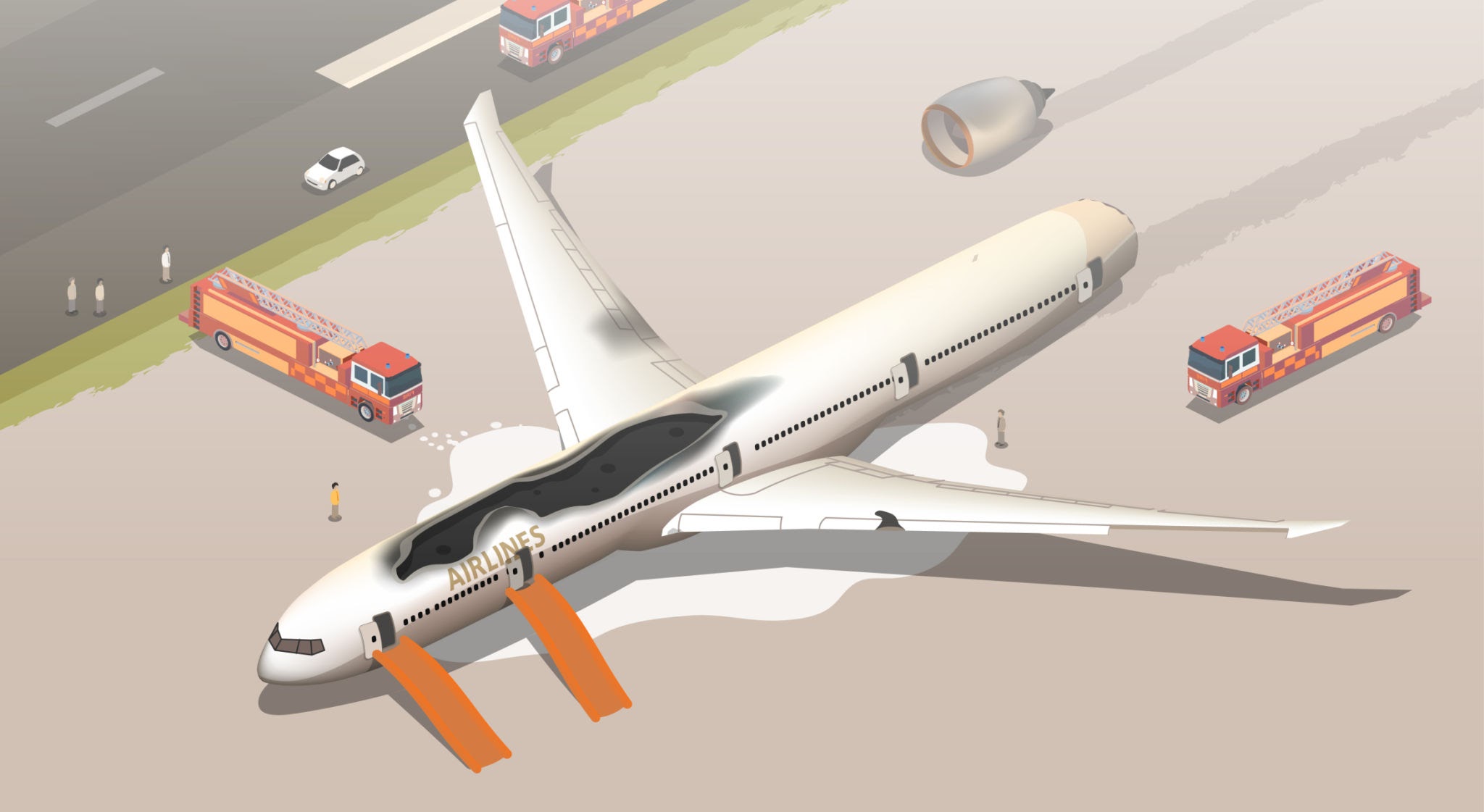
To shift airline incentives, international aviation authorities must enact a statutory Right to Survival mandate 4 . This legal architecture would compel air carriers to reinvest a fixed percentage of net operating revenue into post-failure survival technologies and emergency air rescue infrastructure.
Under Title 49 of the United States Code, the Federal Aviation Administration already possesses broad statutory authority to prescribe general requirements and minimum standards for air commerce safety 8 . Extending this mandate to require modular survivability systems on newly certificated airframes would force market convergence.
Furthermore, evolving ICAO Annex 8 airworthiness standards to incorporate a public, quantifiable Survivability Rating—analogous to the automotive Euro NCAP or NHTSA crash-test star ratings—would fundamentally alter consumer behavior. When commercial survivability is transformed into a transparent, marketable commodity, airlines operating capsule-equipped aircraft gain a formidable competitive advantage. As passenger demand shifts toward high-survivability fleets, the underlying rescue capsule economics stabilize naturally.
Concurrently, global aviation underwriters would restructure commercial hull and liability insurance premiums. Airlines operating modular rescue cabins would experience exponential reductions in catastrophic wrongful-death liabilities and litigation reserves. These actuarial savings would directly offset the heightened initial acquisition cost of capsule-equipped airframes.
Strategic Implementation: Starting with High-Risk Routes
Attempting an immediate, fleet-wide retrofit of every active transport aircraft is economically and industrially impossible. The most pragmatic implementation strategy targets high-risk transoceanic, polar, and remote overwater routes where conventional emergency landing fields are entirely absent 5 . In these operational sectors, an unrecoverable inflight failure forces an open-ocean ditching—a scenario with historically low survival rates due to high sea states, structural disintegration on impact, and extreme hypothermia.
By introducing detachable passenger capsules on long-range widebody fleets first, the aerospace industry can validate the crowdfunding economic flywheel on a controlled, high-margin scale. As manufacturing efficiencies mature and structural component costs decline through economies of scale, modular survivability can systematically expand into medium-haul regional corridors and short-haul domestic networks 7 .
Additionally, rapid breakthroughs in advanced materials science—specifically carbon-nanotube reinforced polymers, thermoplastic composites, and AI-optimized topological lattice structures—are drastically reducing the structural weight penalties that doomed Tatarenko’s early aluminum-alloy prototypes.
Modern aerospace analysis indicates that advanced composites can compress the structural weight penalty below . When paired with ultra-high-bypass engine architectures and boundary-layer ingestion propulsion, this residual drag penalty becomes negligible over an aircraft’s lifecycle.
“The price of greatness is responsibility.”— Winston Churchill
Conclusion: A Legacy of Life
Therefore, the historical stalling of Vladimir Tatarenko’s detachable cabin was not a failure of aerodynamic science or mechanical engineering; it was an artifact of rigid, corporate-only aerospace financial models. By democratizing capital acquisition through transparent passenger crowdfunding and instituting progressive international survivability mandates, the global aviation community can overcome the economic friction that has kept rescue capsules tethered to the drafting board.
The path toward zero-fatality commercial aviation demands collaborative courage across the entire aerospace ecosystem—requiring aerospace engineers to refine structural weight ratios, regulatory bodies to modernize airworthiness certification, and passengers to invest directly in their own protection.
When we review the grand trajectory of flight—from the fragile fabric wings of Kitty Hawk to supersonic commercial transports—every transformative leap was initially dismissed as economically impossible. Let us not permit short-term accounting metrics to dictate the boundaries of human survival. With innovative capital architectures, legal reform, and thermodynamics working in unison, the detachable rescue capsule can define the standard of tomorrow’s skies.