



The Perfect Storm Behind the 2026 D&O Premium Spike
Corporate liability in 2026 looks nothing like 2021. Directors face personal lawsuits faster than ever before. Meanwhile, insurers are rewriting the rules of protection.
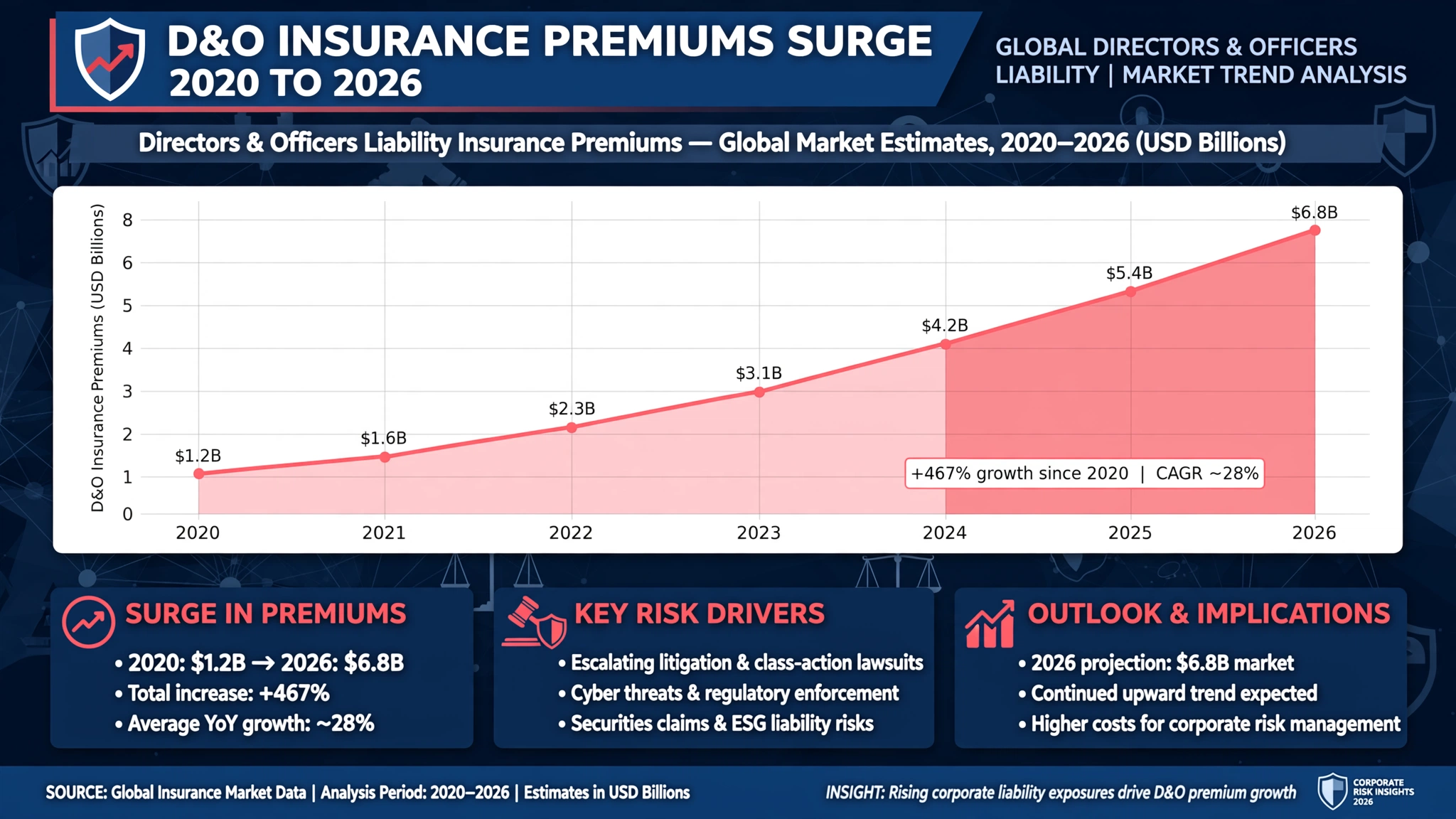
Therefore, understanding how D&O insurance premiums work becomes a survival skill. For example, a mid-cap tech firm paid $180k in 2021 for $10M limit. Today, that same limit costs $480k with more exclusions.
In addition, this surge reflects more than inflation. It reflects a systemic shift in how courts assign blame to individuals.
For a complete overview of risk categories, explore our pillar section on Corporate Liability.
How Securities Class Actions Redefined Personal Risk
Securities litigation exploded after the 2023-2024 market volatility. Stanford data shows 235 federal filings in 2024 alone 1 .
Moreover, plaintiffs no longer sue only the company. They name the CEO, CFO, and independent directors personally. Consequently, Side A personal protection triggers more frequently.
Furthermore, the average settlement for a securities class action reached $48.5M in 2024 2 . Defense costs alone often exceed $2M before trial. Thus, insurers price personal exposure much higher.
How Regulatory Enforcement Multiplied Exposure
The SEC filed 784 enforcement actions in FY2024 3 . ESG misrepresentation and AI-washing became top priorities.
Similarly, state attorneys general launched parallel probes. Therefore, a single disclosure mistake triggers three separate investigations.
For high-risk sectors, review our technical guide on Directors & Officers D&O Liability Insurance Coverage in High-Risk Markets.
“In corporate governance, the greatest risk is not taking a risk, but pretending that personal liability does not exist.”— Peter Drucker
How D&O Insurance Policies Actually Work in 2026
Most articles explain what D&O insurance is. However, that definition will not save your assets. You must understand how insurers structure, price, and deny coverage.
“It takes 20 years to build a reputation and five minutes to ruin it. If you think about that, you’ll do things differently.”
— Warren Buffett
How Side A, B, and C Coverage Allocates the Liability
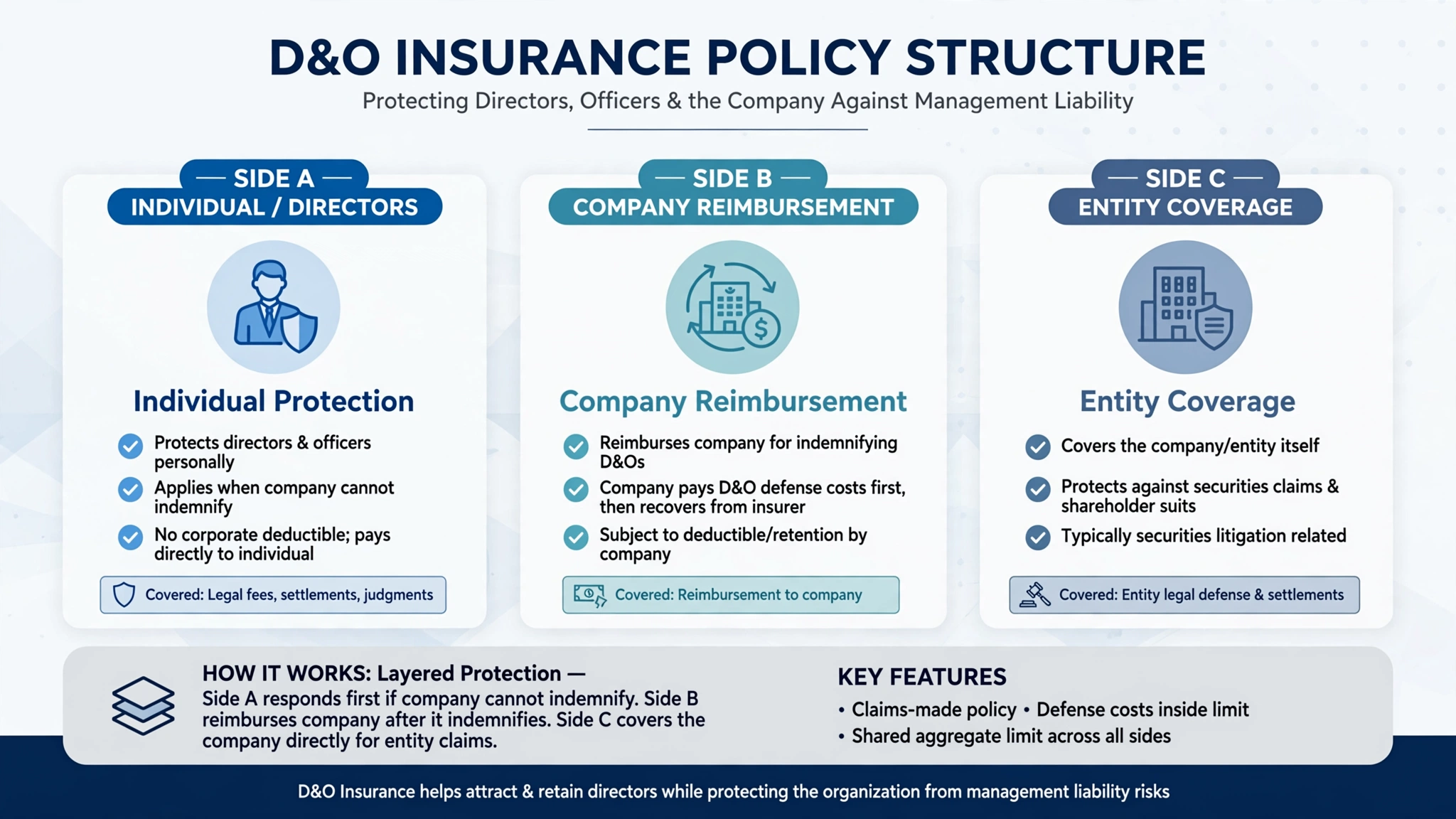
Side A: Personal Asset Protection. This layer pays directors directly when the company cannot indemnify them. For example, during insolvency or when bylaws prohibit indemnification.
Therefore, Side A has zero deductible. Moreover, top programs include Difference-in-Conditions (DIC) Side A, which drops down if underlying insurers refuse to pay.
Side B: Corporate Reimbursement. The company pays defense costs for its directors first. Then Side B reimburses the company. Consequently, this side carries a retention of $250k to $2M for mid-cap firms.
Side C: Entity Securities Coverage. Side C covers the company itself for securities claims. However, it only applies to publicly traded firms for securities litigation. Private companies need broader Entity Coverage.
In addition, all three sides share a single aggregate limit unless you buy dedicated Side A limits. That design creates the trap. One large Side C settlement can erode the limit protecting your personal assets.
How Insurers Calculate Your Premium: The 5-Factor Underwriting Model
Insurers no longer price D&O insurance premiums on revenue alone. They use a predictive liability score.
1. How Litigation History Drives Pricing:Prior lawsuits increase your loss run. For example, a prior SEC inquiry adds 35-60% load, even without a penalty.
2. How Market Cap Volatility Triggers Surcharges:A stock drop of over 20% in 12 months signals securities class action risk. Marsh reported that volatile issuers pay 2.2x more 4 .
3. How Governance Quality Reduces Cost:Insurers score board independence, cybersecurity committees, and insider trading policies. A weak governance score adds 25% premium.
4. How Industry Class Defines Base Rate:Crypto, biotech, fintech, and AI firms sit in Class 4 high-risk. Their base rate per million starts at $12k, versus $4k for low-risk manufacturing.
5. How Financial Condition Determines Retention:Debt-to-equity above 2.5x pushes retention up by 50%. Consequently, you pay more out-of-pocket before insurance responds.
SIMULATION: Real 2026 Premium Math
|
Company Profile |
Limit |
2021 Premium |
2026 Premium |
Retention |
Cost per $1M |
|---|---|---|---|---|---|
|
SaaS Series C $150M rev, Private |
$10M |
$95,000 |
$285,000 |
$350,000 |
$28,500 |
|
Public Biotech $600M mkt cap |
$20M |
$320,000 |
$890,000 |
$1,000,000 |
$44,500 |
|
Public AI Infrastructure $2B mkt cap |
$30M |
$480,000 |
$1,450,000 |
$2,500,000 |
$48,333 |
Therefore, the simulation proves that D&O insurance premiums 2026 have tripled for growth sectors. Moreover, retentions doubled, so total cost of risk quadrupled.
How Policy Exclusions Create Hidden Bankruptcy Traps
This is where most boards get destroyed. Insurers added surgical exclusions in 2024-2026.
Insured vs. Insured Exclusion: The policy will not cover lawsuits between insured persons. However, bankruptcy trustees sue former officers using company rights. Without a bankruptcy carve-back, you have no cover.
Conduct Exclusion with Final Adjudication: Fraud exclusions now trigger only after final, non-appealable adjudication. Nevertheless, some cheaper forms trigger on “in fact” determination, allowing insurers to deny advancement of defense costs.
Regulatory Exclusion Creep: Some policies exclude ESG, cyber, and crypto-related regulatory claims. Therefore, you must negotiate a specific regulatory investigation sublimit.
Is Your CEO Personally Bankrupt If Your Company Gets Sued in 2026?
This viral question drives Google searches for a reason. The answer is yes, under specific conditions.
How Courts Are Piercing the Corporate Veil Faster
Delaware Chancery data shows a 38% increase in Caremark duty-of-oversight claims surviving motion to dismiss in 2024-2025 5 .
Moreover, personal liability now extends to inadequate AI governance and cyber oversight. For example, if the board ignored a critical cybersecurity audit, directors can face personal liability for resulting customer lawsuits.
In addition, D&O policies with defense costs inside the limit erode quickly. A $5M limit with $2.5M in defense costs leaves only $2.5M for settlement. Consequently, directors fund the rest personally.
Therefore, you need dedicated Side A DIC tower of at least $5M to $10M above the main program. This layer sits outside bankruptcy estate and cannot be eroded by entity claims.
How to Build a Bulletproof Corporate Protection Strategy
A resilient strategy combines insurance architecture with governance hygiene.
“An ounce of prevention is worth a pound of cure. But an ounce of insurance is worth a ton of prevention when the lawsuit arrives.”
— Benjamin Franklin
Step 1: How to Structure Limits and Retention Strategically. Buy primary $5M with $350k retention, then excess layers in $5M blocks. However, always add a $10M Side A DIC tower that is bankruptcy-proof and non-rescindable.
Step 2: How to Negotiate Critical Enhancements. Demand severability of application, non-rescindable Side A, and broad Bump-Up exclusion carve-backs for appraisal actions. Furthermore, ensure conduct exclusion requires final adjudication in underlying proceeding.
Step 3: How to Document Oversight to Reduce Premiums. Insurers audit board minutes. For example, quarterly cyber risk reports and documented ESG disclosures reduce underwriting load by 15-20%.
For sector-specific wording benchmarks, see our deep dive on D&O Coverage in High-Risk Markets and the full Corporate Liability category hub for claims playbooks.
The Financial Verdict: How Much Should You Really Pay for Protection?
The 2026 corporate liability trap punishes unprepared boards with personal exposure. Meanwhile, it rewards boards that understand how D&O insurance premiums actually work.
Consequently, your budget should follow this rule: allocate 0.3% to 0.8% of market capitalization for total D&O program cost, including premium and retention funding. For a $500M public company, that means $1.5M to $4M in risk budget.
Moreover, treat Side A DIC coverage as non-negotiable personal asset insurance. It costs roughly $60k per $5M for clean risks. However, it protects 100% of your net worth when Side B/C collapse.
Therefore, the final verdict is clear: In 2026, going cheap on D&O insurance is the most expensive decision a director can make. Premiums are surging because personal liability is real, permanent, and accelerating. Buy structure, not just limits.
Bibliography