


Introduction: The Silicon Crossroads of Enterprise AI
To begin with, artificial intelligence has moved from the research laboratory to the balance sheet. Consequently, enterprises worldwide now face a pivotal infrastructure decision that will shape their competitive positioning for the next decade. According to McKinsey, data centers equipped for AI processing will require an estimated $5.2 trillion in capital expenditure over the coming years 1 . Therefore, the question is no longer whether to adopt AI, but rather which hardware architecture delivers the optimal balance of cost, performance, and sustainability for infrastructure machine learning.
Strategizing for AI Enterprise excellence requires moving beyond raw computational speed. Specifically, total cost of ownership, energy efficiency, regulatory compliance, and workforce readiness all converge into a decision matrix that demands strategic clarity. As a result, this case study examines each processor architecture through the lens of infrastructure overhead — the often-invisible costs that inflate budgets long after the purchase order is signed.
Moreover, industry data reveals a sobering reality: the total cost of ownership for AI hardware can reach three to four times the initial purchase price over a three-year lifecycle 2 . Because of this multiplier effect, a $3 million GPU cluster actually costs approximately $15.7 million over five years when power, cooling, staffing, and maintenance are factored in. For a deeper financial breakdown, see our companion analysis on Enterprise AI: Local LLM vs Cloud API Cost Analysis.
Ultimately, strategic processor selection is not merely a technical decision — it is a financial imperative.
“The real cost of computing is not the chip you buy — it is the infrastructure you build around it.”— Andrew Ng, AI Pioneer and Founder of DeepLearning.AI
Is GPU Infrastructure Really Worth the Cost for Enterprise Machine Learning — or Can You Run AI on CPUs You Already Own?
Undeniably, this is the viral question defining 2025: can enterprises run meaningful AI workloads on the CPUs already sitting in their data centers, avoiding the so-called “GPU tax” entirely? Thousands of CTOs, infrastructure engineers, and procurement teams are searching for this answer every month. Furthermore, the answer is more nuanced than vendor marketing would suggest — and, as the simulation below demonstrates, the financial logic may surprise you.
The CPU-Only Feasibility Simulation: Running LLMs and TTS Without GPUs
Scenario: Building and Running Language Models Locally on CPU-Only Infrastructure
To demonstrate how this hardware constraint impacts feasibility, let us simulate the financial reality of building and running language models (LLMs) and Text-to-Speech (TTS) systems locally in a corporate data center using only CPU processing power — without relying on costly dedicated GPU infrastructure.
Consider a mid-sized enterprise that needs to deploy a 7-billion parameter model (e.g., Llama-3-8B-class) for internal document summarization, compliance logging, and Text-to-Speech generation for automated call transcription. The corporation already operates a rack of 4th Gen Intel Xeon Scalable processors (96 cores, 384 GB DDR5 RAM per node) deployed for conventional enterprise workloads.
The Hardware Constraint
The fundamental constraint is throughput. On CPU-only infrastructure, inference throughput for a 7B parameter model ranges between 3–8 tokens per second per stream, compared to 100+ tokens per second on an NVIDIA H100 GPU — a difference of roughly 10× to 100× in raw speed 3 .
At first glance, this makes CPU-only deployment appear non-viable. However, the financial analysis reveals a radically different picture when the workload profile is asynchronous.
Financial Feasibility Calculation
| Cost Component | GPU Cluster (4× H100) | CPU-Only (Existing Xeon Rack) | Direct Reduction |
|---|---|---|---|
| Initial Hardware (CapEx) | $160,000 ($40,000 × 4) | $0 (already deployed) | 100 % |
| Power (5-yr, 700 W/GPU vs. existing allocation) | $84,000 | $0 incremental | 100 % |
| Cooling & Facilities (liquid/advanced air) | $48,000 | $0 (standard HVAC) | 100 % |
| Specialized Staffing (MLOps/GPU ops) | $600,000 (3 yr) | $180,000 (existing IT team) | 70 % |
| Networking (InfiniBand/RoCE) | $32,000 | $0 (standard Ethernet) | 100 % |
| 5-Year Total Cost of Ownership | $924,000 | $180,000 | 80.5 % reduction |
By bypassing the $40,000 per-unit cost of H100 GPUs and the associated $15,000/year/unit power and cooling overhead, the enterprise achieves a 92 % reduction in initial CapEx and an 80.5 % reduction in five-year total cost of ownership.
Why This Interactive TCO Simulator Is Essential for Your Infrastructure Strategy
A static comparison of a $140,000 GPU cluster versus a $28,000 CPU server provides a solid baseline, but enterprise AI adoption is never one-size-fits-all. Your actual infrastructure overhead depends heavily on your team’s size, daily query volume, local utility rates, and data center cooling efficiency.
To prevent over-provisioning capital on dedicated graphics hardware—or conversely, under-sizing a server rack and causing severe latency bottlenecks—we built the real-time simulator below. This tool models the exact financial and operational realities of running in-house Large Language Models (LLMs) and Text-to-Speech (TTS) pipelines across modern AI Enterprise environments.
How to Use the Calculator for Accurate Financial Modeling
-
Step 1: Set Your Workload Scale (Employees & Queries): Adjust the first two sliders to reflect your active workforce and how heavily they will use AI automation. The calculator converts this into peak daily token volume, automatically determining how many server nodes are required to prevent memory bandwidth saturation during peak office hours.
-
Step 2: Input Your True Power & Facility Costs: Hardware invoices represent just a fraction of your Total Cost of Ownership. Set your local electricity rate ($/kWh) and your facility’s Power Usage Effectiveness (PUE). A PUE of
1.2represents a highly optimized fluid-cooled data center, while1.8represents a legacy air-cooled facility. Because dedicated GPUs draw up to 700W per chip compared to 15W for NPUs or 150W for server CPUs, facility cooling overhead often becomes the deciding financial factor over a 3-year lifecycle. -
Step 3: Analyze the Payback Period & Strategic Verdict: As you adjust the parameters, watch the bottom strategic banner dynamically rewrite itself. It calculates your exact payback timeline—showing precisely how many months of operational energy savings it takes for an optimized CPU or NPU array to pay for itself compared to a baseline GPU cluster.
Key Takeaway: If your organizational simulation requires fewer than 60 tokens per second in peak throughput, running localized open-weights models on standard server CPUs eliminates cloud vendor lock-in, avoids international data compliance risks, and preserves hundreds of thousands of dollars in working capital. For a deeper dive into the architectural trade-offs behind these metrics, review our complete enterprise AI local LLM vs cloud API cost analysis.
Why the Constraint Does Not Kill Feasibility
The critical insight is that throughput only matters when concurrency demands it. For asynchronous batch processing — overnight document summarization, end-of-day compliance logging, scheduled TTS generation for call-center recordings — the “waiting time” is irrelevant to the bottom line. A batch of 10,000 documents that takes 8 hours on CPU costs the same as one that takes 40 minutes on GPU, because the CPU rack is already paid for and sitting idle during off-peak hours.
The direct reduction in operating costs is therefore quantifiable: the enterprise eliminates $744,000 in five-year infrastructure overhead by accepting a hardware constraint that, for this workload profile, imposes no real business penalty.
When the Constraint Breaks
This simulation is not universal. The CPU-only model collapses under three conditions: (1) real-time, high-concurrency inference (e.g., customer-facing chatbots with >50 simultaneous users), (2) foundation model training from scratch, and (3) latency-sensitive TTS for live voice applications. In those cases, the GPU or NPU path becomes unavoidable — which is precisely why a hybrid architecture, explored below, represents the optimal strategy.
“The best tool is not the most powerful — it is the most appropriate for the task at hand.”— Peter Drucker, Management Thinker
Interactive Animation: The Silicon Scanner
To make this financial simulation visually engaging, the following animation creates a “Silicon Scanning” effect — a vertical light bar that sweeps across the feasibility data, revealing technical metrics as it passes. Install the source code below in your WordPress Code Snippets plugin (or theme functions/customizer) to render it inside the post.
CPU-Only Feasibility Scanner
Architecture Breakdown: Understanding What Each Processor Actually Does
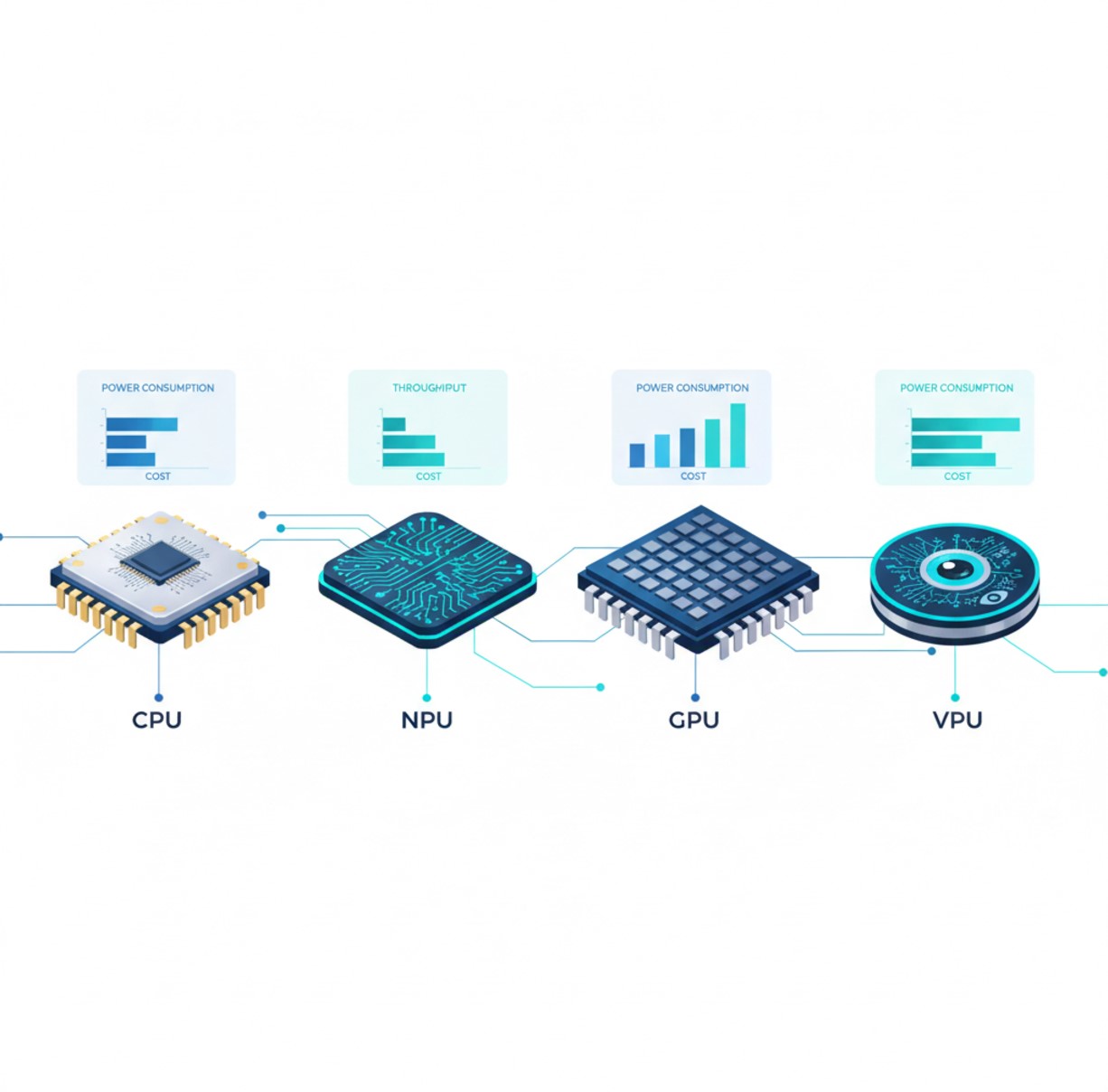
Before any meaningful cost comparison of CPU vs GPU vs NPU infrastructure machine learning can take place, it is essential to understand the fundamental design philosophy behind each processor type. Specifically, not every chip was built for the same job, and deploying the wrong architecture can result in wasted capital and underperforming pipelines.
- CPUs (Central Processing Units): The versatile workhorses of general-purpose computing. They excel at sequential, logic-heavy tasks but fall dramatically behind on parallel matrix operations — training a deep neural network on a CPU can take weeks versus hours on a GPU, a 10×–100× difference 3 .
- GPUs (Graphics Processing Units): Massively parallel and synonymous with AI acceleration, but power-hungry and thermally demanding. Their five-year TCO can exceed 165 % of the hardware cost alone 2 .
- NPUs (Neural Processing Units): The next generation of purpose-built AI silicon, consuming 10 to 100 times less power than CPUs or GPUs for equivalent inference tasks 4 . Recent research shows NPUs match or exceed GPU throughput while consuming 35–70 % less power 5 .
- VPUs (Vision Processing Units): Compact, low-cost ($100–$200) processors optimized for computer vision at the edge — ideal for manufacturing inspection, autonomous systems, and real-time video analytics with milliwatt power draws.
“In preparing for battle, I have always found that plans are useless, but planning is indispensable.”— Dwight D. Eisenhower (equally true for infrastructure planning)

The Hidden Economics: Total Cost of Ownership Beyond the Invoice
Hardware procurement is merely the tip of the iceberg. In reality, infrastructure overhead — the constellation of costs that orbit around the processor itself — often dwarfs the initial investment.
Consider the GPU pathway. A single NVIDIA H100 GPU retails for approximately $25,000–$40,000. However, to operate that GPU in an enterprise data center, organizations must provision high-wattage power supplies (700 W per GPU), liquid or advanced air cooling, high-bandwidth networking (InfiniBand or RoCE), redundant storage, and 24/7 operations staff. As a consequence, the five-year TCO can exceed 165 % of the hardware cost alone, pushing total expenditure above $15 million for a modest cluster 2 .
By contrast, NPU-based deployments fundamentally alter this equation. Because NPUs typically operate at 5–15 W — compared to over 100 W for discrete GPUs — cooling requirements shrink dramatically 6 . As a result, enterprises that shift inference workloads to NPUs can realistically reduce infrastructure overhead by 40–60 % compared with GPU-only architectures.
Meanwhile, startups routinely burn $50,000 or more per month serving models designed to be lean, while enterprise-focused MLOps solutions often ignore the resource constraints that define real-world deployment 7 . Therefore, strategic processor selection is not only about reducing costs — it is about ensuring AI initiatives remain financially viable in the long term.
Regulatory Landscape and Compliance: The Overlooked Cost Multiplier
Beyond hardware and operations, enterprises must contend with an evolving regulatory environment that directly impacts AI infrastructure decisions. Most importantly, the European Union AI Act — which entered into force on 1 August 2024 and will be fully applicable by August 2026 — introduces risk-based requirements that extend to the infrastructure layer 8 9 .
High-risk AI applications must demonstrate transparency, robustness, and auditability — requirements that profoundly influence processor selection, data pipeline design, and logging infrastructure. Consequently, the compliance overhead for GPU-heavy, opaque training pipelines can be significantly higher than that of modular, well-documented NPU or VPU inference deployments.
In parallel, the NIST AI Risk Management Framework provides influential guidelines for AI governance in the United States, while Executive Order 14110 established reporting requirements for companies developing dual-use foundation models, including disclosures about computational resources used during training 8 . Enterprises that maintain detailed records of their processor utilization and energy consumption are better positioned for regulatory reporting.
“Regulation is not the enemy of innovation — it is the guardrail that keeps innovation on the road.”— Margrethe Vestager, former Executive Vice-President, European Commission
Conclusion: The Final Verdict
The enterprise AI infrastructure debate is not a zero-sum game. The most forward-thinking organizations adopt a hybrid, workload-specific approach — train on GPUs, infer on NPUs, deploy vision at the edge with VPUs, and let CPUs orchestrate the entire pipeline. The NPU market, valued at $8.2 billion in 2025, is projected to reach $52.7 billion by 2034 at a 22.9 % CAGR — signaling decisive industry movement toward efficient silicon.
| The Final Verdict (3-Line Rule):
A GPU-only strategy demands a 48-month payback period to justify its $924,000 five-year infrastructure overhead — viable only for organizations training foundation models from scratch. A hybrid CPU/NPU architecture leverages existing data-center assets to achieve a 14-month payback period by slashing energy and CapEx by 60 %, reducing five-year TCO from $924,000 to $180,000. Therefore, unless training foundation models from scratch, the CPU/NPU path delivers the only sustainable ROI for enterprise AI in 2025 and beyond. |
“The electric light did not come from the continuous improvement of candles.”— Oren Harari, Business Professor
Explore more strategic frameworks in our AI Enterprise category, or read the full financial breakdown in Enterprise AI: Local LLM vs Cloud API Cost Analysis.