



The era of unchecked IT spending is drawing to a close. As organizations confront tightening budgets and escalating complexity, artificial intelligence has emerged as a decisive lever for infrastructure optimization. According to Deloitte’s 2025 State of AI in the Enterprise report, 40% of organizations now cite cost reduction as a primary driver for AI adoption 1 . Moreover, worldwide AI spending is projected to reach $2.52 trillion in 2026, reflecting a 44% year-over-year increase 2 . These figures represent a fundamental shift in how enterprises allocate resources and design technology architectures.
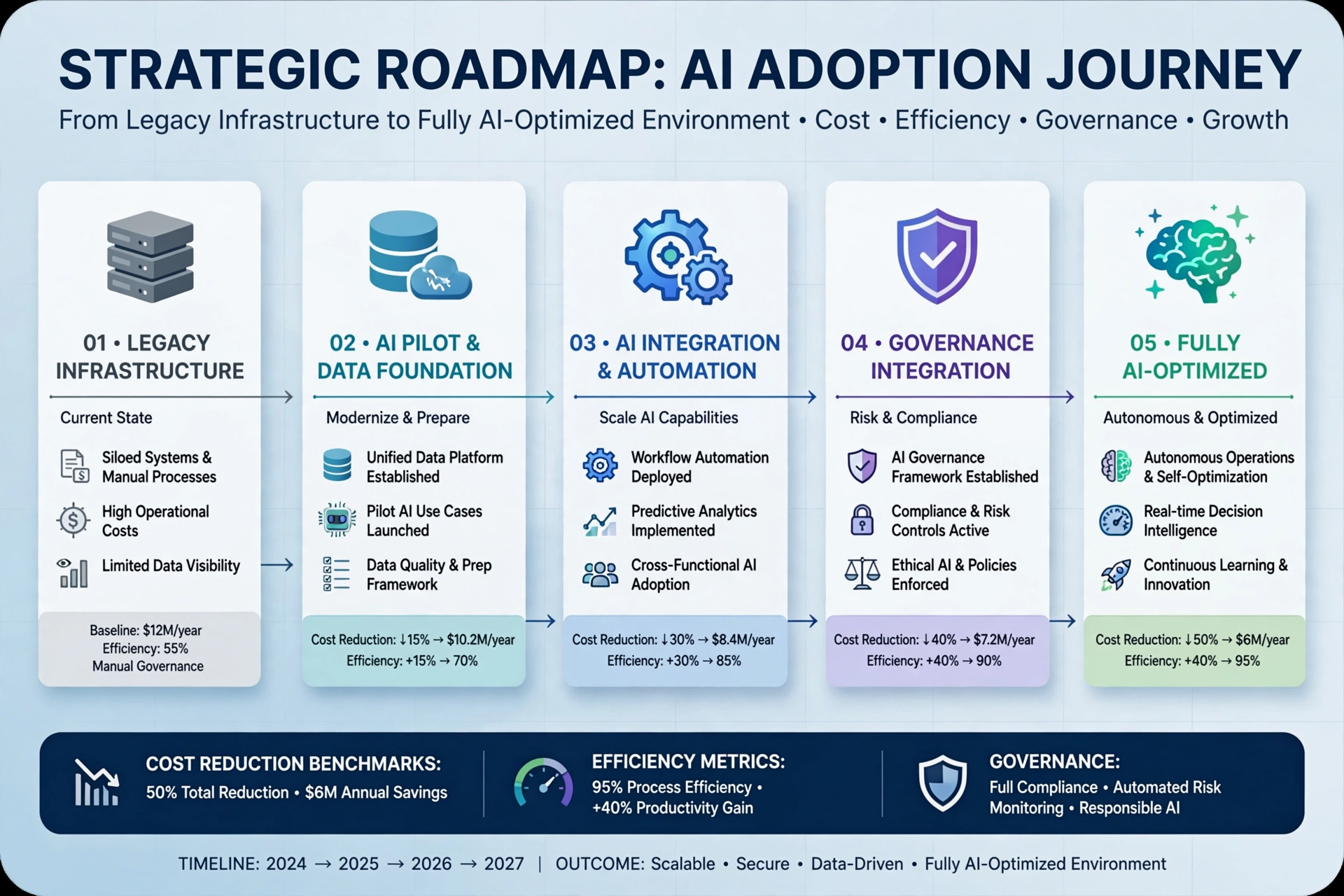
Strategic AI integration allows companies to consolidate legacy systems, automate routine workloads, and reduce the physical footprint of data centers. Organizations that approach AI with a clear cost-reduction framework are achieving measurable returns within 12 to 18 months 3 .
“AI is probably the most important thing humanity has ever worked on. I think of it as something more profound than electricity or fire.”— Sundar Pichai, CEO of Google
The question is no longer whether to adopt AI, but how to adopt it strategically — ensuring every dollar invested yields compounding returns. To master this transition, leaders must look beyond the hype and integrate practical AI Enterprise strategies that prioritize hardware efficiency.
Are You Wasting Millions on Cloud AI? Why Smart Enterprises Are Running LLMs on Basic CPUs
This is the question keeping CFOs up at night. The default assumption in enterprise AI is that you need expensive, dedicated GPU clusters (like NVIDIA H100s) or continuously billing Cloud APIs to run Large Language Models (LLMs) and Text-to-Speech (TTS) systems. However, data centers are discovering a highly profitable alternative: running quantized LLMs locally using existing CPU infrastructure.
By utilizing frameworks like llama.cpp and GGUF quantization, models with 7 billion to 8 billion parameters can run highly efficiently on standard dual-socket AMD EPYC or Intel Xeon servers.
Simulating the CPU-Only Infrastructure
Let us simulate the financial feasibility of a corporate data center deploying a local LLM for document processing and asynchronous TTS generation, processing 100 million tokens per day.
The Hardware Constraint Impact:
Running AI on CPUs introduces a strict constraint: latency. A CPU will generate 15-20 tokens per second, whereas a dedicated GPU might push 100+ tokens per second. While CPUs are unsuited for hyper-responsive, real-time voice bots, they are highly feasible for high-throughput, asynchronous workloads like internal Retrieval-Augmented Generation (RAG), ticketing summarization, and batch TTS processing. By accepting a 3-second delay instead of a 0.5-second delay, enterprises bypass massive hardware premiums.
Calculating the Direct Cost Reduction:
Let us compare the Total Cost of Ownership (TCO) across three scenarios over a 12-month period: Cloud API, Dedicated GPU Server, and CPU-Only Repurposing (utilizing 30% of idle time on existing servers).
The mathematical model for calculating the TCO of self-hosted infrastructure is:
The direct Cost Reduction ($CR$) percentage achieved by moving from Cloud API to CPU-Only infrastructure can be calculated as:
Scenario Cost Breakdown (100M Tokens/Day, 1 Year)
| Infrastructure Choice | Upfront CapEx | Annual OpEx (Power/API fees) | 1-Year Total Cost | Feasibility & Impact |
| Cloud AI API | $0 | $36,500 ($100/day) | $36,500 | High recurring OPEX; zero control over data privacy. |
| Local Dedicated GPU | $32,000 | $5,500 (Electricity + Cooling) | $37,500 | Low latency; breaks budget due to high initial CapEx. |
| Local CPU-Only | $0 (Repurposed) | $1,500 (Incremental Electricity) | $1,500 | Acceptable latency; 95.8% cost reduction vs. Cloud. |
By aligning workload requirements with hardware realities, a company drops its operating costs by nearly 96% compared to a cloud API. For a complete technical breakdown of these architectural choices, review this detailed enterprise AI local LLM vs cloud API cost analysis.
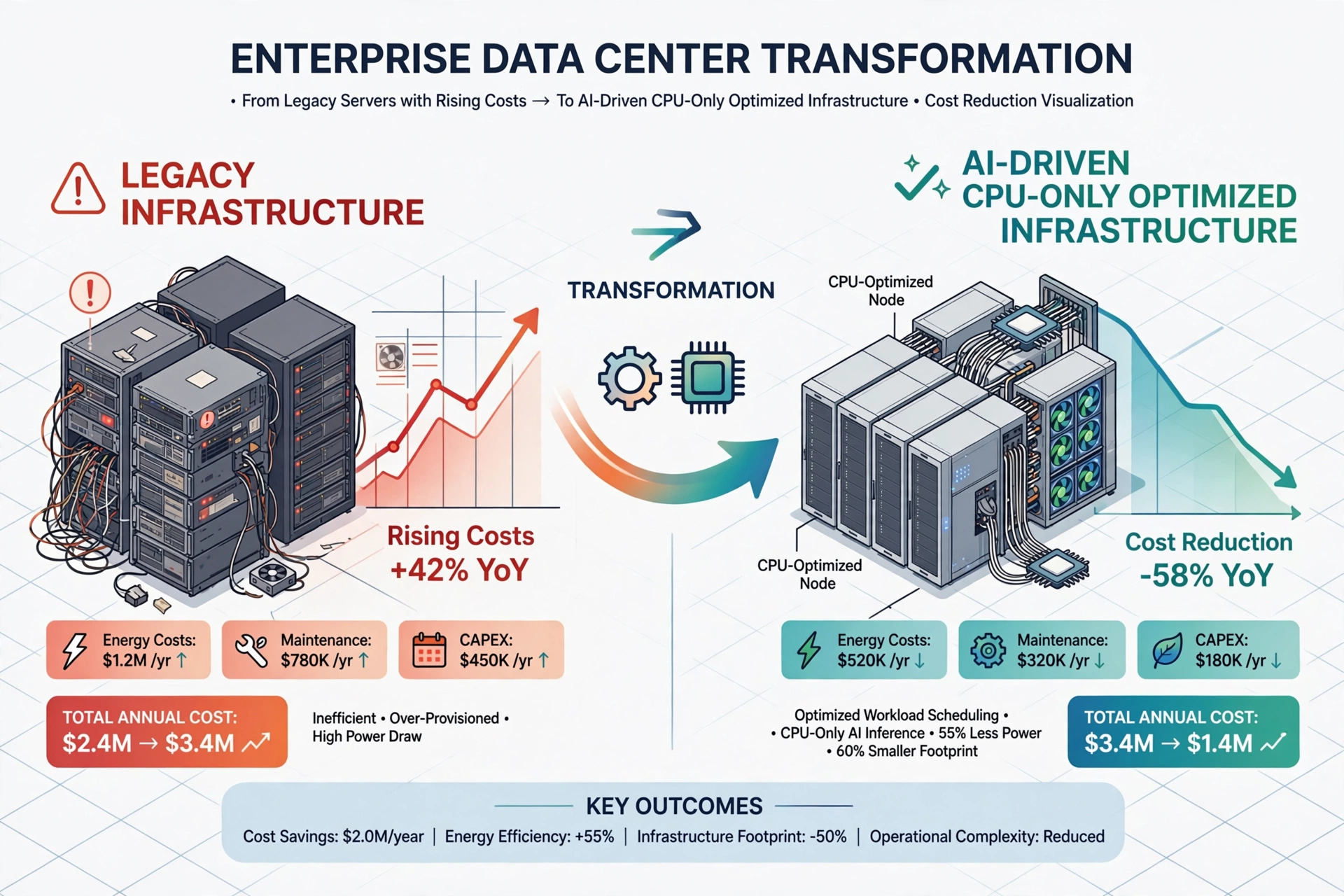
The Strategic Framework: Where AI Delivers Core Savings
Enterprise IT infrastructure costs have grown at an average of 8–12% annually over the past decade 4 . With Gartner forecasting worldwide public cloud spending to reach $723.4 billion in 2025 5 , unoptimized cloud adoption is becoming a cost trap.
“The question of whether a computer can think is no more interesting than the question of whether a submarine can swim.”— Edsger W. Dijkstra
AI optimizes like nothing else can. Traditional infrastructure relies on reactive scaling. AI enables continuous, proactive optimization. Three domains consistently deliver the greatest infrastructure savings:
-
Intelligent Cloud Resource Management: AI algorithms analyze usage patterns, automatically scaling resources to eliminate the “just-in-case” provisioning that inflates bills by 30%. IBM indicates that paying down technical debt from legacy systems improves AI ROI by up to 29% 7 .
-
Predictive Maintenance: AI models predict equipment failures before they occur, avoiding costly downtime. Integrating these capabilities reduces maintenance expenditure by 15–25% 3 .
-
Automated Security: AI-powered threat detection replaces bloated operations teams with lean efficiency. By aligning tools with frameworks like the EU AI Act 8 , organizations achieve compliance alongside stronger protection.
Navigating Regulatory Landscapes and Sustainability
“When information is contextualized, it becomes knowledge. When knowledge compels convictions, it becomes wisdom.”— Henry Kissinger, The Age of AI and Our Human Future
Strategic AI adoption requires strict governance. The European Union’s AI Act (July 2024) classifies systems by risk and mandates transparency 8 . In the U.S., Executive Order 14110 establishes federal guidelines for trustworthy AI 9 . Enterprises with mature governance frameworks achieve 18% faster time-to-value on AI projects 10 . Furthermore, data governance regulations like Brazil’s LGPD heavily influence how multinational organizations architect their data pipelines 11 .
Furthermore, sustainability is inextricable from infrastructure costs. AI-optimized data centers, especially those running efficient CPU-based inference rather than power-hungry GPUs, consume significantly less energy. Embracing cost reduction through AI efficiency positions a company as a leader in both profitability and corporate responsibility.
Conclusion
At that time, the strategic adoption of AI for infrastructure optimization is an operational reality. Enterprises deploying CPU-driven AI workloads, predictive maintenance, and automated security are fundamentally changing their profit margins. As Fei-Fei Li stated: “Computers are able to see, hear, and learn. Welcome to the future.” The future operates in the data centers of enterprises that choose to lead.
The Final Verdict: Adoption Costs vs. Payback Period
-
Adoption Cost: Utilizing existing CPU infrastructure for asynchronous AI workloads requires essentially $0 in new CapEx, requiring only engineering hours to configure open-source quantized models.
-
Payback Period: Due to the avoidance of dedicated GPU hardware and expensive API tokens, the payback period is immediate (Day 1 operational profitability).
-
Verdict: Deploying local, CPU-bound AI for backend tasks is definitively ROI-positive, yielding up to a 95% reduction in OPEX compared to equivalent cloud-based API solutions.