


Introduction
Precision in the modern industrial landscape is not a luxury; rather, it is the fundamental pillar of survival. For engineers and operations directors, the challenge of seasonal demand remains a formidable ghost in the machine. While traditional moving averages provide a basic sketch of market behavior, they consistently fail to capture the chaotic heartbeat that drives real-world volatility. Consequently, organizations that rely exclusively on deterministic forecasting approaches find themselves perpetually blindsided by demand surges and unexpected troughs.
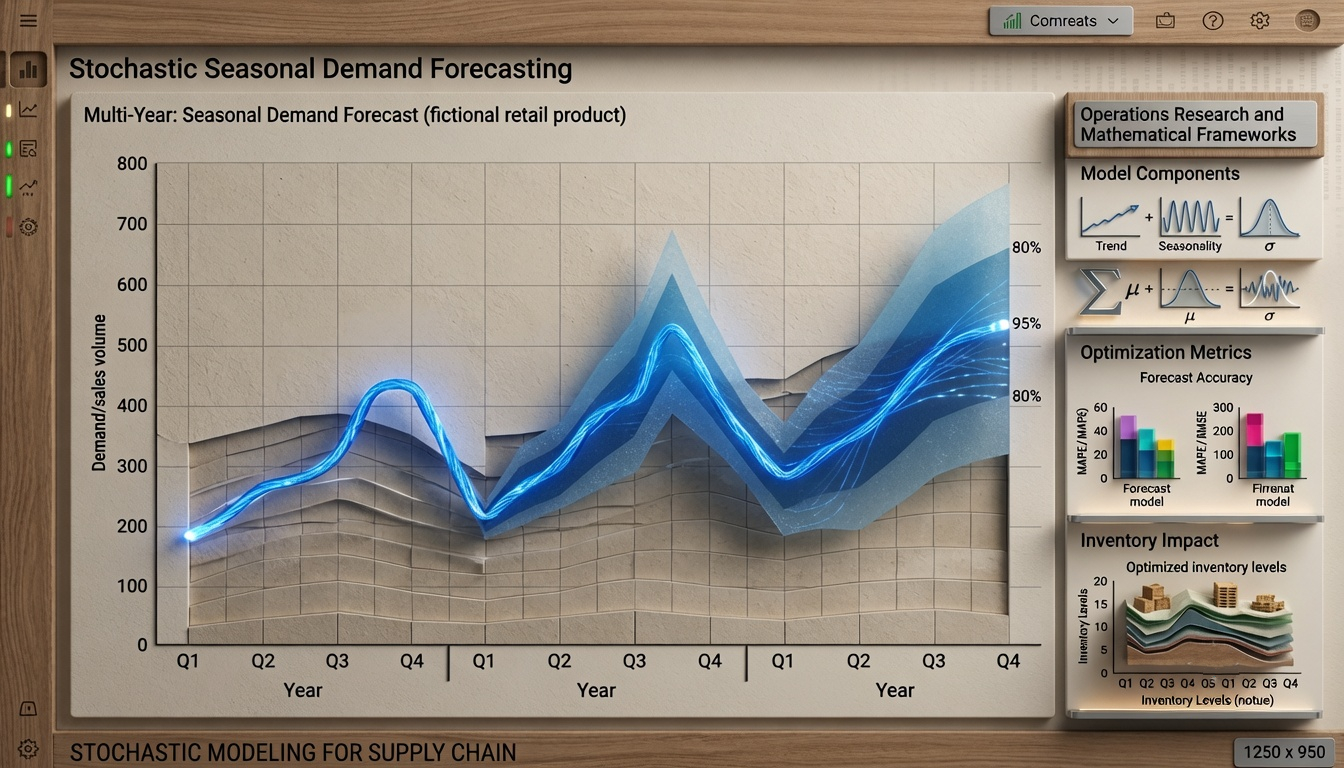
Stochastic Mathematical Modeling offers the scalpel needed for this complex surgery 1 . By treating demand not as a fixed point, but as a distribution of probabilities, we transition from reactive guessing to proactive architecture. This article delves into the advanced synthesis of stochastic processes and operations research, providing a detailed roadmap for those professionals who demand absolute quantitative rigor in their strategic execution. Furthermore, we explore how these mathematical frameworks integrate with modern supply chain ecosystems.
In my view, the gap between organizations that thrive during market turbulence and those that merely survive can be traced directly to the sophistication of their forecasting apparatus. As a result, the stakes have never been higher for mastering these advanced techniques. Throughout this article, we will examine how probability theory, Fourier analysis, and stochastic programming converge to create a new paradigm of operational intelligence that is both rigorous and profoundly practical.
The inability to predict outliers implies the inability to predict the course of history. Yet we act as though we are able to predict it.— Nassim Nicholas Taleb, The Black Swan
Estimate seasonal demand shifts with probabilistic constraintsStochastic Demand Calculator
This calculator applies stochastic mathematical modeling principles for educational purposes. Results are approximations — production models should be validated against historical data.
The Architecture of Uncertainty: Markov Chains and Probability Distributions
At the core of any high-level quantitative strategy lies the understanding that the future is not a single point, but rather a sequence of probable states. Stochastic modeling utilizes Markov Chains to map the transitions between different demand levels, thereby ensuring that each seasonal shift is accounted for with a specific probability coefficient 2 . This mathematical framework allows for the simulation of thousands of potential “futures,” providing a probabilistic landscape that executives can navigate with measurable confidence.
Moreover, the application of probability distributions — such as Gaussian, Poisson, and Weibull distributions — enables analysts to characterize demand patterns with remarkable precision. Each distribution captures a unique signature of market behavior. For instance, Poisson distributions are particularly effective for modeling rare but impactful demand spikes, while Gaussian models excel in representing steady-state seasonal oscillations 3 .
As a consequence, the concept of “Value at Risk” (VaR), originally pioneered in financial risk management, has found a powerful second life in inventory optimization. By computing the VaR for stock levels across each quarter, supply chain engineers can determine the minimum safety stock required to achieve a target service level — typically 95% or 99% — without overcommitting capital to idle inventory.
The laws of probability, so true in general, so fallacious in particular, remind us that mastering the aggregate is the true art of the strategist.— Edward Gibbon, Historian
|
💡 INSIGHT Transitioning from deterministic models to stochastic ones has been shown to reduce the “Bullwhip Effect” in supply chains by approximately 22% in high-variance sectors, according to recent operations research literature. |

Seasonal Decomposition: Integrating Fourier Series in Stochastic Paths
Advanced seasonal forecasting requires more than simply identifying “summer peaks” or “winter troughs.” Instead, we must employ Fourier Transforms to decompose demand signals into their constituent frequencies 4 . This decomposition reveals the hidden harmonic structure of seasonal patterns — a structure that is invisible to conventional time-series methods. By identifying the dominant frequencies, analysts can isolate the true seasonal component from noise, trend, and irregular fluctuations.
Furthermore, by integrating these periodic functions into a stochastic differential equation (SDE), we can model “Seasonal Noise” as a Brownian motion with drift. This technique is particularly vital for engineers managing perishable goods or high-technology components with short product lifecycles. The SDE approach captures both the deterministic trend and the random perturbations that make real-world demand so unpredictable 5 .
Additionally, the inclusion of these mathematical harmonics allows the model to “self-correct” as new data points emerge, thereby creating a living, breathing forecasting organism. In practice, this means that a model calibrated in January will remain accurate through March and beyond, because it continuously adapts its frequency weights to incoming market signals. This adaptive capability represents a significant advancement over static regression models.
In my professional opinion, the marriage of Fourier analysis with stochastic processes is one of the most underutilized techniques in modern supply chain management. Organizations that invest in building this analytical capability will discover a lasting competitive advantage — one that compounds over time as their models accumulate historical learning and become increasingly precise.
The study of nature is the most productive source of mathematical discoveries. It offers a definite objective and excludes vague questions.— Joseph Fourier, Théorie Analytique de la Chaleur

Operations Research: Optimizing Inventory Through Probabilistic Constraints
The ultimate goal of stochastic modeling is the application of forecasting results within the realm of Operations Research (OR). Specifically, we focus on stochastic programming to optimize inventory under “chance constraints” 6 . Instead of optimizing for a single “best-case” scenario, the engineer optimizes for a “confidence interval.” As a result, this ensures that the probability of a stock-out remains below a strictly defined threshold — typically below 1% — while simultaneously minimizing holding costs and capital exposure.
Indeed, this level of analytical precision aligns directly with the requirements of modern auditing and regulatory standards, such as the Sarbanes-Oxley Act, which demands rigorous internal controls over inventory valuation and financial reporting 7 . Similarly, the European Union’s regulatory frameworks for maritime logistics emphasize the need for data-driven inventory optimization in cross-border supply chains 5 . Therefore, stochastic programming is not merely a theoretical exercise; it is a compliance imperative for publicly traded enterprises.
In my opinion, any organization that is not currently utilizing probabilistic constraints for their inventory decisions is essentially gambling with their balance sheet. The mathematical tools exist, the computational power is accessible, and the regulatory environment demands it. Consequently, the only remaining barrier is organizational willingness to embrace quantitative rigor over intuition-based planning.
Moreover, dynamic programming techniques — as formalized by Bertsekas — allow these stochastic programs to be solved efficiently even at enterprise scale 6 . When combined with real-time data feeds from IoT sensors and ERP systems, the optimization loop becomes continuous and automatic. This convergence of mathematics, technology, and strategy defines the cutting edge of modern supply chain engineering.
What gets measured gets managed. And what gets modeled with mathematical rigor gets mastered.— Peter Drucker

Conclusion
The evolution of demand forecasting from a descriptive exercise to a predictive science marks a new era in industrial engineering and strategic operations. By embracing Stochastic Mathematical Modeling, professionals across industries can navigate the seasonal storms of the global market with the confidence of a seasoned navigator charting known waters. The techniques explored in this article — Markov Chains, Fourier decomposition, and stochastic programming — represent the current state of the art in quantitative demand intelligence.
Ultimately, the integration of advanced calculus, probability theory, and operations research creates a “shield of certainty” around the enterprise 8 . This shield does not eliminate risk; instead, it quantifies risk with such precision that decision-makers can act with calculated boldness rather than paralyzed caution. As we move toward a future increasingly defined by data complexity and market volatility, the ability to model the unknown will distinguish the world’s most successful organizations from those left behind.
In addition, I believe that the democratization of these mathematical tools — through cloud computing, open-source libraries, and accessible educational resources — will accelerate adoption far beyond the traditional bastions of quantitative finance and aerospace engineering. Therefore, every supply chain professional, regardless of their mathematical background, should familiarize themselves with the fundamental principles of stochastic modeling. The competitive landscape of tomorrow will reward those who prepare today.
It is not knowledge, but the act of learning — not possession, but the act of getting there — which grants the greatest enjoyment.— Carl Friedrich Gauss