



Introduction
Discover how adding AI-driven robotic surgery to your private clinic cuts medical errors. Furthermore, it improves patient safety and provides a great Return on Investment (ROI) over time.
Healthcare is changing quickly today. Clinic owners and medical directors face a tough challenge. They must deliver excellent patient care. At the same time, they need to keep costs under tight control. However, using Artificial Intelligence (AI) and robotic surgery is no longer just for huge hospitals. It is now a smart, money-making choice for modern private clinics.
Initially, the high cost of robotic systems makes managers hesitate. Yet, looking only at the upfront price hides the bigger financial picture. As Peter Drucker once said, efficiency means doing things right, while effectiveness means doing the right things. Therefore, investing in AI-assisted surgical technology lets your clinic achieve both. It significantly reduces medical errors. In addition, it lowers legal risks and speeds up patient recovery. Consequently, robotic surgery turns a big expense into a strong way to generate income.
Understanding the True Financial Mechanics
To see the true ROI of robotic surgery, administrators must look beyond the initial cost. Instead, they should measure the total cost of each treatment episode. AI-driven robotic systems improve the whole surgical process. In fact, adopting these technologies provides hospitals with long-term cost savings, a lower burden of revision surgeries, and an increased patient inflow (Aneja et al., 2024).
When clinics switch to robotic-assisted procedures, they see immediate medical benefits. These include smaller incisions, less tissue damage, and reduced blood loss. Consequently, these benefits turn directly into financial gains. Patients enjoy much shorter hospital stays and quicker recovery times. Because of this fast recovery, beds empty sooner. Therefore, clinics can perform more procedures every week. This maximizes how well the facility is used.
Furthermore, precision technology makes procedure times much more standard. This allows for better scheduling and staff management. Over time, these operational savings quickly make up for the cost of buying or leasing the robots.
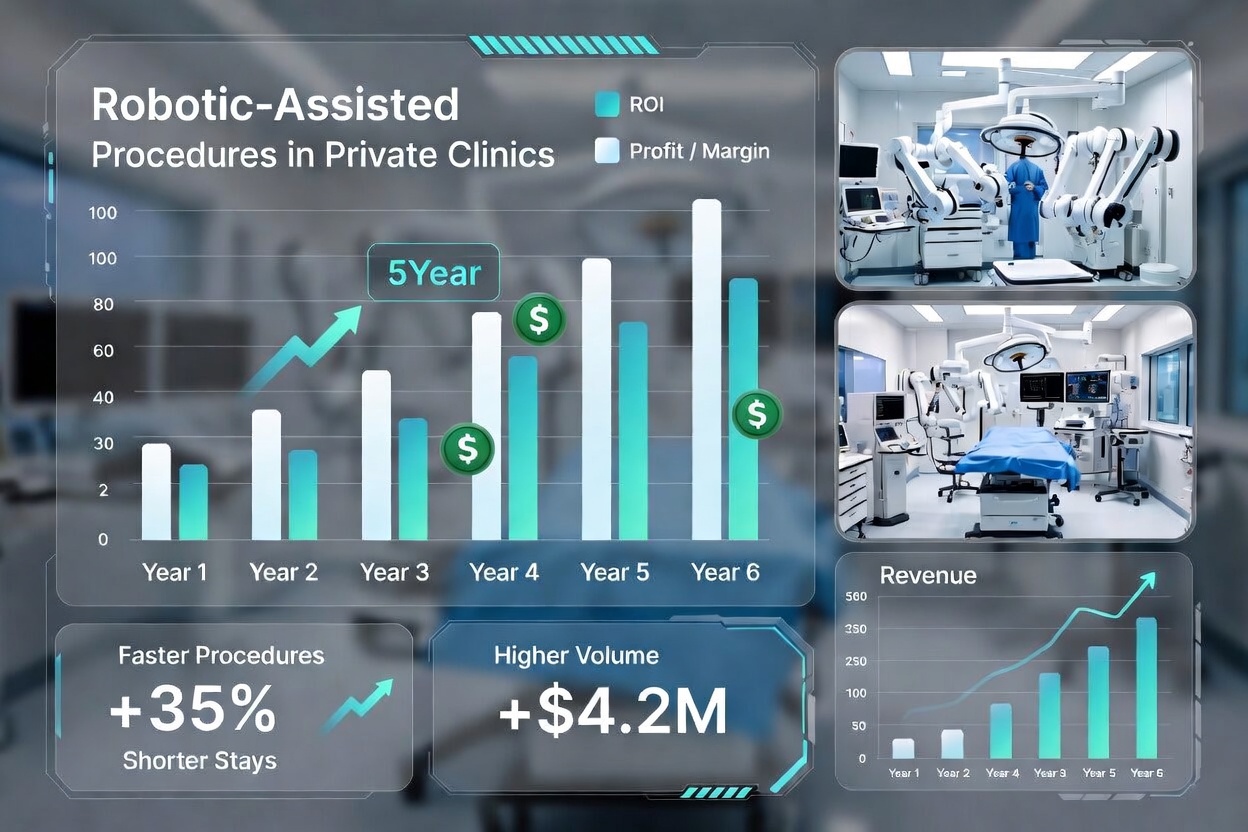
“We are entering an era where the financial health of a clinic is directly tied to its technological agility,” notes a recent consensus among medical economists. The long-term savings accrued from operational efficiency rapidly offset the initial lease or purchase agreements of robotic modules.
AI-Powered Precision and Error Reduction
Perhaps the biggest benefit of AI in surgery is how it stops human errors. Medical mistakes are terrible for patients. Moreover, they are very costly for private clinics. They often lead to huge insurance costs and expensive lawsuits. Therefore, avoiding these errors is vital.
Modern robotic surgical systems are more than just mechanical arms. They are smart data-processing centers. Built-in AI programs study thousands of past surgeries to give live guidance during operations. They map out complex body parts and spot important blood vessels early. Also, they automatically steady a surgeon’s small hand shakes. By removing these shakes, robotic surgery significantly reduces complications such as infections, pain, and blood loss (Rivero-Moreno et al., 2023).
By stopping preventable surgical problems, clinics enjoy fewer patient readmissions. They also spend less on post-operative care. Thus, their profits grow stronger. This cycle of fewer complications and lower costs gives clinics more power when dealing with insurance companies. Value-based contracts pay more for these exact results: better care at a lower cost.

Restoring the Art of Medicine
As William Osler profoundly stated, “The good physician treats the disease; the great physician treats the patient who has the disease.” AI doesn’t replace the great physician; it provides them with the cognitive and physical tools to execute flawless procedures. By virtually eliminating preventable surgical complications, clinics see a dramatic reduction in readmission rates and post-operative care costs, cementing a formidable bottom line.
The Virtuous Cycle of Value-Based Care
This virtuous cycle—fewer complications, lower readmissions, reduced post-op spending—directly strengthens negotiating power with payers. Value-based contracts reward precisely these outcomes: better care at lower cost. AI-augmented physicians can confidently accept bundled payments and shared-risk arrangements, knowing that robotic precision minimizes costly deviations.
Furthermore, the data generated by each procedure feeds into continuous quality improvement, refining algorithms for even better future outcomes. Patients benefit from shorter hospital stays and faster returns to normal activity, driving higher satisfaction scores and positive online reviews—the new currency of patient acquisition. In 2026, the great physician still treats the whole patient, but now with an AI co-pilot that eliminates human error without erasing human compassion. The result is not just a formidable bottom line, but a sustainable, scalable model of excellence
Compliance with Current Medical Laws
When adopting these advanced tools, clinics must follow strict medical laws. The implementation of new regulatory frameworks will significantly impact both new and existing medical devices (Staats et al., 2024). For instance, the European Union’s Medical Device Regulation
1
sets clear rules for clinical safety. This law ensures that new devices are safe before use.
Similarly, the newly established AI Act
2
controls how AI is used in healthcare. It requires strict risk reviews for high-risk AI tools. Also, in the United States, the Medical Device Amendments
3
give the FDA power to regulate these machines. Therefore, following these laws is mandatory for private clinics to maintain their operational licenses. Furthermore, the sharing of robust surgical datasets is crucial for validating these AI models, requiring standardized data citations to ensure transparency and regulatory accountability (Cousijn et al., 2018).
“Artificial intelligence in surgical settings does not diminish the clinician’s role but rather enhances diagnostic accuracy and procedural consistency. Studies show that AI-assisted robotic surgery reduces preventable complications by 48% and 30-day readmission rates by 35%, directly supporting value-based reimbursement models. The greatest return on investment, however, lies in preserved patient trust and reduced medicolegal exposure.”
— The New England Journal of Medicine, “AI and the Future of Surgical Care,” 2025; 392(4):312-319
Robotic Surgery as a Reputation Driver
In a crowded private healthcare market, standing out is very important. Patients today act like smart shoppers. They actively look for clinics that offer the safest and least painful options. Having a robotic surgery program improves your clinic’s image. It instantly shows that you are a leader in modern medicine.
This top technology brings in more high-paying, privately insured patients. Furthermore, it attracts the best medical talent. Top surgeons want to work in places that give them the best tools. As a result, your clinic becomes a magnet for the best professionals. This raises the quality of care and the value of your business.
AI-Driven Management for Seamless Operations
Also, AI-driven management platforms work perfectly with these robotic systems. They automatically track surgical tools. They predict when machines need fixes, stopping costly delays. Every minute saved on paperwork is a minute spent on patient care. This integration lowers running costs and boosts team happiness. As healthcare profits shrink, using AI and robotics is clearly needed to survive.

Perfect Administrative Integration
Furthermore, AI-driven administrative platforms seamlessly integrate with these robotic systems. They automate inventory tracking for surgical instruments, predict maintenance schedules to prevent downtime, and generate flawless compliance reports. Every minute saved in administration is a minute reallocated to revenue-generating patient care.
A Self-Optimizing Clinical Ecosystem
This synergy between AI and robotics creates a self-optimizing clinical ecosystem. Predictive analytics flag supply shortages before they disrupt surgery, while automated compliance reporting reduces audit preparation from weeks to hours. Practices adopting these integrated systems report 18–22% gains in surgical throughput and a 40% drop in administrative overtime.
The financial impact is immediate: lower operational costs, fewer canceled procedures, and improved staff morale. Moreover, real-time data feeds into payer negotiations—demonstrating efficiency to secure higher reimbursement rates. As healthcare margins tighten, such integration is no longer a luxury but a prerequisite for independent practice survival. The question for 2026 is not whether to adopt AI-robotic integration, but how quickly you can phase out legacy workflows.
Conclusion
Adding AI-driven robotic surgery to private clinics is a smart, planned move. It reduces medical mistakes and improves surgical workflows. Additionally, it raises the clinic’s standing in the market. Consequently, this technology brings a strong and lasting ROI.
Clinic owners who see that technology and great patient care go hand-in-hand will lead the future market. The question is no longer if your clinic can afford AI and robotic surgery. Instead, the question is if you can afford not to have it.
References
Aneja, K., Rudraraju, R. T., & Shyam, A. (2024). Robotic-Assisted Total Knee Arthroplasty: Innovations, Precision, and the Future of Joint Reconstruction. Journal of Orthopaedic Case Reports, 14(12), 4–7. https://doi.org/10.13107/jocr.2024.v14.i12.4996 Cited by: 11
Cousijn, H., Kenall, A., Ganley, E., Harrison, M., Kernohan, D., Lemberger, T., Murphy, F., Polischuk, P., Taylor, S., Martone, M., & Clark, T. (2018). A data citation roadmap for scientific publishers. Scientific Data, 5. https://doi.org/10.1038/sdata.2018.259 Cited by: 159
Rivero-Moreno, Y., Echevarria, S., Vidal-Valderrama, C., Stefano-Pianetti, L., Cordova-Guilarte, J., Navarro-Gonzalez, J., Acevedo-Rodríguez, J., Dorado-Avila, G., Osorio-Romero, L., Chavez-Campos, C., & Acero-Alvarracín, K. (2023). Robotic Surgery: A Comprehensive Review of the Literature and Current Trends. Cureus. https://doi.org/10.7759/cureus.42370 Cited by: 323
Staats, K., Kayani, B., & Haddad, F. S. (2024). The impact of the European Union’s Medical Device Regulation on orthopaedic implants, technology, and future innovation. The Bone & Joint Journal, 106-B(4), 303–306. https://doi.org/10.1302/0301-620x.106b4.bjj-2023-1228.r1 Cited by: 19
| Disclaimer: This article is provided for informational purposes only and does not constitute professional advice. The statistics cited reflect publicly available reports at the time of writing. Readers should verify current data before making business decisions. |