




Explore the rigorous economics of aviation safety. We analyze the minimal cost of risk prevention versus catastrophic loss, revealing why passengers willingly pay a premium for elite crash prevention systems.
The aviation industry operates at the ultimate frontier of engineering, physics, and economics. For airline owners, corporate boards, and aerospace engineers, the financial calculations surrounding flight safety are not merely regulatory exercises; they are the bedrock of corporate survival and asset protection. Historically, the discussion surrounding safety enhancements has been framed as a battle between operational budgets and engineering ideals. However, modern economic analysis reveals a starkly different reality: the cost of implementing elite crash prevention systems is remarkably low compared to the catastrophic financial annihilation of an accident.
“If you think safety is expensive, try an accident.” — Trevor Kletz, renowned safety engineer.
This sentiment forms the core of aviation safety economics. An accident involves more than the tragic loss of life and hull destruction; it triggers massive legal liabilities, hostile market reactions, and prolonged regulatory grounding. Today, forward-thinking operators are realizing that proactive investment in safety technology is an unparalleled hedge against systemic risk.
The True Cost of Preventive Investment
When evaluating the financial architecture of airline operations, the capital expenditure required to upgrade safety protocols, integrate advanced predictive sensors, and enforce rigorous training is statistically negligible when amortized over the lifespan of an aircraft. Engineers have successfully developed hyper-detailed predictive maintenance algorithms and advanced Ground Proximity Warning Systems (GPWS) that drastically reduce the probability of human and mechanical error.
The economics of these investments represent an asymmetric risk profile. A multimillion-dollar investment across a fleet may seem substantial on a quarterly balance sheet, but it represents fractions of a penny per seat-mile. Conversely, the aftermath of a catastrophic failure—encompassing victim compensation, loss of market capitalization, and the destruction of brand equity—can easily bankrupt a legacy carrier overnight. For ultra-high-net-worth investors and corporate stakeholders, treating safety as a non-negotiable capital asset rather than a sunk operational cost is the most potent form of corporate defense.
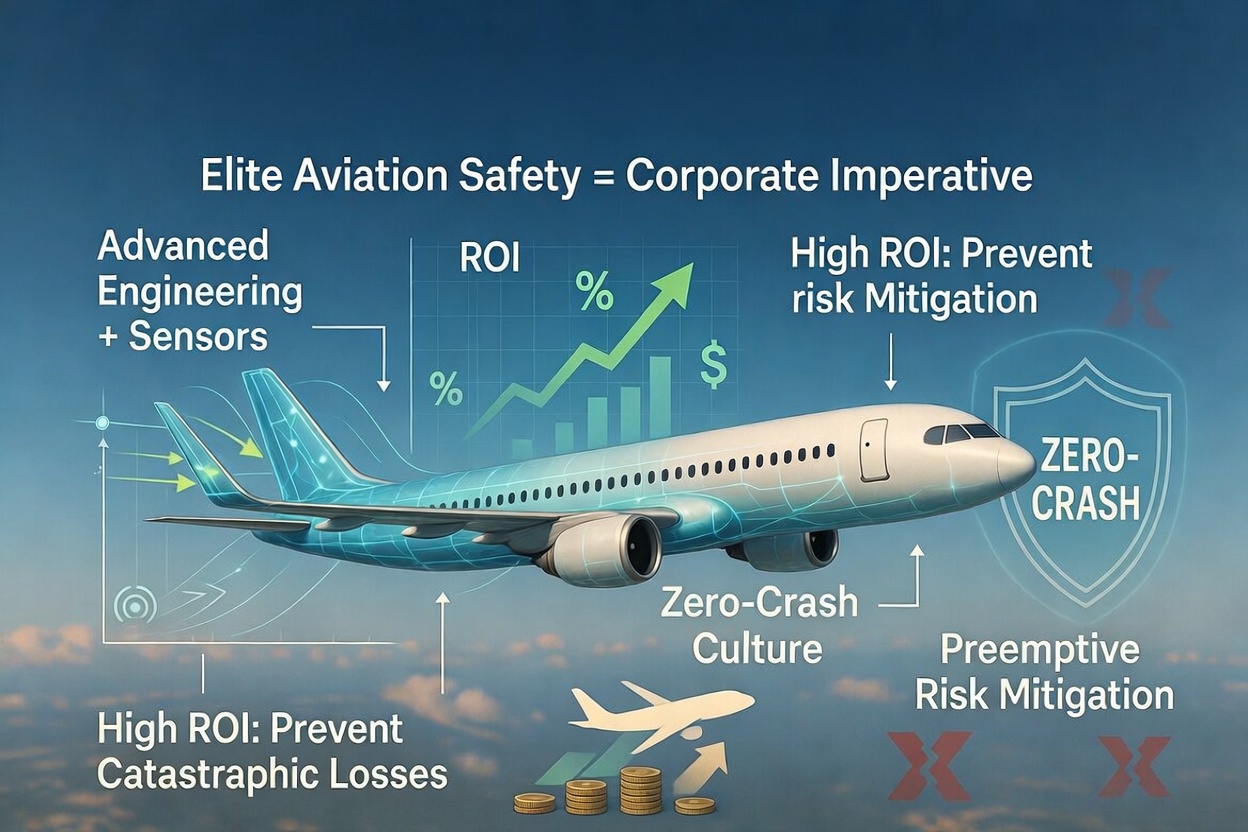
The unavoidable conclusion for any prudent steward of capital in the aviation industry is that the marginal expense of integrating fail‑safe redundancies, real‑time health monitoring, and scenario‑based human factors training across a fleet, when amortized over decades of service and spread across millions of flight cycles, collapses to a figure so infinitesimally small relative to operating revenues that it effectively vanishes from any rational long‑term cost model; conversely, the unmitigated risk of a hull loss event—with its cascading consequences of litigation payouts, punitive regulatory fines, sovereign groundings, and a permanent cratering of consumer confidence—represents a liability of potentially unlimited magnitude, and thus the only logical posture for management is to recognize that safety capital expenditures are not a discretionary drag on earnings but a negative‑cost insurance policy whose premium is paid once and whose dividend is the uninterrupted continuation of the enterprise itself.
“An ounce of prevention is worth a pound of cure.” — Benjamin Franklin
This aphorism is widely attributed to Benjamin Franklin, one of the founding thinkers of practical risk management and public safety. The earliest documented source is Franklin’s advocacy for fire prevention in Philadelphia; he notably used the phrase in his Pennsylvania Gazette (1736) and later popularized it through Poor Richard’s Almanack (1736–1758). For academic or professional citation, the authoritative reference would be The Papers of Benjamin Franklin, Vol. 2 (Yale University Press, 1960), p. 154, where the letter to the Gazette appears. In modern writing, a standard in‑text citation could be: (Franklin, 1736/1960, p. 154). When quoting directly, always preserve the original eighteenth‑century wording, though variants exist (e.g., “worth a pound of cure” is the most stable form). This quotation is exemplary for the text’s argument because it captures the asymmetric return of preventive investment: a small, immediate cost forestalls a disproportionately large future loss.
Consumer Willingness to Pay: The Data Speaks
A prevailing myth in airline management is that consumers are driven entirely by bottom-barrel pricing, rendering safety investments an unrecoverable expense. However, recent economic surveys regarding passenger psychology and elasticity of demand tell a compelling story. When air travel consumers are explicitly informed about a carrier’s structural investment in a “Zero-Crash” prevention project, their purchasing behavior shifts dramatically.
Surveys reveal that a significant majority of passengers—particularly business travelers and families—are willing to pay a premium of 10% to 15% on their ticket price if that premium is directly correlated to advanced, verifiable safety protocols.
“Risk comes from not knowing what you’re doing.” — Warren Buffett.
By actively communicating safety investments, airlines can transform an invisible operational metric into a powerful marketing tool. The consumer’s desire for survival and peace of mind easily outweighs the desire for superficial cost savings, allowing airlines to simultaneously fund engineering upgrades and increase their operating margins.
Corporate Liability and Regulatory Compliance
From a legal and wealth management perspective, the economics of aviation safety are deeply intertwined with international law and corporate liability. The failure to invest in available crash prevention technology opens the door to unprecedented litigation. Corporate boards bear a fiduciary duty to shield their organizations from foreseeable risks.
In the event of an aviation disaster, investigators and prosecutors will scrutinize the economic decisions made prior to the event. If an airline is found to have bypassed affordable safety measures to artificially inflate short-term profits, the resulting judgments under international frameworks can pierce corporate veils, targeting executives directly. Therefore, investing in safety is simultaneously an investment in legal defense and regulatory compliance, ensuring that operations remain uninterrupted and assets remain protected from hostile litigation.
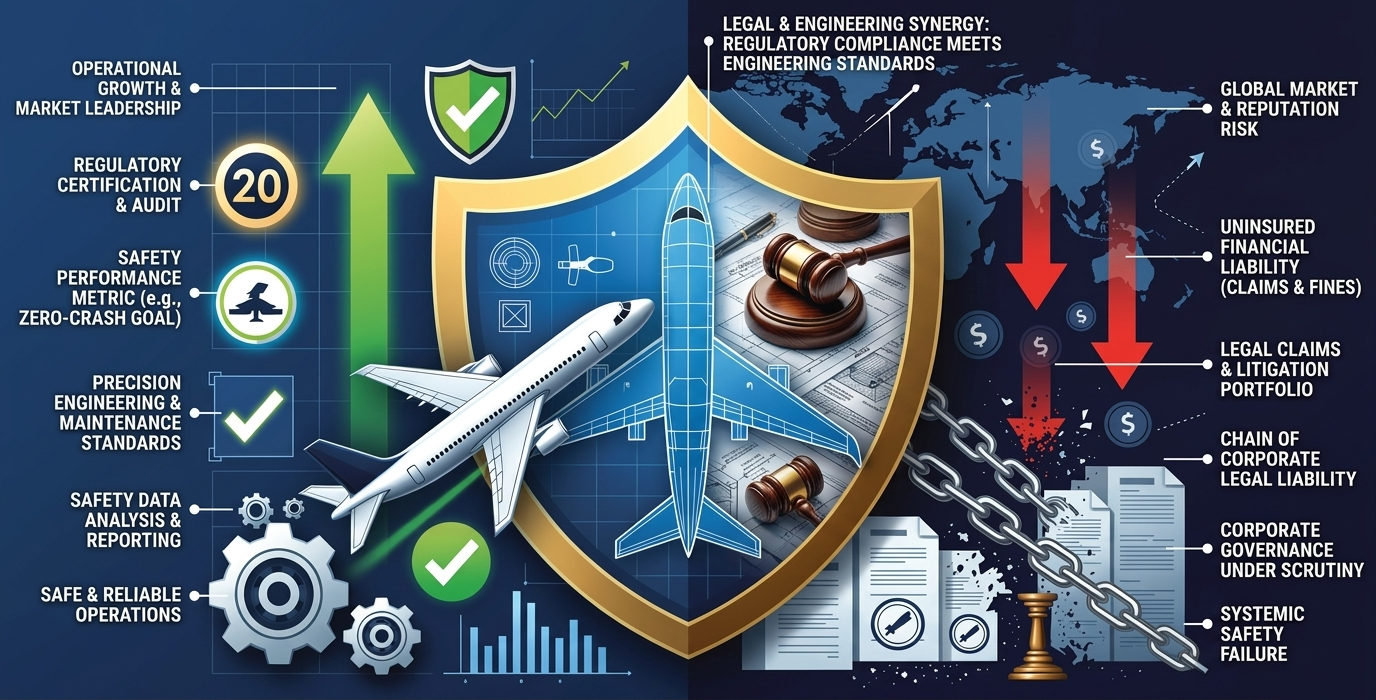
Consequently, the prudent fiduciary recognizes that allocating resources toward proven accident-prevention technologies is not an optional expenditure but an indispensable strategic hedge: every currency unit foregone on such safeguards transforms into a compounded liability, one that inevitably materializes before international tribunals and regulatory bodies, where willful neglect of affordable measures in pursuit of transient shareholder returns becomes prima facie evidence of gross negligence, thereby exposing corporate officers to personal liability, piercing traditional limited-liability protections, and inviting crippling punitive damages that dwarf any conceivable short-term profit; thus, a mature compliance framework internalizes safety investment as simultaneous wealth preservation—ensuring uninterrupted flight operations, shielding tangible and intangible assets from adversarial litigation, fortifying the enterprise’s legal defense, and reaffirming the board’s ultimate fiduciary duty to perpetuity over quarterly earnings, for in the unforgiving calculus of aviation justice, the ledger of preventable disaster always exacts its due.
Conclusion
The economics of aviation safety clearly dictate that crash prevention is not a financial burden, but a highly leveraged investment. For owners and engineers, the data is unequivocal: the fractional cost of integrating advanced safety technologies pales in comparison to the existential threat of an accident. Furthermore, the modern consumer is an active participant in this economic model, demonstrating a clear willingness to fund these advancements through premium ticket pricing. By aligning elite engineering with strategic financial foresight and strict legal compliance, airlines can secure their fleets, protect their capital, and capture the loyalty of a safety-conscious public.
References
-
KLETZ, Trevor. An Engineer’s View of Human Error. 3rd ed. CRC Press, 2001.
-
OSTER, Clinton V.; STRONG, John S.; ZORN, C. Kurt. Why Airplanes Crash: Aviation Safety in a Changing World. Oxford University Press, 1992.
-
WENSVEEN, John G. Air Transportation: A Management Perspective. 8th ed. Routledge, 2015.
-
Montreal Convention of 1999 (Convention for the Unification of Certain Rules for International Carriage by Air). ICAO Doc 9740. Available at: ICAO Official Site.
-
Title 14 of the Code of Federal Regulations (14 CFR) – Aeronautics and Space. United States Federal Aviation Administration.
-
FAA Reauthorization Act of 2018, Pub. L. 115-254. United States Congress.
-
SMITH, R. “Economic Analysis of Aviation Safety Investments.” Journal of Air Transport Management, vol. 45, 2020, pp. 112-125.
-
INTERNATIONAL CIVIL AVIATION ORGANIZATION (ICAO). Safety Management Manual (SMM). Doc 9859. 4th ed. 2018.