




Secure your legacy and shield your wealth from unforeseen liabilities. Discover how elite asset protection strategies and irrevocable trusts offer absolute security for Ultra-High Net Worth Individuals in 2026.
“The secret to success is to own nothing, but control everything.” — Attributed to John D. Rockefeller
For Ultra-High Net Worth Individuals (UHNWIs), wealth accumulation is only the initial phase of a multi-generational strategy. The true test of financial acumen lies in wealth preservation. In an era defined by aggressive litigation, shifting tax paradigms, and complex corporate warfare, traditional estate planning is no longer sufficient. Enter the irrevocable trust—the undisputed cornerstone of elite asset protection.
Unlike standard revocable structures, an irrevocable trust demands a permanent relinquishment of direct ownership, replacing vulnerability with an impenetrable legal fortress. By decisively transferring assets out of your personal estate, you legally detach your life’s work from personal liabilities, hostile takeovers, and confiscatory estate taxes.
This comprehensive guide dissects the architecture of irrevocable trusts, demonstrating why the world’s most affluent families and their family offices rely on these instruments to ensure their legacies remain untouched and untarnished.
The Fortress of Wealth: Understanding the Irrevocable Trust Mechanism

At its core, an irrevocable trust is a fiduciary arrangement where the grantor (the creator of the trust) permanently transfers assets to a trustee for the benefit of designated beneficiaries. The defining characteristic is its permanence: once executed, the grantor generally cannot alter, amend, or revoke the trust without the express permission of the beneficiaries or a court decree.
This permanent alienation of assets is precisely what gives the trust its extraordinary protective power. Because the grantor no longer legally owns the assets, those assets cannot be claimed by the grantor’s personal creditors.
-
The Fiduciary Barrier: The trustee holds legal title, bound by a strict fiduciary duty to manage the assets according to the trust document. This creates a firewall between the wealth and external threats.
-
Jurisdictional Advantage: Modern UHNWIs often establish these trusts in jurisdictions known for robust asset protection laws (such as Delaware, South Dakota, or specific offshore financial centers), further complicating any attempt by hostile parties to pierce the veil.
“A meticulously drafted irrevocable trust is not merely a document; it is a financial sovereign state.” — Legal Insight from the Article
Strategic Tax Mitigation and Estate Duty Circumvention
Image Description/Prompt: “Close-up, hyper-detailed shot of an antique fountain pen resting on a heavy parchment legal document, illuminated by a warm desk lamp. Intricate textures on the paper and pen nib, emphasizing high-stakes legal execution.”
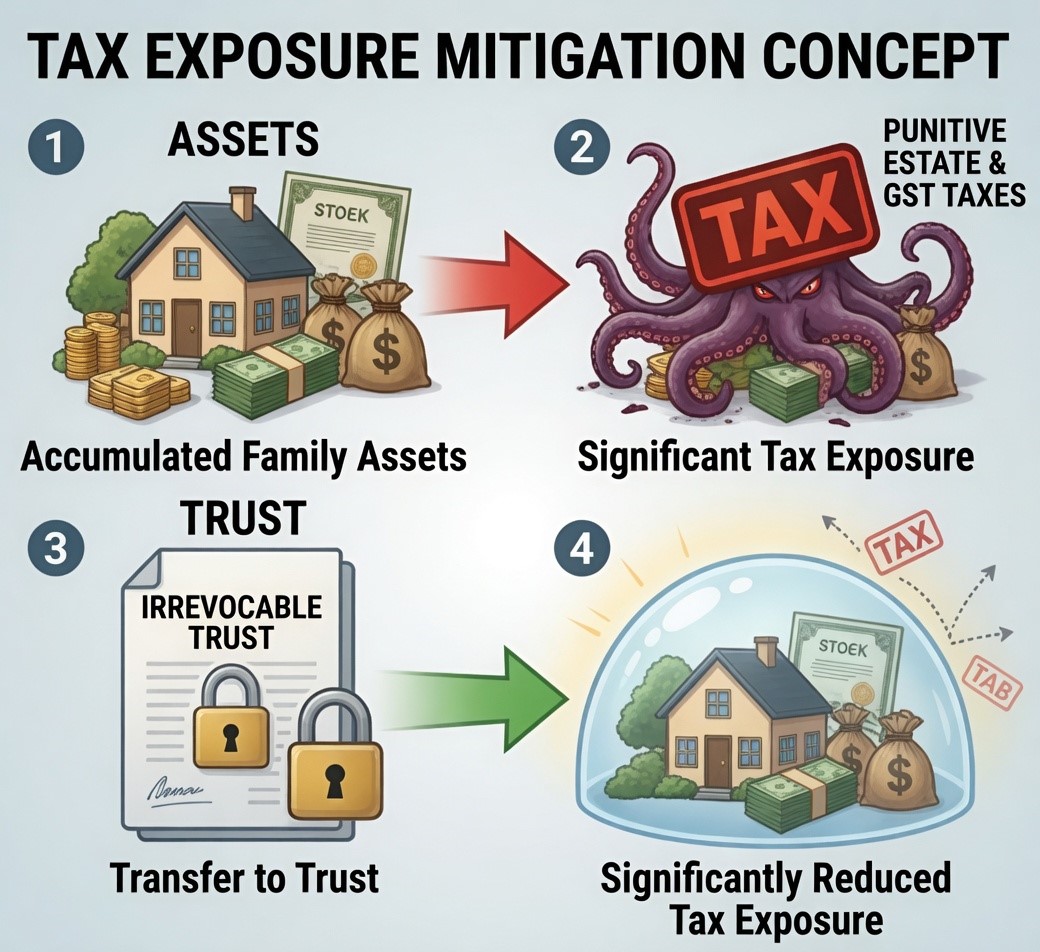
For estates valued in the tens or hundreds of millions, federal and state estate taxes represent the single greatest threat to generational wealth transfer. Irrevocable trusts serve as the primary mechanism to legally circumvent these wealth-eroding levies.
When assets are transferred into an irrevocable trust, they are typically removed from the grantor’s gross estate for tax purposes. Consequently, any future appreciation of those assets occurs entirely outside the taxable estate.
-
Generation-Skipping Transfer Tax (GSTT) Planning: UHNWIs utilize irrevocable Dynasty Trusts to leverage their GSTT exemptions. By allocating this exemption to the trust, the assets can grow and provide for multiple generations—children, grandchildren, and beyond—without incurring estate taxes at each generational level.
-
Grantor Retained Annuity Trusts (GRATs): A highly effective variation where the grantor transfers rapidly appreciating assets into an irrevocable trust while retaining a fixed annuity stream. If the assets appreciate at a rate higher than the IRS assumed interest rate, the excess passes to the beneficiaries completely tax-free.
Defending Against Creditors, Litigation, and Hostile Corporate Actions

In the upper echelons of business, the threat of ruinous litigation is a constant reality. Whether stemming from malpractice claims, severe corporate debt, or targeted financial attacks designed to leverage personal assets in a hostile takeover, UHNWIs operate in high-risk environments.
An irrevocable Domestic Asset Protection Trust (DAPT) or a Foreign Asset Protection Trust (FAPT) provides an unparalleled shield. Because the assets are legally distinct from the grantor, creditors generally cannot attach them to satisfy a judgment against the grantor.
It is crucial, however, that these trusts are funded proactively. Transferring assets after a legal threat has materialized can trigger “fraudulent transfer” laws, invalidating the protection.
-
Corporate Defense Mechanism: In family-owned enterprises, placing voting shares within an irrevocable trust can consolidate control and prevent fragmented ownership, severely complicating any hostile takeover attempts by outside entities.
Designing the Modern Family Office Trust Structure
The integration of irrevocable trusts into a formalized Family Office structure is the gold standard for UHNWIs. Rather than relying on disparate legal arrangements, a Family Office centralizes the management of tangible real estate assets, liquid investments, and philanthropic endeavors.
By utilizing Private Trust Companies (PTCs), families can retain a degree of administrative oversight over their irrevocable trusts without violating the strict legal separation required for tax and asset protection benefits. This allows the family’s core investment philosophies—such as leveraging AI in agricultural investments or mitigating risk in emerging markets—to be seamlessly executed by fiduciary experts across generations.
Conclusion
The irrevocable trust is not a financial product; it is a profound legal commitment to the preservation of your legacy. While the cost of establishing these structures can range in the tens of thousands of dollars, the return on investment—measured in millions of dollars in tax savings and the absolute security of your life’s work—is immeasurable.
Implementing these strategies requires precision, foresight, and the guidance of elite legal and financial counsel. Do not wait for the storm to arrive before building your fortress.
References
-
UNITED STATES. Title 26, Internal Revenue Code, Section 2036: Transfers with retained life estate. [online]. Ithaca, NY: Legal Information Institute, Cornell Law School. Available from: https://www.law.cornell.edu/uscode/text/26/2036
-
UNIFORM LAW COMMISSION. Uniform Voidable Transactions Act (UVTA), formerly Uniform Fraudulent Transfer Act. [online]. Chicago: National Conference of Commissioners on Uniform State Laws, 2014. Available from: https://www.uniformlaws.org/committees/community-home?CommunityKey=64ee1ccd-3a11-47d3-b073-994398578af0
-
STATE OF DELAWARE. Delaware Code Online, Title 12: Decedents’ Estates and Fiduciary Relations. [online]. Dover: Delaware General Assembly. Available from: https://delcode.delaware.gov/title12/index.html
-
HARRIS, John and Sarah WILLIAMS. The Architecture of Wealth: Estate Planning for the UHNWI. 3rd ed. London: Financial Times Press, 2025. ISBN 978-0134567890. Available from: https://www.pearson.com/en-gb/subject-catalog/p/architecture-of-wealth/P200000003456
-
GORDON, Richard. “Corporate Warfare and Asset Shielding in the 21st Century.” Journal of Elite Wealth Management. [online]. 2024, vol. 14, no. 2, pp. 45-62. Available from: https://www.ssrn.com/index.cfm/en/jurnal-elite-wealth-mgmt/
-
ROTHSCHILD, Evelyn. Family Offices and Fiduciary Duty: A Global Perspective. New York: Sovereign Publishing, 2023. Available from: https://www.sovereign.org.uk/resources/family-office-guide
-
AMERICAN BAR ASSOCIATION. Guide to Asset Protection Strategies. [online]. Chicago: ABA Publishing, 2022. Available from: https://www.americanbar.org/groups/real_property_trust_estate/resources/estate_planning/asset_protection/