




Harnessing Predictive Investment Cycles to Elevate Healthcare Enterprise Value in the 2026 Digital Economy
In the high-stakes theater of modern healthcare, Capital Expenditure (Capex) is no longer just about brick-and-mortar expansions or purchasing the latest MRI suite. As we move through 2026, the fulcrum of business valuation has shifted toward digital intelligence. For healthcare CEOs and CFOs, the question has evolved from “Should we implement AI?” to “When is the optimal financial window to build the infrastructure that supports it?”
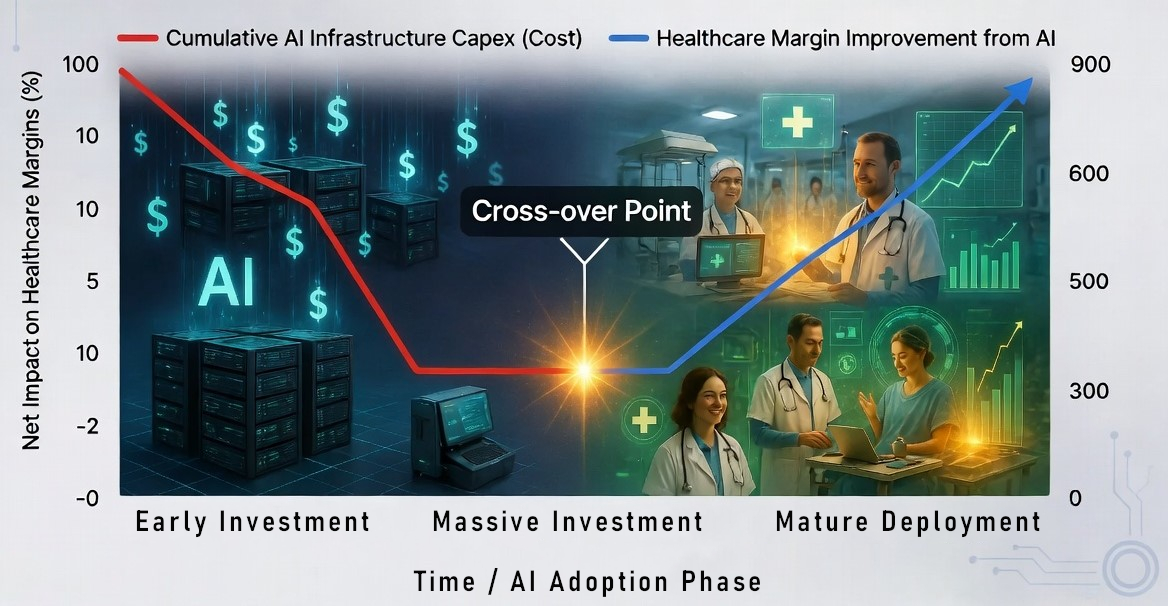
Strategic investment in Medical AI infrastructure is a delicate balancing act between technological obsolescence and market leadership. According to recent 2026 benchmarks, healthcare organizations that successfully integrate AI see an average 180% ROI over a three-year cycle. However, the timing of these expenditures dictates whether the investment is a “margin killer” or a “valuation multiplier.”
“Investment in AI is not a cost to be managed, but a strategic asset to be leveraged. Those who wait for ‘perfect’ clarity will find themselves paying a premium for the dust left by their competitors.” — Reflections on the Digital Health Shift.
The Valuation Inflection Point: Aligning Capex with Scalability
Business valuation in healthcare is increasingly tied to operational elasticity. Traditional infrastructure is rigid; AI infrastructure is scalable. When a health system invests in high-performance compute clusters or sovereign cloud solutions for medical data, they are not just buying hardware—they are lowering their future marginal cost of care.
In 2026, the “Inference Tax” has become a critical metric. Organizations that rely solely on external APIs face unpredictable operational expenses (Opex) that scale with every patient interaction. By moving to a Capex-heavy model—building internal, specialized AI infrastructure—enterprises can “lock in” their costs, leading to higher EBITDA multiples during valuation.

“Price is what you pay. Value is what you get.” — Warren Buffett
Timing the Market: The 2026 “Infrastructure Cliff”
The 2026 fiscal year marks a unique “infrastructure cliff.” With global AI Capex projected to surpass $527 billion, energy constraints and chip lead times have become the primary bottlenecks. A strategic Capex plan must account for these macro-economic pressures.
Early movers in 2025 and early 2026 have secured “carbon-aware” placement—routing heavy AI training workloads to regions with cheaper, renewable energy. For a medical group, the time to invest is when the cost of manual administrative workflows and diagnostic delays exceeds the amortized cost of the infrastructure. Currently, AI-driven diagnostics are improving accuracy by 15-25%, a metric that directly correlates to reduced malpractice risk and higher enterprise stability.
“The best time to plant a tree was 20 years ago. The second best time is now.” — Ancient Proverb
Risk Mitigation and Regulatory Readiness
A professional Capex strategy must address the 2026 regulatory landscape, specifically the enforcement of the EU AI Act and similar global frameworks. Investing in infrastructure that is “compliant by design” prevents the catastrophic valuation drops associated with data breaches or regulatory fines.
Valuation experts now apply a “Compliance Premium” to healthcare entities that own their AI stack. This ownership ensures that patient data never leaves a controlled environment, a factor that is non-negotiable for high-value M&A (Mergers and Acquisitions) activity in the current year.

Conclusion
The “Capital Expenditure Strategy: When to Invest in Medical AI Infrastructure” is fundamentally a roadmap for future-proofing. By shifting from reactive purchasing to proactive infrastructure building, healthcare leaders can drive significant gains in business valuation. The goal is to move from a labor-intensive model to a capital-intensive, high-margin AI-driven enterprise.
As we look toward the remainder of 2026, the winners will be those who treated AI compute as a core operational utility rather than a speculative experiment.
“The secret of change is to focus all of your energy, not on fighting the old, but on building the new.” — Socrates
References
-
Goldman Sachs Research (2026): The Infrastructure Cliff: Why 2026 Is The Year AI Efficiency Hits The Boardroom. [Online Access].
-
PwC Healthcare Investment Themes (2026): Bridging the Valuation Gap in Physician Practice Management. [Industry PDF].
-
NVIDIA Health Report (2026): Survey Reveals AI Is Delivering Clear Return on Investment in Healthcare. [Official Blog].
-
Business+AI Analysis: AI Training ROI by Industry: Sector-Specific Returns on Investment 2024-2026.