




Protecting high-stakes capital requires more than traditional litigation; it demands a surgical approach to asset recovery, blending forensic precision with aggressive legal maneuvers in an era of corporate instability.
The New Frontier of Insolvency
In the volatile economic landscape of 2026, corporate bankruptcy is no longer a simple end-of-life event for a business; it has become a strategic theater of war. For creditors—ranging from private banking institutions to elite engineering firms and high-net-worth individual lenders—the challenge is no longer just about “filing a claim.” It is about navigating a complex web of liability management exercises, offshore shells, and digital asset obfuscation.
As Winston Churchill famously noted, “Success is not final, failure is not fatal: it is the courage to continue that counts.” In the world of corporate restructuring, that courage must be backed by a relentless, multifaceted asset recovery strategy. When a corporate giant falters, the window for recovery is narrow, and the competition for remaining liquidity is fierce. This article delves into the elite legal mechanisms and forensic strategies required to ensure that creditors are not merely observers of a liquidation, but active participants in the restoration of their wealth.
Forensic Accounting: Unearthing the Digital Paper Trail
The modern corporate structure often masks its true value within layers of subsidiary transactions and intangible assets. To recover what is owed, one must first see through the fog. Forensic accounting in 2026 has evolved beyond simple audits into a high-stakes digital investigation, utilizing AI-driven pattern recognition to identify “leakage”—unauthorized or fraudulent transfers designed to deplete the estate before a filing.
“A successful man is one who can lay a firm foundation with the bricks others have thrown at him.” — David Brinkley.
In the context of asset recovery, those “bricks” are the data points found in hidden ledgers, encrypted transaction histories, and inter-company transfers. Creditors must engage experts who can reconstruct missing financial records and verify the accuracy of the debtor’s “Statement of Financial Affairs.” If a debtor claims insolvency while shifting capital into R&D shells or “related-party” service contracts, forensic tracing is the primary weapon to bring those assets back into the reachable pool.

Piercing the Corporate Veil and Liability Management
The “corporate veil” is intended as a shield for shareholders and directors, but in cases of fraud or gross undercapitalization, it can be pierced. Creditors are increasingly looking toward “alter ego” theories to reach beyond the insolvent entity into the pockets of the parent company or the individual directors themselves.
Recent trends in 2026 suggest that “Liability Management Exercises” (LMEs)—where companies restructure debt outside of court to benefit certain lenders over others—are being scrutinized more heavily. These deals often delay the inevitable while stripping the company of its most valuable collateral. A strategic creditor must be prepared to challenge these transactions as “fraudulent transfers” or “preferences” under the law. As Robert Kiyosaki once observed, “Don’t let the fear of losing be greater than the excitement of winning.” In the courtroom, this means being the first to challenge a “sham” restructuring before the assets vanish into a pre-packaged liquidation.
In the architecture of corporate governance, the line between structural integrity and a decorative facade is often the difference between successful asset recovery and a total loss for creditors. In 2026, the concept of transparency has been weaponized; it is frequently utilized as a polished exterior designed to project stability, while the underlying financial foundations are hollowed out through aggressive liability management or offshore shifting.
The Duality of Disclosure: Mechanism vs. Mask
The “use” of a facade occurs when a corporation adopts the vocabulary of openness—releasing ESG reports, hosting investor webinars, and publishing vague “impact” statements—without providing the granular data required to verify solvency. This is “transparency in name only,” a tactical maneuver used to delay litigation or appease stakeholders while assets are quietly dissipated. Conversely, the “non-use” of facades—or genuine transparency—involves the proactive disclosure of ledger-level detail and clear, unencumbered paths to collateral. For the elite creditor, distinguishing between these two states is the first step in a surgical recovery strategy.
“The truth is like the sun. You can shut it out for a time, but it ain’t goin’ away.” — Elvis Presley.
When corporate structures are used merely as a facade, the law acts as the “electric light” that exposes the vacancy within. Shifting from a superficial “ritual” of feedback and reporting to a model of substantive disclosure is not just an ethical choice; it is a legal imperative for any firm seeking to survive the scrutiny of bankruptcy court or a hostile takeover attempt.
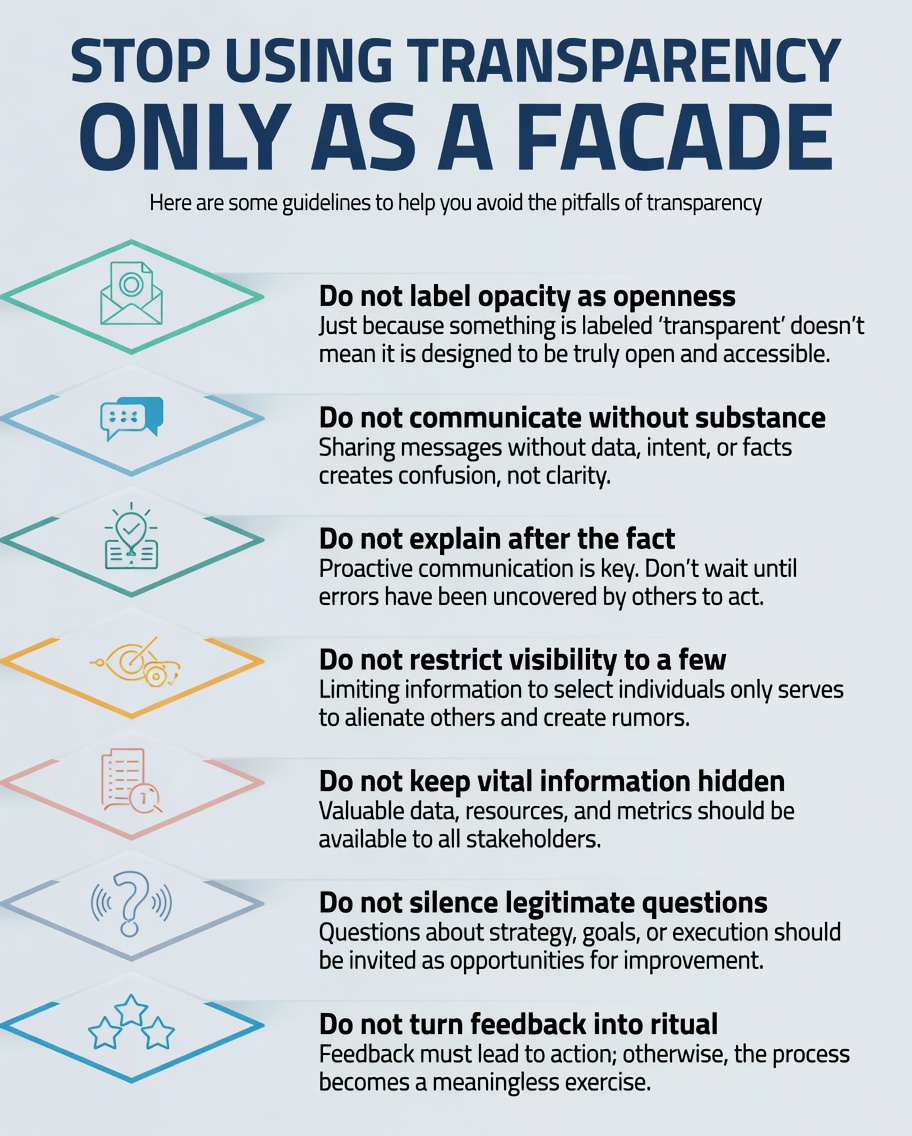
In the realm of high-stakes corporate law, transparency must be a mechanism of accountability, not a mask for insolvency. Utilizing openness merely as a facade—where companies “label opacity as openness” or provide “communication without substance”—undermines the trust of creditors and investors alike. This superficiality often signals a deeper structural failure or an attempt to shield assets from legitimate recovery efforts. As Justice Louis Brandeis once stated:
“Sunlight is said to be the best of disinfectants; electric light the most efficient policeman.” For asset recovery to be effective, disclosure must move beyond “rituals” and into actionable data. Only through genuine, proactive visibility can creditors pierce the corporate veil and ensure that wealth preservation is grounded in reality, not artifice.
The enduring relevance of Justice Louis Brandeis’s “sunlight” metaphor lies in its transition from theory to technology. For the modern creditor, “sunlight” isn’t just a metaphor for honesty—it represents the real-time data flow and forensic transparency required to prevent asset dissipation.
-
The “Disinfectant” Effect: In corporate law, opacity often hides “rot”—fraudulent transfers, commingled funds, or ghost subsidiaries. By demanding transparency, creditors “disinfect” the bankruptcy estate, ensuring that hidden liabilities are exposed before they can infect the recovery process.
-
The “Electric Light” as a Policeman: Today, this “electric light” is powered by AI-driven forensic accounting and global blockchain tracking. When a corporate structure is used as a facade, the law acts as the switch that turns the light on.
International Jurisdictions: Asset Tracing in a Globalized Economy
Wealth is rarely stationary. For creditors of multinational corporations, asset recovery often involves chasing capital through the British Virgin Islands (BVI), the European Union, or Singapore. The 2026 legal framework has seen significant updates, such as the EU Directive on Harmonising Insolvency Law, which grants practitioners better access to cross-border asset-tracing information.
In jurisdictions like the BVI, the courts have become increasingly hospitable to “Norwich Pharmacal” orders, which compel third parties (like banks) to disclose information about the movement of funds. Whether dealing with traditional real estate or non-traditional assets like cryptocurrency, the strategy remains the same: use the law of the jurisdiction where the asset sits, not just where the company is incorporated. This global chess game requires a network of elite law firms and local consulting partners who understand the nuance of international treaties and domestic enforcement.

Strategic Litigation and Injunctions: Freezing the Move
The most effective asset recovery strategy is often the one that prevents the asset from moving in the first place. Mareva Injunctions (freezing orders) are the “nuclear option” for creditors. By freezing a debtor’s assets globally, a creditor gains immense leverage in negotiations.
However, speed is of the essence. As legal scholar Jonathan Sacks noted, “Optimism is the belief that things will get better. Hope is the belief that, together, we can make things better.” For a creditor, “hope” is a well-drafted, ex-part application for a freezing order. This tactical maneuver forces the debtor to the bargaining table, often resulting in a settlement that avoids the years-long slog of a full bankruptcy proceeding. In 2026, the integration of real-time financial monitoring allows legal teams to act within hours of a suspected asset flight, turning “hope” into a mathematical certainty.
Conclusion: The Future of Wealth Preservation
Corporate bankruptcy does not have to mean a total loss for the creditor. By employing a combination of forensic accounting, jurisdictional maneuvering, and aggressive litigation, owners and engineers of financial strategy can recover significant value from seemingly empty estates. The key is proactivity. Waiting for the bankruptcy trustee to find your money is a losing game; hunting for it yourself is the hallmark of the elite creditor.
Wealth preservation in the face of corporate failure is not just about the law—it is about the resolve to protect what was built. As you navigate the complexities of 2026’s financial world, remember that the law provides the tools, but the strategy provides the victory.
References
-
BENNETT, Danielle. Getting ahead of Chapter 11 filings in 2026: A practical guide. Wolters Kluwer, 2026. [online]. Available at: https://www.wolterskluwer.com/en/expert-insights/getting-ahead-of-chapter-11-filings-in-2026-a-practical-guide
-
CLIFFORD CHANCE. International Regulatory Update: 30 March – 03 April 2026. London: Clifford Chance, 2026. [online]. Available at: https://www.cliffordchance.com/briefings/2026/04/IRU-30-March-3-April-2026.pdf
-
APPLEBY. 2026 Guide to Asset Tracing and Recovery in the British Virgin Islands. Road Town: Appleby Global, 2026. [online]. Available at: https://www.applebyglobal.com/publications/2026-guide-to-asset-tracing-and-recovery-in-the-british-virgin-islands/
-
DYKEMA. Bankruptcy And Restructuring Trends To Watch In 2026. Detroit: Dykema Gossett PLLC, 2026.
-
UNITED STATES. Bankruptcy Code: Title 11, United States Code. 2026 Edition. Washington D.C.: U.S. Government Publishing Office.
-
EUROPEAN UNION. Directive (EU) 2026/XXX on harmonising certain aspects of insolvency law. Official Journal of the European Union, 2026.
-
TATMAN LEGAL. The Role of Forensic Accounting in Bankruptcy Cases for Creditors. 2025. [online]. Available at: https://tatmanlegal.com/the-role-of-forensic-accounting-in-bankruptcy-cases-for-creditors/
-
OECD (2023). G20/OECD Principles of Corporate Governance. [online]. Paris: OECD Publishing. Available at: https://www.oecd.org/en/publications/g20-oecd-principles-of-corporate-governance-2023_ed592a12-en.html
-
WORLD BANK (2020). Stolen Asset Recovery (StAR) Initiative. [online]. Washington, D.C.: The World Bank Group. Available at: https://star.worldbank.org/
-
INTERNATIONAL MONETARY FUND. Corporate Governance and Insolvency: Global Best Practices 2026. [online]. Washington, D.C.: IMF, 2026. Available at: https://www.imf.org/en/publications/legal-aspects-of-corporate-governance
-
TRANSPARENCY INTERNATIONAL. The Corporate Transparency Index 2026: Annual Report. [online]. Berlin: Transparency International, 2026. Available at: https://www.transparency.org/en/publications/corporate-transparency-index-2026