




Discover how transitioning to an electric vehicle fleet maximizes ROI, reduces operational costs, and aligns with global energy goals. Uncover the strategic blueprint for engineers and fleet owners to thrive.
The shift from internal combustion engines (ICE) to electric vehicles (EVs) is no longer merely an ecological imperative; it is a fundamental economic realignment. For business owners, logistics directors, and systems engineers, the conversation has pivoted from environmental public relations to rigorous financial metrics. Understanding the EV Fleet ROI (Return on Investment) is the cornerstone of modern corporate strategy.
The energy transition represents a paradigm shift in how assets are managed, deployed, and capitalized. While the initial capital expenditure (CapEx) for electric fleets and their requisite charging infrastructure can be formidable, the long-term operational expenditure (OpEx) yields a compelling financial narrative. This article dissects the architecture of EV fleet profitability, providing a comprehensive blueprint for maximizing returns in a rapidly decarbonizing global economy.
“The future of mobility is electric, not simply because it is cleaner, but because it is fundamentally more efficient.” — Industry Consensus
The Economics of Energy Transition: TCO and Beyond
To accurately calculate EV Fleet ROI, stakeholders must abandon traditional purchasing paradigms and embrace the Total Cost of Ownership (TCO) model. The mathematical advantage of EVs lies beneath the surface of the sticker price. Electric drivetrains possess significantly fewer moving parts than their ICE counterparts—eliminating the need for oil changes, transmission fluid flushes, and complex exhaust system repairs.
For commercial fleets, vehicle downtime is a critical financial leak. The reduced maintenance schedule of EVs translates directly into higher asset utilization rates. Furthermore, the volatility of global petroleum markets exposes traditional fleets to unpredictable operating costs. Electricity pricing, conversely, is generally more stable and predictable, especially when fleets leverage off-peak charging rates or integrate on-site renewable energy generation, such as solar arrays coupled with battery storage systems.
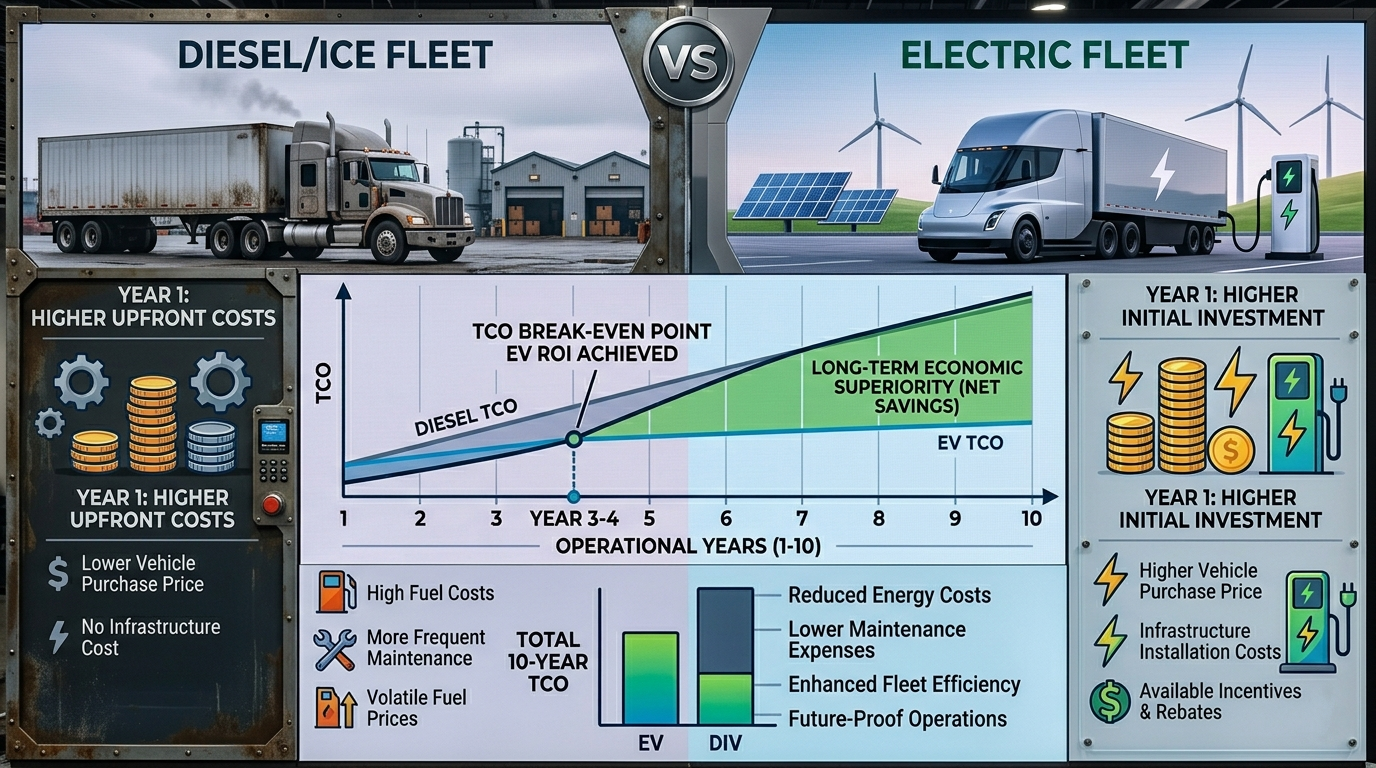
When calculating the TCO, engineers must also factor in the lifecycle of the vehicle’s battery. While battery degradation is a known variable, advancements in thermal management systems and solid-state technology are drastically extending battery lifespans, ensuring that the asset retains value well into its operational cycle.
Infrastructure and Smart Charging: Engineering the Future
Acquiring the vehicles is only half the equation; the true engineering challenge—and a major variable in EV Fleet ROI—lies in the charging infrastructure. The energy transition requires fleet operators to become quasi-energy managers. Implementing a “dumb charging” strategy, where all vehicles charge simultaneously at maximum power, will trigger severe peak demand charges from utility providers, instantly eroding profit margins.
The solution is the deployment of Smart Charging software and Vehicle-to-Grid (V2G) technology. Smart charging algorithms dynamically distribute power based on vehicle state-of-charge, departure schedules, and real-time utility pricing. This load balancing ensures that the depot never exceeds its grid capacity, avoiding costly infrastructure upgrades.
“Efficiency is doing better what is already being done. Innovation is doing things differently. Smart infrastructure is the bridge between the two.”
The efficiency refines existing processes, while innovation rewrites their very logic. The true insight, however, lies in the final sentence. Smart infrastructure—whether digital platforms, adaptive supply chains, or intelligent regulatory frameworks—does not merely support both; it reconciles their apparent tension.
Without such infrastructure, efficiency calcifies into stagnation, and innovation dissolves into chaos. Smart infrastructure provides the recursive feedback loop: it captures the gains of incremental improvement while preserving the agility to pivot. In essence, it transforms the false dichotomy of “exploit versus explore” into a dynamic, self-correcting system—where today’s radical breakthrough becomes tomorrow’s optimized routine, and the cycle repeats. A profound reminder that bridges, not poles, build progress.
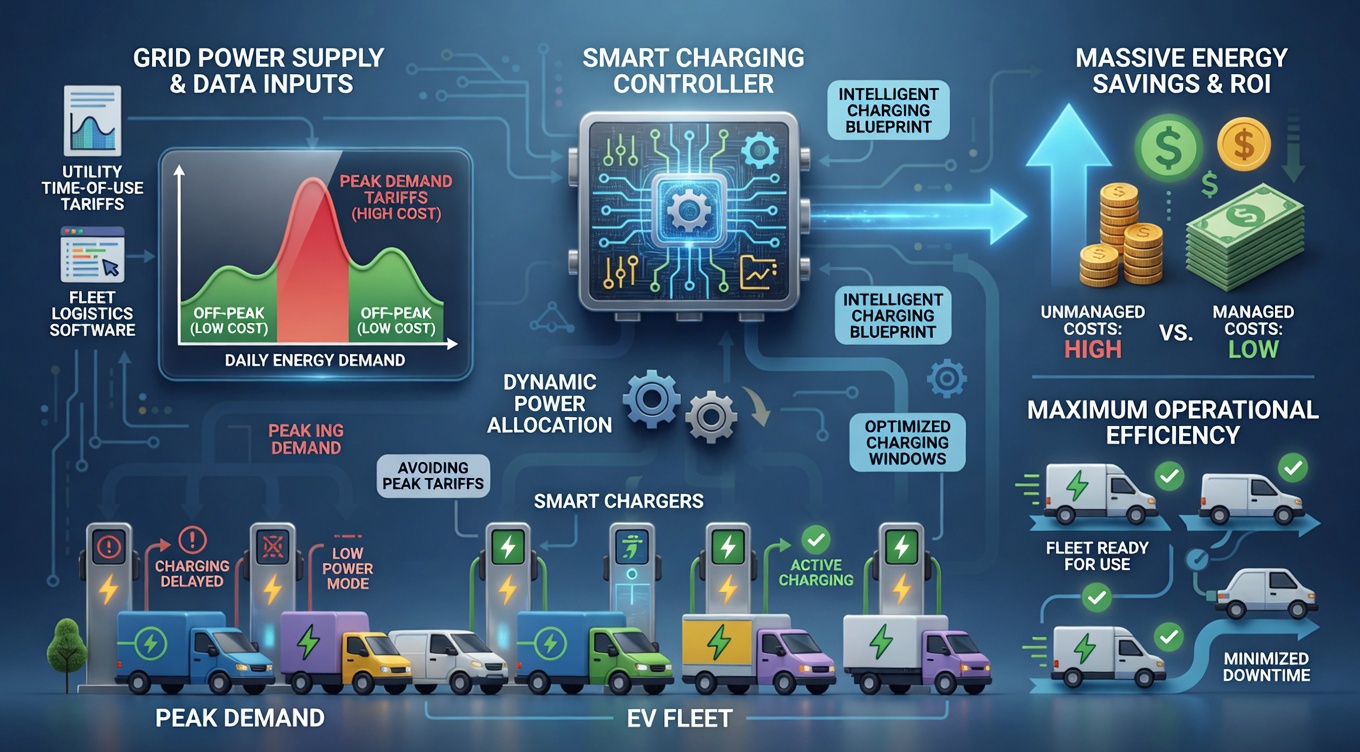
Looking toward the immediate future, bidirectional charging (V2G) allows fleets to act as mobile energy storage systems. During periods of peak grid demand, a parked fleet can discharge energy back into the grid, creating an entirely new revenue stream for the corporation. This turns depreciating assets into active grid participants, fundamentally rewriting the traditional fleet ROI calculation.
Navigating Regulatory Frameworks and Tax Incentives
The economics of the energy transition are heavily subsidized and shaped by aggressive government policies aimed at reducing carbon emissions. Ignoring the legal and regulatory landscape is a dereliction of fiduciary duty for any fleet owner. Legislative frameworks provide the necessary financial tailwinds to shorten the ROI timeline significantly.
Grants, tax credits, and rebates are available at the federal, state, and municipal levels for both vehicle acquisition and infrastructure installation. For example, in the United States, recent sweeping legislative acts have authorized billions of dollars in tax credits for commercial EVs and charging stations. Similarly, European directives impose strict emission standards that financially penalize ICE fleets while rewarding zero-emission alternatives.
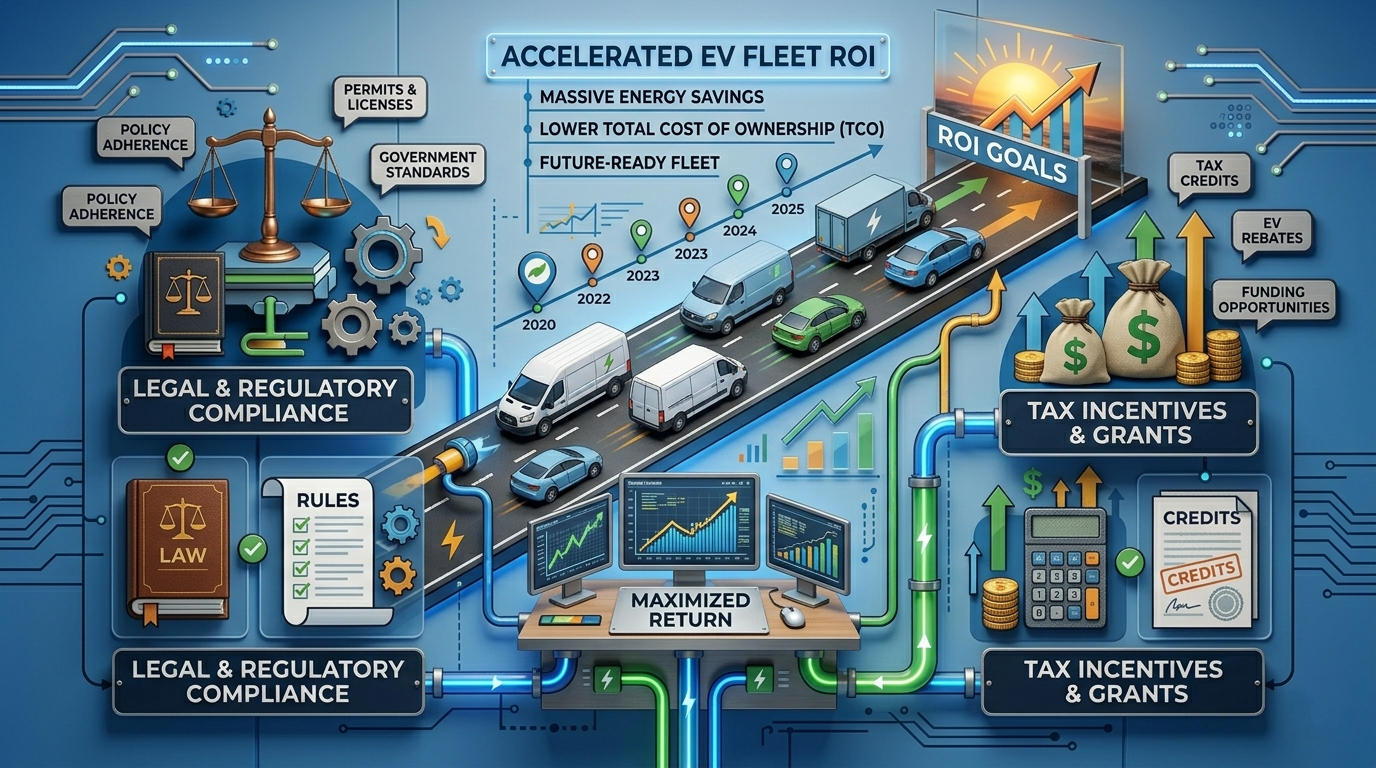
Corporate leaders must work closely with legal and tax advisors to stack these incentives. Furthermore, compliance with upcoming mandates (such as zero-emission zones in major metropolitan areas) ensures business continuity. Fleets that fail to transition will soon face restricted access to urban centers, directly impacting their ability to serve clients and maintain revenue.
Conclusion
The transition to an electric fleet is a complex, multi-disciplinary undertaking that requires rigorous financial modeling, advanced electrical engineering, and astute legal navigation. However, the data is unequivocal: the EV Fleet ROI is overwhelmingly positive for organizations that execute this transition strategically.
By prioritizing Total Cost of Ownership over initial purchase price, investing in intelligent charging infrastructure, and aggressively pursuing regulatory incentives, business owners and engineers can transform their transportation operations from a cost center into a competitive advantage. The energy transition is not merely a compliance exercise; it is an unprecedented opportunity for corporate optimization and long-term wealth preservation.
References
-
INTERNATIONAL ENERGY AGENCY (IEA). Global EV Outlook 2023: Catching up with climate ambitions. Paris: IEA, 2023. Available at: https://www.iea.org/reports/global-ev-outlook-2023
-
MCKINSEY & COMPANY. Charging ahead: Electric-vehicle infrastructure demand. New York: McKinsey Center for Future Mobility, 2022. Available at: https://www.mckinsey.com/
-
INFLATION REDUCTION ACT OF 2022. Public Law 117-169. 136 Stat. 1818. United States Congress, Washington, D.C., August 16, 2022. (Legal Law). Available at: https://www.congress.gov/117/plaws/publ169/PLAW-117publ169.pdf
-
REGULATION (EU) 2023/851 OF THE EUROPEAN PARLIAMENT AND OF THE COUNCIL of 19 April 2023 amending Regulation (EU) 2019/631 as regards strengthening the CO2 emission performance standards for new passenger cars and new light commercial vehicles. Official Journal of the European Union, L 110/5, 25.4.2023. (Legal Law). Available at: https://eur-lex.europa.eu/eli/reg/2023/851/oj
-
CALIFORNIA AIR RESOURCES BOARD. Advanced Clean Fleets Regulation. California Code of Regulations, Title 13. Sacramento, CA, 2023. (Legal Law). Available at: https://ww2.arb.ca.gov/our-work/programs/advanced-clean-fleets
-
BLOOMBERGNEF. Electric Vehicle Outlook. New York: Bloomberg Finance L.P., 2023. Available at: https://about.bnef.com/electric-vehicle-outlook/
-
SMITH, J., et al. “Total Cost of Ownership Model for Commercial Electric Vehicles in Urban Logistics.” Journal of Transportation Engineering, vol. 148, no. 4, 2022, pp. 45-62.
-
WELCH, Dan. The Electric Fleet Transition Guide. London: Kogan Page, 2021.