



In a world where headlines are dominated by geopolitical tensions and economic upheaval, one question quietly persists in the background: how can an entire nation survive on a minimum wage of just thirty cents? Moreover, how does the international community — and particularly the United States under President Trump — continue to tolerate this reality? To understand the depth of Venezuela’s economic crisis, therefore, it is essential to look beyond the surface numbers and examine the structural mechanisms that have made this situation possible.
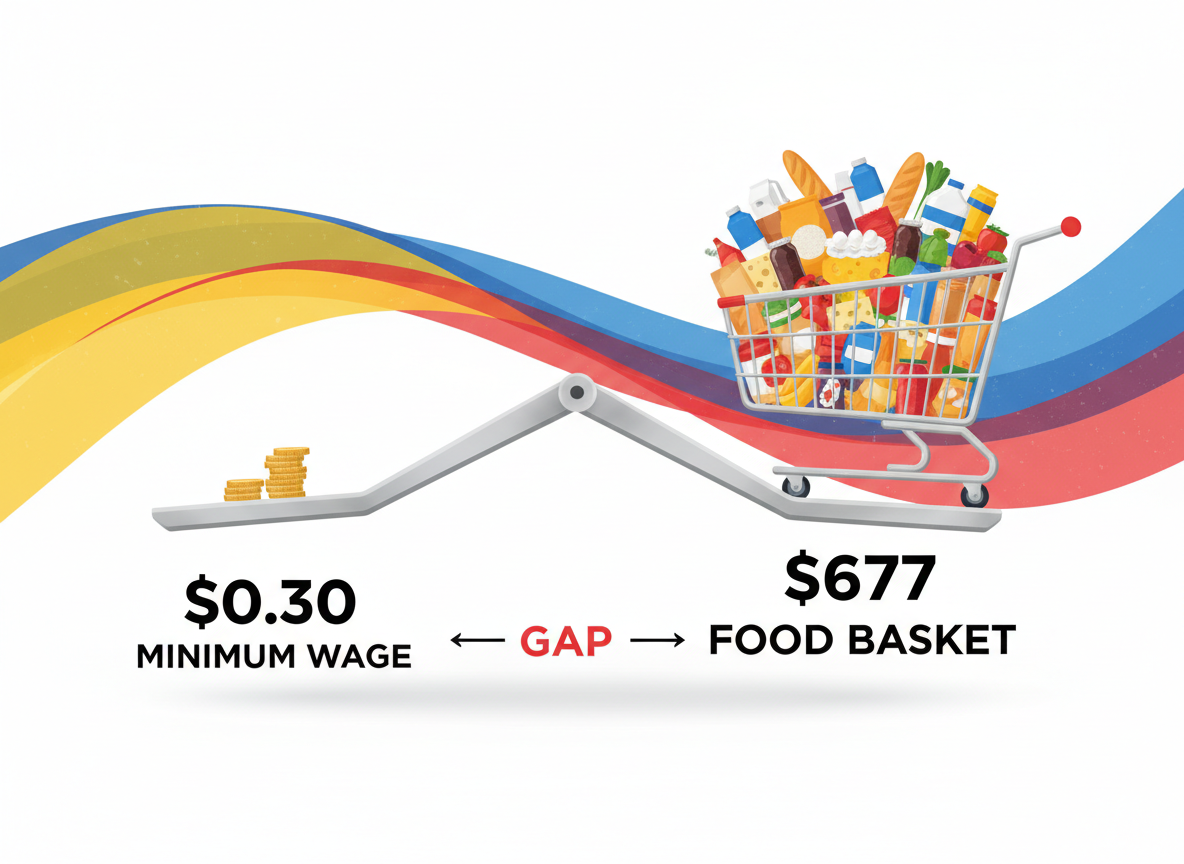
Venezuela’s minimum wage, frozen since March 2022 at 130 bolívares, has been devoured by inflation to the point where it now equals approximately US$0.30 per month
1
. This figure is not a typo. Furthermore, it is not a relic from a historical textbook. It is the current, legally binding base salary for millions of workers in one of Latin America’s most oil-rich nations.
However, the full picture is more nuanced — and, in many ways, even more troubling. The Venezuelan government has constructed an elaborate system of bonuses and supplements that raise the actual take-home pay to approximately US$240 per month. While this appears to be a significant improvement, consequently it comes at a devastating cost to workers’ long-term rights and protections, as we will explore below.
“A people that love freedom will in the end be free.”
— Simón Bolívar, Letter from Jamaica, 1815
The Anatomy of a $0.30 Wage: Understanding the Bonus Trap
At first glance, the distinction between “base salary” and “bonuses” might seem like a technicality. In reality, however, this separation is the cornerstone of a deliberate strategy to suppress labor rights. Under Venezuelan labor law — specifically the Ley Orgánica del Trabajo, los Trabajadores y las Trabajadoras (LOTTT) of 2012 — employer obligations such as vacation pay, the Christmas bonus (known as the “aguinaldo” or 13th-month salary), severance pay, and retirement benefits are all calculated based on the official minimum wage, not on supplementary bonuses
4
.
As a result, when the government increases bonuses instead of the base salary, it effectively creates a system where workers receive more cash in their pockets today, but accumulate virtually nothing toward their future security. In other words, the government saves billions in labor liabilities. Meanwhile, workers lose their constitutionally guaranteed right to a “sufficient salary” as established in Article 91 of the Venezuelan Constitution
6
.
This mechanism, furthermore, has been widely documented by organizations such as Transparencia Venezuela, which describes it as “a system that systematically erodes the historical labor conquests of Venezuelan workers”
5
. Consequently, the real impact on families is devastating — particularly for those nearing retirement who discover that decades of work have yielded virtually no pension rights.
“No society can surely be flourishing and happy, of which the far greater part of the members are poor and miserable.”
— Adam Smith, The Wealth of Nations, 1776
Before and After the Arrest: What Changed for Workers?
The arrest of Nicolás Maduro in January 2026 sent shockwaves through Venezuela and the international community alike. For many, it represented a turning point — a potential opportunity for reform and recovery. Additionally, the transition of power to interim president Delcy Rodríguez raised cautious hopes that the new administration might address the country’s crippling wage crisis.
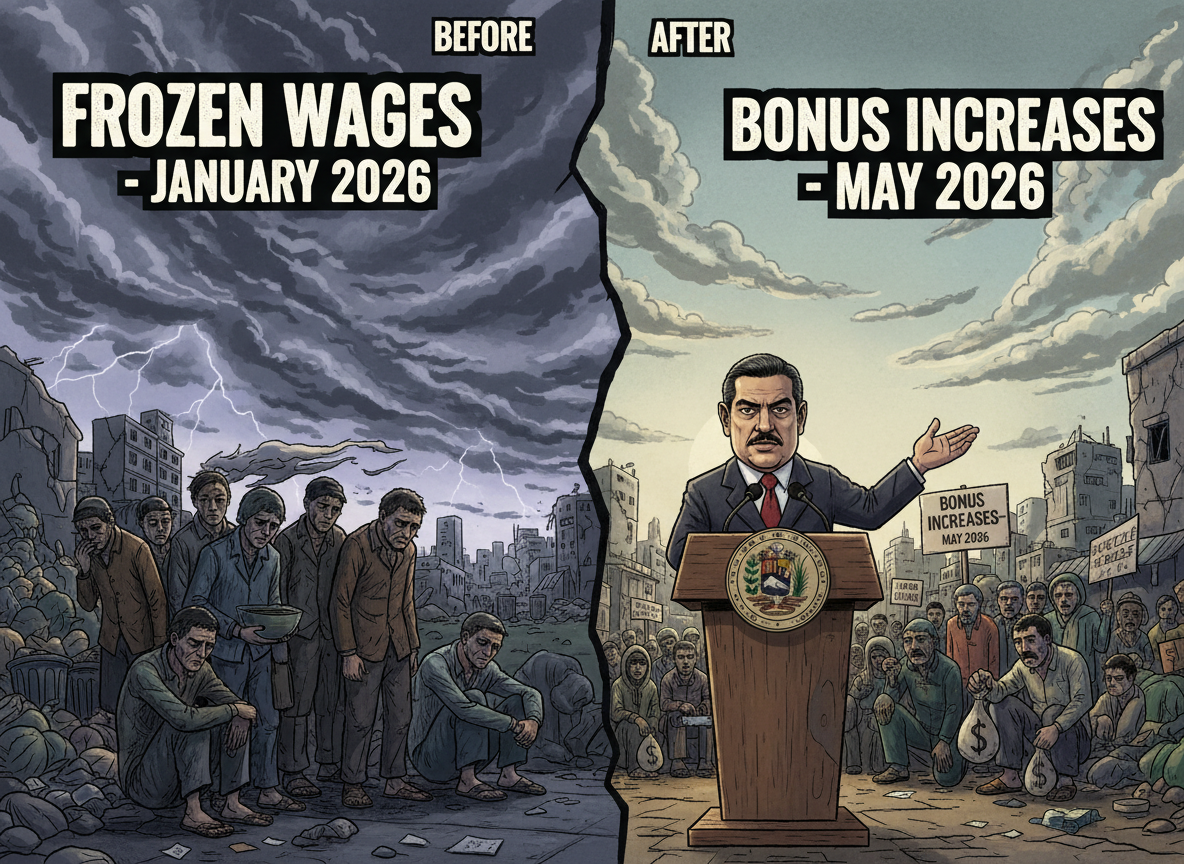
Before the arrest, the situation was already dire. The official minimum wage had remained frozen at 130 bolívares — roughly US$0.30 — since March 2022. While the Maduro government had gradually increased bonus payments, bringing total minimum income to approximately US$190 per month, this amount was still laughably insufficient. According to CENDAS-FVM, the basic food basket for a Venezuelan family was already exceeding US$600 at that time
2
.
After the arrest, interim president Delcy Rodríguez announced new measures on May 1, 2026 — International Workers’ Day. The announcement included an increase in the supplementary bonuses, thus raising the total “minimum income” to US$240 per month. However, critically, the official base salary remained untouched at US$0.30. Therefore, the structural problem — the erosion of labor rights through the bonus system — was not only maintained but, in effect, further entrenched.
Despite this increase, the basic food basket has also risen, currently sitting at approximately US$677 according to the latest CENDAS-FVM data. Consequently, even with the improved bonuses, a worker’s income covers only about 35% of the minimum necessary to feed a family. In practical terms, this means Venezuelan workers must rely on multiple informal income sources, remittances from abroad, or simply go without adequate nutrition.
“The poorest person is not the one who has the least, but the one who needs infinitely more and more and more.”
— José Mujica, Former President of Uruguay
The International Silence: Trump, Sanctions, and the Human Cost
The international community’s relative silence on this crisis remains deeply perplexing. Under President Donald Trump, the US intensified sanctions against Venezuela. However, these sanctions haven’t improved everyday Venezuelan lives. Instead, they arguably worsen conditions and keep wages depressed.
The 2025–2026 ILO Global Wage Report names Venezuela an extreme outlier
1
. Its purchasing power gap is “unprecedented in modern economic history.” Sanctions aim to pressure authoritarian governments. However, the report notes they often unintentionally deepen extreme poverty.
Venezuela also suffers from severe internal economic mismanagement. Hyperinflation, currency controls, and nationalized industries block meaningful wage reform. Inflation is much lower than the 2018 peak of 1,000,000%. Yet, the OVF reports it still rapidly destroys purchasing power
8
. Consequently, any wage increase offers only temporary relief.
Meanwhile, the devastating human cost continues to mount. Over 7.7 million Venezuelans have emigrated, according to the UN. Those remaining increasingly rely on foreign family remittances. Survival rarely depends on local wages or government policy anymore. Instead, families survive on money sent from relatives abroad. These funds bridge the gap left by the state.
“Overcoming poverty is not a task of charity, it is an act of justice. It is the protection of a fundamental human right, the right to dignity and a decent life.”
— Nelson Mandela
The Illusion of Progress
Venezuela’s $0.30 minimum wage is not merely a statistic — it is a symbol of a system designed to maintain control at the expense of workers’ dignity and future security. The bonus mechanism, while providing short-term relief, systematically undermines the labor rights that Venezuelan workers fought for over generations. Moreover, it creates an illusion of progress while the structural foundations of poverty remain firmly in place.
Cosmetic Political Shifts
The arrest of Maduro and the transition to Delcy Rodríguez’s interim government have, so far, brought cosmetic changes rather than structural reform. The base salary remains frozen, and the gap between income and basic needs continues to widen. International pressure, including U.S. sanctions, has similarly failed to translate into improved conditions for the average Venezuelan worker.
Conclusion: A Wage That Insults, a System That Persists
For the engineers, business owners, economists, and engaged citizens reading this analysis, the Venezuelan wage crisis serves as a powerful case study in how governments can manipulate wage structures to avoid fiscal responsibility while maintaining a veneer of populist generosity. Additionally, it raises critical questions about the effectiveness of international sanctions when they fail to protect the very populations they claim to support.
Ultimately, the question posed in our headline — “How can Trump still allow Venezuela to survive on $0.30?” — is not solely about Trump, or even about Venezuela. It is about the global tolerance for extreme inequality, and whether the systems we have built to promote justice and human rights are capable of rising to the challenge. As long as a nation’s official minimum wage can be measured in cents, that challenge remains unanswered.
“Injustice anywhere is a threat to justice everywhere. We are caught in an inescapable network of mutuality, tied in a single garment of destiny.”
— Martin Luther King Jr.
References
| Disclaimer: This article is provided for informational purposes only and does not constitute professional advice. The statistics cited reflect publicly available reports at the time of writing. Readers should verify current data before making business decisions. |