



Introduction
In less than a decade, a single pharmaceutical product has managed to disrupt not just the healthcare industry, but also the food sector, aviation, cosmetics, and even national economies. Ozempic, the brand name for semaglutide, was initially developed to treat type 2 diabetes. However, its remarkable weight loss side effects have turned it into one of the most transformative drugs of the 21st century. Consequently, entire industries are now scrambling to adapt to a world where appetite suppression comes in a weekly injection.
Furthermore, this is not merely a pharmaceutical story. It is, above all, an economic and cultural phenomenon that touches Wall Street valuations, supermarket revenues, airline fuel costs, and the very concept of beauty standards. As a result, investors, policymakers, and business leaders worldwide are asking the same question: what happens when millions of people simply stop eating as much?
In addition, the Ozempic weight loss pen has sparked a fierce debate about accessibility, inequality, and the commodification of health. Throughout this article, we will explore how this small injection pen has become, arguably, the most disruptive force in global markets since the smartphone.
“What industries is Ozempic disrupting and how does GLP-1 affect the global economy?”
— Trending Google Search Query, 2025–2026
What Is Ozempic and How Does GLP-1 Actually Work?
The Danish pharmaceutical giant Novo Nordisk created a molecule that mimics a natural gut hormone — and accidentally launched a revolution.
What Is Ozempic and Who Created It?
Ozempic is a brand name for semaglutide, a GLP-1 receptor agonist manufactured by Novo Nordisk, a Danish pharmaceutical company founded in 1923. Initially, the drug received FDA approval in 2017 exclusively for the management of type 2 diabetes. Nevertheless, clinical trials quickly revealed that patients were also losing significant amounts of weight — sometimes 15% or more of their body mass
2
.
Moreover, Novo Nordisk subsequently developed Wegovy, a higher-dose version of semaglutide specifically approved for chronic weight management. As a result, the company’s market capitalization surged to over $570 billion by 2024, briefly making it Europe’s most valuable company
1
.
The Pen That Changed GDP
In Denmark, Novo Nordisk’s success has been so extraordinary that the company now accounts for roughly half of the Danish stock market’s total value. Accordingly, economists have noted that semaglutide sales alone contributed approximately 0.5 percentage points to Denmark’s GDP growth in 2023. This means a single drug is measurably moving an entire nation’s economic output — an unprecedented phenomenon in modern pharmaceutical history.
“The greatest danger in times of turbulence is not the turbulence — it is to act with yesterday’s logic.”
— Peter Drucker, The Effective Executive
What Is GLP-1 and How Does Ozempic Work?
GLP-1 stands for glucagon-like peptide-1, a naturally occurring hormone produced in the small intestine after eating. This hormone signals the brain to feel full, slows gastric emptying, and stimulates insulin secretion. Essentially, semaglutide mimics this hormone but remains active in the body for much longer — approximately seven days, which is why it only requires a weekly injection.
Therefore, patients not only experience reduced appetite, but they also report diminished cravings for sugar, alcohol, and even addictive behaviors. Additionally, emerging research suggests GLP-1 agonists may have neuroprotective properties, potentially benefiting conditions such as Alzheimer’s and Parkinson’s disease
6
.
The Cultural Phenomenon and the Study That Changed Everything
Hollywood celebrities, TikTok influencers, and a landmark cardiovascular trial turned Ozempic into the most talked-about drug on the planet.
The Cultural Phenomenon and Aesthetic Use
Before long, Ozempic transcended its medical origins and became a cultural icon. Celebrities in Hollywood, social media influencers, and wealthy individuals began using semaglutide off-label purely for cosmetic weight loss. Consequently, the phrase “Ozempic face” — describing the gaunt, hollowed facial appearance resulting from rapid weight loss — entered the popular lexicon. Similarly, “Ozempic body” became a trending topic across platforms like TikTok, Instagram, and X (formerly Twitter).
In the meantime, this aesthetic-driven demand created severe drug shortages worldwide. Patients who genuinely needed semaglutide for diabetes management found themselves unable to obtain prescriptions. Thus, regulators in multiple countries were forced to issue warnings and restrict off-label prescriptions
4
.
The Study That Changed Everything: Preventive Medicine
However, the true game-changer arrived in 2023 with the publication of the SELECT trial. This landmark study, published in the New England Journal of Medicine, demonstrated that semaglutide reduced the risk of major cardiovascular events — heart attacks, strokes, and cardiovascular death — by 20% in obese patients without diabetes
3
.
As a consequence, this study reframed obesity from a lifestyle choice into a treatable medical condition with serious cardiovascular implications. Furthermore, it provided the scientific justification for insurance companies and national health systems to begin covering GLP-1 medications. In other words, the SELECT trial transformed semaglutide from a “vanity drug” into a genuine life-saving intervention.
“The measure of intelligence is the ability to change.”
— Albert Einstein
The Impact in Denmark
The economic ripple effects have been extraordinary for Denmark specifically. Novo Nordisk now employs over 55,000 people, and the company’s tax contributions have allowed Denmark to increase public spending without raising taxes. In fact, some Danish economists have coined the term “Novo Nordisk economy” to describe the disproportionate influence a single pharmaceutical firm has on the country’s fiscal health. In addition, related industries — from logistics to real estate near Novo Nordisk facilities — have experienced remarkable growth. Nonetheless, this concentration of economic power in one company also raises concerns about vulnerability should demand decline.
How Ozempic Is Disrupting Entire Industries Worldwide
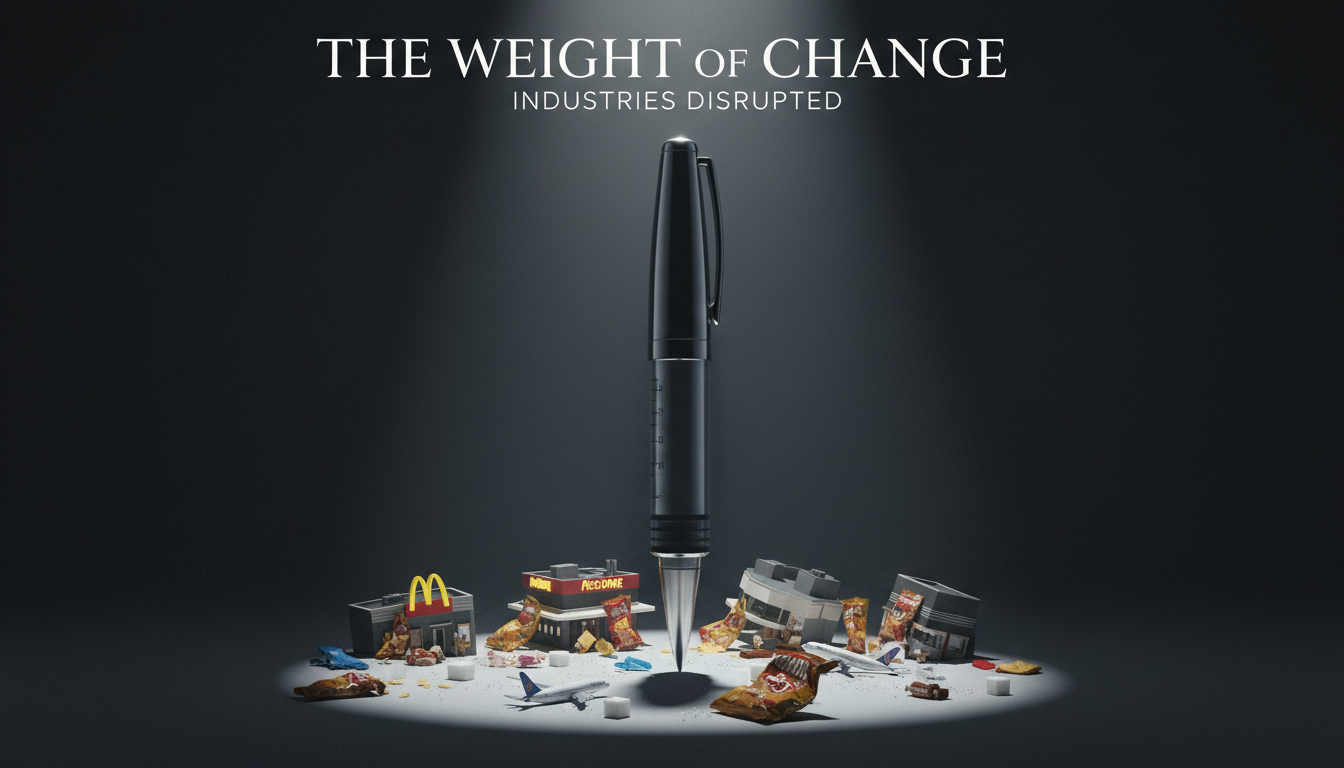
From McDonald’s to airline fuel budgets, the appetite-suppression revolution is sending shockwaves through sectors that never expected a pill to threaten profits.
Threat to the Food and Fast Food Industry
Perhaps the most visible disruption has occurred in the food industry. According to Morgan Stanley, if GLP-1 drugs are adopted by even 7% of the U.S. population by 2035, total caloric consumption could decline by approximately 1.5–2.5% nationally
8
. Consequently, major food companies such as Nestlé, PepsiCo, and Mondelez have already acknowledged this threat in their annual reports.
Similarly, fast food giants are feeling the pressure. Walmart has reported measurable reductions in grocery purchases among customers filling GLP-1 prescriptions. Meanwhile, restaurant chains are beginning to introduce smaller portion sizes and “GLP-1 friendly” menu items. In essence, the Ozempic weight loss pen is achieving what decades of public health campaigns could not — genuinely reducing caloric intake at a population level.
Impact on Sugar, Aviation, and Addictions
Beyond food, the ripple effects extend in surprising directions. For instance, the sugar industry faces existential questions as GLP-1 users report dramatically reduced sweet cravings. Moreover, airlines are analyzing potential fuel savings: if the average passenger weight decreases by even a few pounds across millions of flights, aggregate fuel costs could drop by hundreds of millions of dollars annually. Therefore, companies like Delta and United have quietly begun modeling GLP-1 adoption scenarios.
Equally remarkable are the reports from addiction specialists. Early research suggests that GLP-1 agonists may reduce cravings for alcohol, nicotine, and even gambling. Accordingly, this has opened an entirely new frontier of research into the neuroscience of compulsive behavior, positioning semaglutide not just as a weight loss drug, but as a potential tool for treating addiction.
“Only when the tide goes out do you discover who’s been swimming naked.”
— Warren Buffett
Sectors Profiting from the “Ozempic Wave”
On the other hand, not all industries are suffering. Several sectors are experiencing a significant boom thanks to the GLP-1 revolution. The athleisure and fitness apparel market is growing as newly slim consumers seek updated wardrobes. In addition, plastic surgery and dermatology practices report increased demand for body contouring procedures to address excess skin. Similarly, the medical aesthetics industry — including treatments like CoolSculpting and skin tightening — has seen revenue increases of 15–25% in markets with high GLP-1 adoption.
Furthermore, the pharmaceutical industry itself is booming. Companies developing next-generation obesity drugs, companion diagnostics, and personalized nutrition plans are attracting billions in venture capital. As a result, the obesity therapeutics market is projected to exceed $150 billion by 2030 — up from less than $6 billion in 2022.
The Pen War: Ozempic vs. Mounjaro
Meanwhile, the competition is intensifying rapidly. Eli Lilly’s Mounjaro (tirzepatide), a dual GIP/GLP-1 receptor agonist, has demonstrated even greater weight loss results — up to 22.5% of body weight in clinical trials. Consequently, this has ignited a fierce pharmaceutical “pen war.” While Novo Nordisk dominates current market share, Eli Lilly is aggressively expanding production capacity. In turn, this competition is driving innovation, lowering future costs, and accelerating global access. Nevertheless, both companies face the challenge of scaling manufacturing to meet unprecedented demand — a race that involves billions of dollars in factory construction worldwide.
The Global Market: Countries, Costs, Patents, and the Future
A worldwide race for production dominance, a parallel market fueled by desperation, and the patent cliff that could change everything for patients.
Every Country’s Role in Global Production
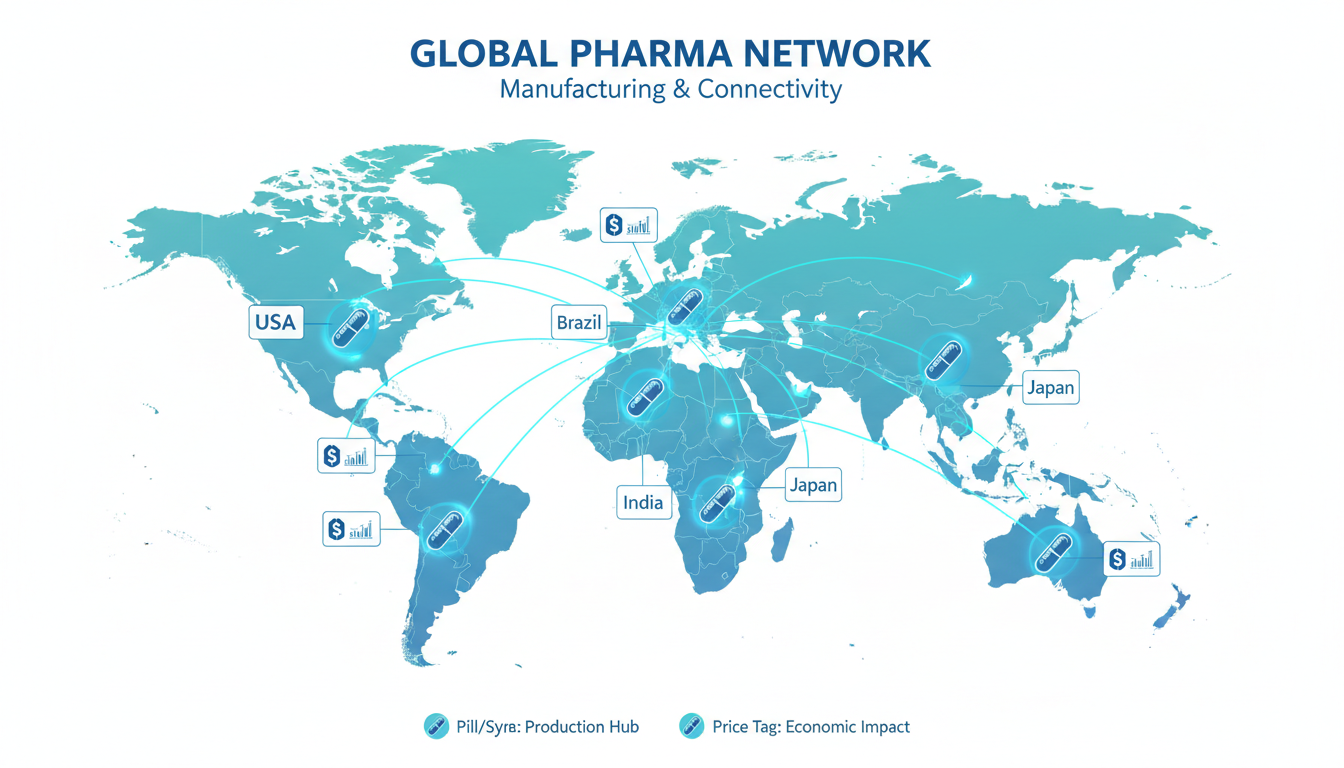
The production of GLP-1 drugs involves a complex global supply chain. Currently, the top 10 countries playing critical roles in manufacturing, distribution, and consumption include:
| # | Country | Role |
|---|---|---|
| 01 | Denmark 🇩🇰 | HQ & primary manufacturing hub (Novo Nordisk) |
| 02 | United States 🇺🇸 | Largest consumer market; Eli Lilly HQ; R&D leader |
| 03 | China 🇨🇳 | Growing domestic production; major API supplier |
| 04 | Germany 🇩🇪 | EU regulatory hub; key distribution center |
| 05 | India 🇮🇳 | Generic manufacturing powerhouse; future generics leader |
| 06 | Japan 🇯🇵 | Advanced clinical trials; strong regulatory framework |
| 07 | Brazil 🇧🇷 | Largest Latin American market; high parallel market activity |
| 08 | France 🇫🇷 | EU distribution; strong public health system integration |
| 09 | South Korea 🇰🇷 | Biosimilar development; aesthetic medicine adoption |
| 10 | United Kingdom 🇬🇧 | NHS integration; public health policy leadership |
Parallel Market and Cost by Country
The cost disparity across nations has created a thriving — and often dangerous — parallel market. In the United States, a monthly supply of Ozempic costs approximately $900–$1,200 without insurance. Meanwhile, in Denmark, subsidized pricing brings this to around $200–$350. In Brazil, however, the monthly cost ranges from $300–$500, which represents a significant burden given average incomes
5
.
| Country | Monthly Cost (USD) | Parallel Market Risk |
|---|---|---|
| 🇺🇸 USA | $900–$1,200 | Medium |
| 🇩🇰 Denmark | $200–$350 | Low |
| 🇨🇳 China | $250–$450 | High |
| 🇩🇪 Germany | $180–$300 | Low |
| 🇮🇳 India | $100–$200 | High |
| 🇯🇵 Japan | $150–$280 | Medium |
| 🇧🇷 Brazil | $300–$500 | High |
| 🇫🇷 France | $180–$320 | Low |
| 🇰🇷 South Korea | $200–$380 | Medium |
| 🇬🇧 UK | $220–$350 | Low |
Therefore, in countries like Brazil, China, and India, where costs are prohibitive relative to average wages, counterfeit and compounded versions have flooded the market. In particular, unregulated compounding pharmacies have begun selling semaglutide at steep discounts, raising serious safety concerns. Accordingly, the WHO and national regulators have issued multiple warnings about counterfeit GLP-1 products
7
.
“It is not the strongest of the species that survives, nor the most intelligent, but the one most responsive to change.”
— Charles Darwin
The Expiration of the Patent and Generics Worldwide
Looking ahead, Novo Nordisk’s core semaglutide patents are expected to begin expiring around 2031–2033 in major markets. Once this happens, generic manufacturers — particularly those in India, China, and South Korea — are poised to produce biosimilar versions at a fraction of the current cost. As a result, analysts project that the price of semaglutide could drop by 70–85% within two years of patent expiration. However, because semaglutide is a biologic (a complex peptide, not a simple chemical molecule), producing high-quality biosimilars will require sophisticated manufacturing capabilities.
In turn, this patent cliff represents both a massive opportunity for global health equity and a significant threat to Novo Nordisk’s revenue stream. Moreover, Eli Lilly, Pfizer, Amgen, and several Chinese biotech firms are all developing their own GLP-1 or next-generation obesity drugs, ensuring that competition will only intensify.
How to Position Yourself for the Future
For investors, business owners, and professionals seeking to navigate this transformative period, several strategies emerge. First, understanding which sectors face disruption — food, beverage, sugar, fast food, bariatric surgery — is essential for risk management. Second, identifying growth opportunities in adjacent sectors — athleisure, medical aesthetics, digital health platforms, personalized nutrition — can provide significant upside.
Third, and most importantly, staying informed about regulatory changes and patent timelines will be crucial for timing investments. In conclusion, the Ozempic weight loss pen is not just a medical device — it is a catalyst for one of the most significant economic realignments of the early 21st century. Those who understand its implications today will be best positioned to thrive tomorrow.
Conclusion
To summarize, the story of Ozempic is far more than a pharmaceutical success. It is, fundamentally, a story about how a single innovation can reshape entire economies, challenge established business models, and redefine cultural norms. From Denmark’s GDP to America’s fast food chains, from Brazil’s parallel drug markets to India’s generic manufacturing plants, the GLP-1 revolution is touching every corner of the global economy.
Ultimately, whether you are a healthcare professional, an investor, a policymaker, or simply a curious reader, understanding the Ozempic weight loss pen phenomenon is essential. After all, in a world where appetite itself can be switched off with a weekly injection, nothing — not food, not fashion, not finance — will ever be quite the same again.
References
Independent research and analysis covering health, technology, and global economics. Our team delivers evidence-based reporting on the trends reshaping modern life.