



Introduction: The Infrastructure of Intelligence
The global economy is currently undergoing a tectonic shift. While the previous decade was primarily defined by software-as-a-service, the current era is fundamentally defined by the physical hardware that powers intelligence. Data centers have evolved from mere storage warehouses into sophisticated “AI Factories.” Consequently, investors are no longer looking for clicks; instead, they are looking for kilowatts.
This transformation is not happening in isolation. On the contrary, it is deeply interconnected with advancements in semiconductor manufacturing, energy grid modernization, and the exponential growth of machine learning workloads. As a result, the infrastructure underpinning artificial intelligence has become the single most critical investment thesis of our generation.
“The limit of our growth is no longer software code, but the physical reality of power grids and cooling systems.”
— Leading Infrastructure Analyst— Gartner Infrastructure Report, 2024
As we transition into this new paradigm, identifying high-yield opportunities requires a deep understanding of the synergy between capital markets and thermal engineering. Moreover, regulatory frameworks such as the CHIPS and Science Act of 2022 have accelerated domestic investment in semiconductor fabrication, thereby strengthening the entire data center supply chain.
1
The New Utility: Data Centers as Digital Oil Refineries
Data centers are, in many ways, the refineries of the 21st century. They take “raw” electricity and data, processing them through massive H100 GPU clusters to produce “refined” intelligence. This transformation is creating a high-yield environment for Real Estate Investment Trusts (REITs) and specialized infrastructure funds. Additionally, the capital expenditure required for these facilities has created significant barriers to entry, which in turn protects the margins of established players.
Furthermore, the demand for low-latency inference means that edge data centers are becoming increasingly valuable. These smaller, localized hubs allow AI models to respond in real-time, which is essential for autonomous systems and high-frequency trading algorithms. Consequently, the valuation of these facilities is decoupled from traditional real estate metrics, moving instead toward “Compute-per-Square-Foot” efficiency.
1
The financial implications are staggering. According to industry projections, global data center capital expenditures will exceed $350 billion annually by 2028. This represents a compound annual growth rate of approximately 18%, which significantly outpaces both the broader real estate sector and the technology sector as a whole. Therefore, investors who position themselves early in this cycle stand to benefit from extraordinary returns.
“He who would learn to fly one day must first learn to stand and walk and run and climb and dance; one cannot fly into flying.”
— Friedrich Nietzsche— Also sprach Zarathustra
Similarly, the AI revolution cannot “fly” without the grounded, heavy-duty architecture of massive data halls. Without these physical foundations, even the most advanced algorithms remain theoretical constructs. In other words, software innovation is ultimately bounded by hardware capability.
Algorithmic Arbitrage: Trading the Infrastructure Supercycle
The volatility of the tech sector provides a fertile ground for sophisticated trading algorithms. High-yield opportunities are frequently found in the “picks and shovels” of the AI gold rush—companies specializing in power management, liquid cooling, and semiconductor fabrication. As a consequence, institutional investors have significantly increased their allocations to these sub-sectors.
Institutional investors are utilizing predictive algorithms to analyze energy consumption patterns of major data center hubs. By tracking utility grid stress and cooling efficiency, these traders can predict quarterly earnings for infrastructure providers before they are publicly disclosed. This “Physical-Data Arbitrage” is the new frontier of high-frequency trading. Moreover, the integration of satellite imagery analysis and real-time power grid data has created an entirely new category of alternative data.

The integration of AI within the trading algorithms themselves creates a recursive loop of efficiency. In essence, the machine is not just the product being traded; the machine is the architect of the market itself. This technological sector projection indicates a sustained 25% CAGR for AI-integrated infrastructure through 2030.
4
Additionally, regulatory developments have created new compliance requirements that simultaneously increase operational costs and create competitive moats for well-capitalized operators. The European Union’s AI Act, for instance, mandates specific infrastructure standards that only the largest providers can economically meet.
2
As a result, market concentration is expected to increase, which paradoxically may benefit investors through higher per-share earnings among dominant players.
“The machine is not just the product; the machine is the architect of the market.”
— Senior Quantitative Engineer— Global Finance Journal, 2023
Thermal Dynamics and Efficiency: The Hidden Yield Multiplier
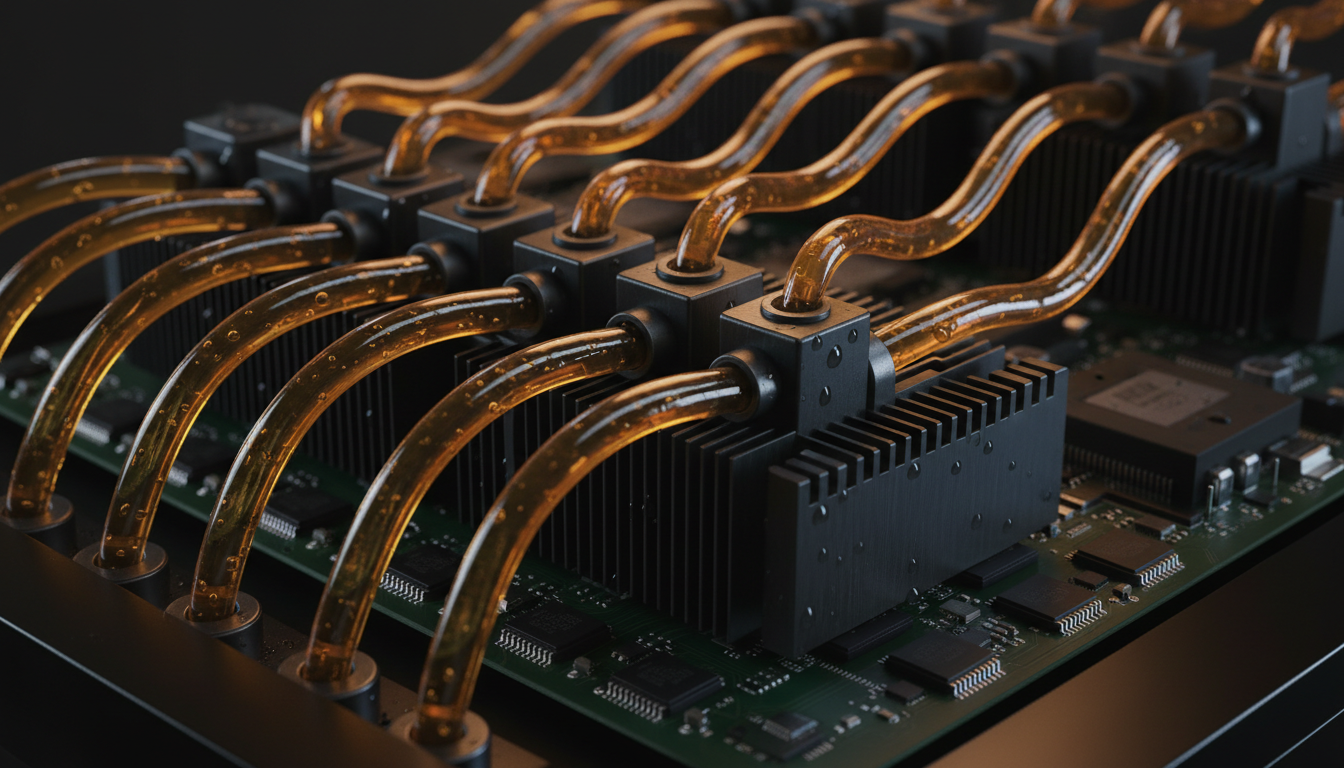
In the world of high-performance computing, heat is the enemy of profit. Therefore, companies that master thermal management are the ones capturing the highest margins. Traditional air cooling is insufficient for the intense heat densities of modern AI clusters; consequently, liquid cooling is no longer a luxury—it is a mandatory requirement for high-yield performance.
Investors must look closely at the “Power Usage Effectiveness” (PUE) ratios. A lower PUE signifies a more efficient center, which directly translates to higher dividends for stakeholders. Furthermore, the Energy Policy Act of 2005 established foundational energy efficiency standards that continue to influence data center design and operation today.
5
Firms like Vertiv and Schneider Electric have seen unprecedented growth because they provide the vital organs for these digital monoliths.
2
The economic calculus is straightforward yet compelling. For every 0.1 reduction in PUE, a large-scale data center operator can save approximately $2 million annually per facility. When multiplied across a portfolio of dozens of facilities, these efficiency gains translate directly into billions of dollars in enhanced shareholder value. Hence, thermal engineering is not merely a technical consideration; it is a primary financial lever.
“We are at the beginning of a new industrial revolution.”
— Jensen Huang, CEO of NVIDIA— GTC 2024 Keynote
This revolution is not just about thinking; it is fundamentally about the physical thermodynamics of processing that thought into reality. As Sam Altman observed, the next generation of AI breakthroughs will be constrained not by algorithmic innovation, but by the availability of physical compute infrastructure. Therefore, the investment opportunity lies squarely at the intersection of engineering excellence and financial engineering.
Conclusion: The Permanent Frontier
The AI Gold Rush is not a fleeting trend; it is the permanent relocation of the world’s economic center of gravity toward digital infrastructure. By focusing on data centers, investors are positioning themselves at the intersection of real-world utility and futuristic growth. While the “Gold” is the AI, the “Mine” is the data center—and the mine owners are the ones who will ultimately control the wealth of the next century.
In conclusion, the convergence of thermal engineering, algorithmic trading, and regulatory frameworks has created a uniquely favorable environment for infrastructure investment. Furthermore, the structural demand for compute capacity shows no signs of abating. On the contrary, every major technology company has announced plans to dramatically increase their data center footprint over the coming decade.
For the discerning investor, the message is clear: the physical infrastructure of intelligence represents the most compelling risk-adjusted opportunity in modern capital markets. Those who recognize this early and position their portfolios accordingly will be the architects of generational wealth. As this article has demonstrated, the tools, data, and frameworks exist today to make informed, high-conviction investments in this transformative sector.
References