


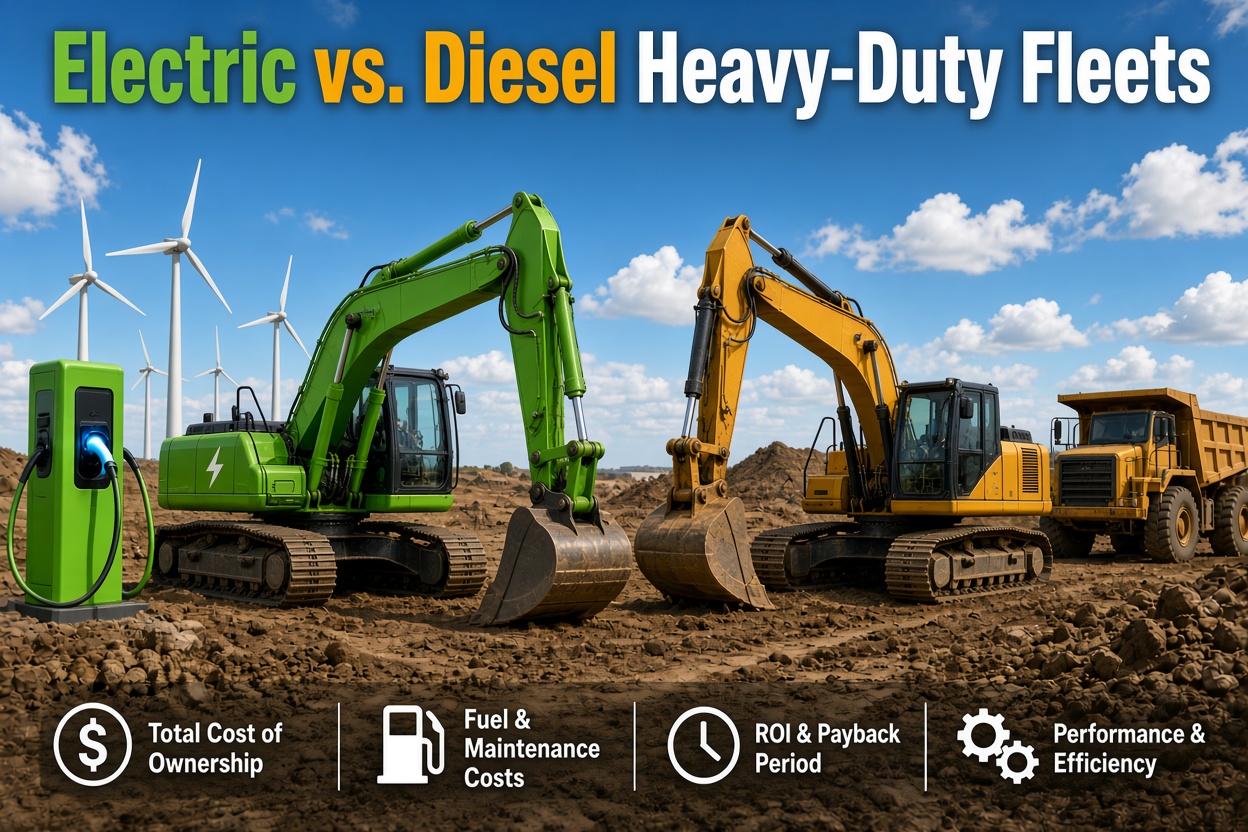
Electric vs. diesel heavy-duty fleets refers to the structured financial comparison of battery-electric and internal-combustion commercial vehicles over their full operational lifecycle, measured through Total Cost of Ownership (TCO) — the sum of capital expenditure, energy, maintenance, infrastructure, and residual value. For Class 7–8 operators, TCO — not sticker price — is the decisive metric in electrification decisions, because energy density, duty cycle, and charging economics dominate lifetime cost far more than procurement.
Key Takeaways
- TCO parity for battery-electric Class 8 tractors is achievable within 4–7 years on high-utilization routes (150,000+ miles/year), driven primarily by energy and maintenance savings of $0.20–$0.35 per mile.
- Depreciation and charging infrastructure remain the largest swing factors; a single depot fast-charger can add $140,000–$300,000 in upfront capex before the first vehicle turns a wheel.
- Diesel retains a structural advantage in long-haul, low-dwell applications where battery weight penalties and sparse megawatt-charging corridors erode payload revenue and uptime.
The TCO Framework: What Actually Moves the Number
A rigorous fleet TCO model decomposes cost into five buckets: capital expenditure (capex), energy/fuel, scheduled and unscheduled maintenance, infrastructure, and residual value. For diesel, the model is mature and well-understood: predictable depreciation, dense refueling networks, and decades of teardown data. For battery-electric vehicles (BEVs), the model is still being negotiated — and the assumptions embedded in it determine whether electrification reads as accretive or dilutive.
The critical analytical error most operators make is treating TCO as a single point estimate. In reality, TCO is a distribution, sensitive to route topology, ambient temperature, driver behavior, grid tariff structure, and the still-volatile trajectory of battery cell pricing. A defensible model must be route-segmented and probabilistic, not fleet-averaged.
Capex: The Upfront Gap and Its Trajectory
Diesel Class 8 tractors currently list at roughly $150,000–$190,000. Comparable battery-electric tractors sit at $300,000–$450,000, a premium of 1.6x to 2.4x [1]. This gap is narrowing as battery pack prices decline — industry tracking places cell-level costs near $115–$130/kWh in 2025, with pack-level integration adding 20–30% — but the convergence is uneven across vehicle classes and geographies.
Crucially, capex is not the vehicle alone. Electrification imposes parallel infrastructure investment: transformers, switchgear, depot charging cabinets, and potentially grid upgrade fees that utilities pass through to the customer. These soft costs are frequently under-modeled and can represent 15–25% of total electrification capex for a mid-sized depot.
Operating Expenditure: Where Electric Earns Its Keep
The economic case for electric fleets rests on energy and maintenance deltas. Diesel prices are volatile and route-dependent; electricity tariffs are structured, contractable, and — with smart charging — can be shifted to off-peak windows.
Energy Cost Mechanics
A diesel tractor averaging 6.5 mpg consumes roughly $0.58–$0.72 per mile in fuel at current retail diesel prices. A comparable BEV consuming 1.4–2.0 kWh per mile at a blended commercial tariff of $0.12–$0.18/kWh lands at $0.17–$0.36 per mile — a savings of $0.20–$0.35 per mile that compounds rapidly at high mileage [2].
Maintenance Compression
Electric drivetrains eliminate engine oil, fuel filters, DPF systems, DEF, and a significant share of brake wear (via regenerative braking). Fleet operators report 30–50% reductions in scheduled maintenance cost per mile for BEVs, though early-life data on high-voltage system reliability remains thin and warranty actuarial tables are still maturing.
Structured Comparison: Diesel vs. Electric Class 8 TCO Drivers
| TCO Component | Diesel Class 8 | Electric Class 8 | Directional Impact |
|---|---|---|---|
| Vehicle Capex | $150k–$190k | $300k–$450k | Diesel advantage |
| Infrastructure Capex | Minimal | $140k–$300k/charger | Diesel advantage |
| Energy Cost / Mile | $0.58–$0.72 | $0.17–$0.36 | Electric advantage |
| Maintenance / Mile | $0.20–$0.28 | $0.10–$0.18 | Electric advantage |
| Payload Capacity | Full | ~1,000–2,000 lb penalty | Diesel advantage |
| Uptime Risk | Low | Charging/availability | Diesel advantage |
| Residual Value (5 yr) | 35–45% | Uncertain / volatile | Neutral to diesel |
| Carbon / ESG Value | Declining | Accreting (credits, ESG) | Electric advantage |
The Weight Penalty and Revenue Erosion
A frequently underweighted variable is payload. Current battery-electric tractors carry packs large enough to impose a 1,000–2,000 lb weight penalty versus diesel, reducing legal payload. For weight-out (as opposed to cube-out) freight, this translates directly into lost revenue per trip — a cost that does not appear on any invoice but materially compresses TCO advantage. Regulatory weight allowances for alternative-fuel vehicles partially offset this in some jurisdictions, but the offset is not universal.
Charging Infrastructure: The Hidden Cost Center
Depot charging is the single most underestimated TCO line item. Beyond the charger itself, operators frequently face utility-side upgrades — transformer upsizing, conductor runs, and in some cases substation work — that can dwarf hardware costs. Time-of-use tariffs and demand charges further complicate the picture: a poorly managed charging profile can erase the energy savings that justify the conversion.
Smart charging, load management, and potentially on-site storage are not optional optimizations — they are TCO-defining variables. Fleets that charge naively during peak windows can see effective energy costs double versus optimized overnight charging.
ESG, Carbon, and the Institutional Value Layer
Beyond direct operating economics, electric fleets carry option value in carbon markets, ESG-linked financing, and corporate Scope 1 disclosure. For publicly traded shippers and logistics firms facing increasingly stringent disclosure regimes, fleet decarbonization is not merely a cost line — it is a balance sheet and capital-access consideration [3]. Voluntary carbon credits, LCFS (Low Carbon Fuel Standard) revenues in regulated states, and green-finance covenant benefits can add $0.03–$0.08 per mile in recoverable value for compliant fleets.
Financial / Operational Verdict
For high-utilization, return-to-base duty cycles — regional haul, drayage, last-mile tractor — battery-electric Class 8 fleets reach TCO parity within 4–7 years and generate positive lifetime economics thereafter, provided charging infrastructure is intelligently deployed and demand charges are actively managed. The case is strongest where routes are predictable, dwell windows exist, and ESG-linked value is monetizable.
For long-haul, irregular-route operations, diesel retains a clear and durable advantage. Battery weight penalties, sparse megawatt-charging infrastructure, and uncertain residual values make full electrification premature on a pure TCO basis. The rational institutional posture is segmented adoption: electrify the routes where the math works today, preserve diesel where it does not, and model the transition as a rolling capital reallocation rather than a fleet-wide mandate.
The operators who win the next decade will not be those who electrify fastest, but those who electrify the right miles first — and let the TCO model, not the press release, dictate the sequence.