


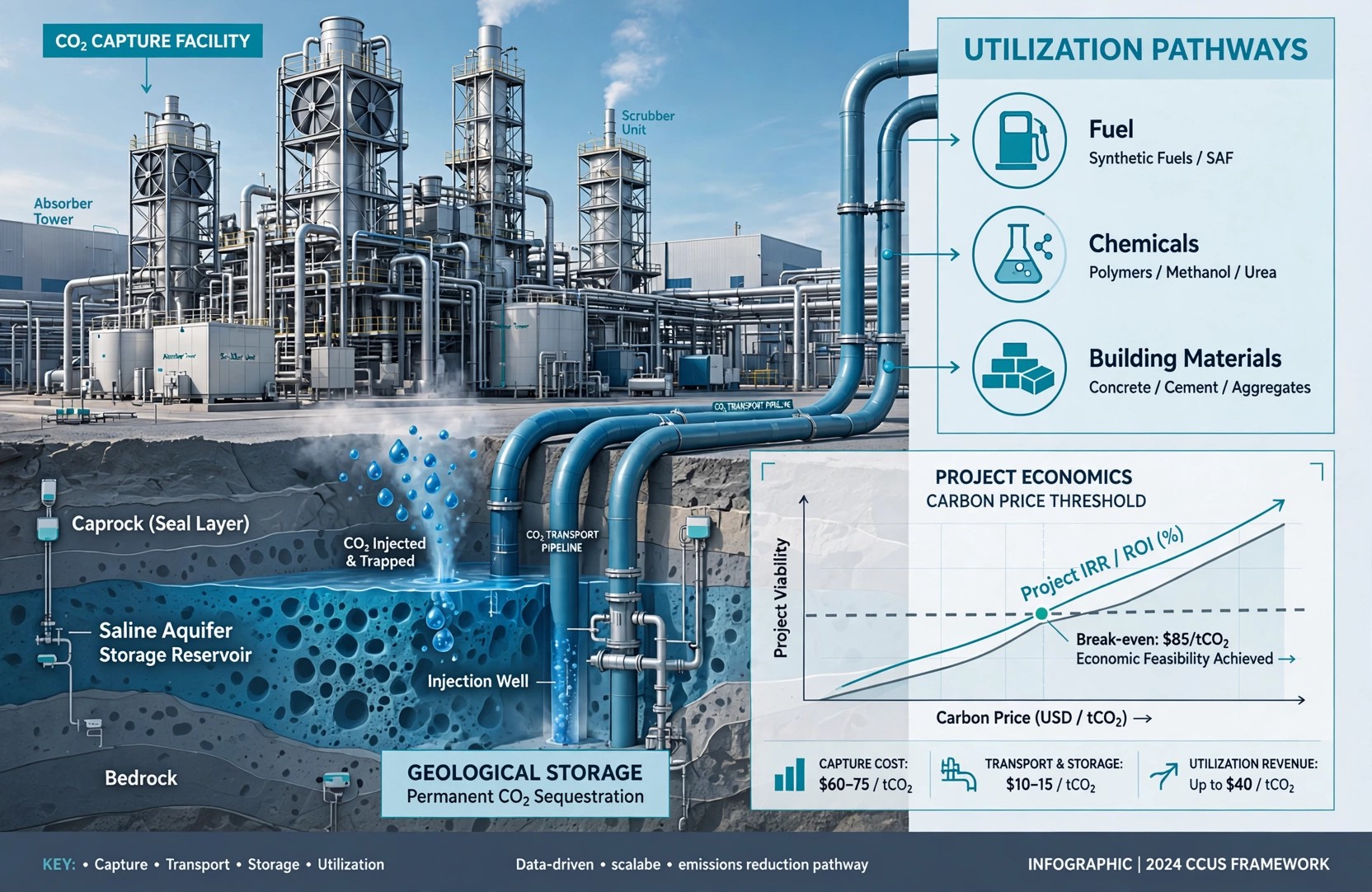
Carbon Capture, Utilization and Storage (CCUS) refers to the suite of technologies that separate CO2 from industrial or power-generation flue gas, transport it, and either utilize it (in enhanced oil recovery, synthetic fuels, aggregates, or chemicals) or permanently sequester it in geological formations. Its project economics are governed by a single brutal variable: the gap between capture cost and carbon price.
Key Takeaways
- CCUS is not one technology but four with sharply divergent economics: post-combustion, pre-combustion, oxy-fuel, and direct air capture (DAC), each with different cost curves and applicability.
- Capture cost ranges from $15–$50/tonne for high-purity industrial sources to $100–$1,000+/tonne for direct air capture, making source selection the dominant economic lever.
- Commercial viability today depends on carbon price, policy credit, or utilization revenue exceeding the all-in capture-plus-storage cost; absent policy, most projects do not clear.
The Capture Cost Curve
The economic logic of CCUS is dictated by CO2 concentration in the source stream. High-purity industrial vents — ethanol fermentation, natural gas processing, ammonia production — yield CO2 at 60–99% purity, requiring minimal separation work and costing $15–$40/tonne to capture. Dilute sources — power plant flue gas at 4–15% CO2 — cost $40–$120/tonne. Direct air capture, at 0.04% atmospheric CO2, costs $100–$1,000+ per tonne, an order of magnitude higher [1].
Source selection is therefore the single most important economic decision in any CCUS project. Not all tonnes are equal, and chasing the hardest tonnes first is a capital-destroying strategy.
Structured Comparison: CCUS Configuration Economics
| Configuration | Source CO2 Purity | Capture Cost ($/t) | Key Use Case | Current Viability |
|---|---|---|---|---|
| Industrial high-purity | 60–99% | $15–$40 | Ethanol, ammonia, gas processing | Commercial today |
| Post-combustion (power) | 4–15% | $40–$120 | Coal/gas power retrofit | Policy-dependent |
| Pre-combustion | High | $50–$100 | IGCC, blue hydrogen | Viable with support |
| Direct Air Capture | 0.04% | $100–$1,000+ | Atmospheric removal | Subsidy-dependent |
The Capex and Opex Stack
A CCUS project is not a single asset but a chain: capture plant, compression, pipeline transport, injection, and monitoring. Each link has its own capex and opex profile. Compression alone — raising CO2 to the ~100+ bar required for dense-phase transport — is often 30–40% of operating cost. Pipeline infrastructure is lumpy: a single trunk line requires scale to amortize, forcing aggregation of sources to justify build-out.
This chain structure explains why CCUS clusters — shared transport and storage infrastructure across multiple emitters — have become the dominant deployment model. The unit of economics is the hub, not the plant.
The Carbon Price Threshold
A CCUS project clears its cost of capital only when monetized carbon value exceeds all-in capture, transport, and storage cost plus a return. In jurisdictions with robust carbon pricing — the EU ETS trading near EUR70–EUR90/tonne — high-purity industrial CCUS approaches viability. In jurisdictions without pricing or with weak credits, projects require 45Q-style tax credits (US, up to $85/tonne for storage, $180/tonne for DAC) or equivalent grant support to reach financial close [2].
The brutal truth: without policy, most CCUS does not get built. The technology is real; the economics are not yet standalone.
Utilization: The Revenue Illusion
Carbon utilization — selling captured CO2 into products — is frequently presented as a path to self-funding. The analytical reality is harsher. Most utilization markets are small, low-margin, or temporary (CO2 is re-emitted when the product is used or degrades). The only large-scale utilization with durable economics is enhanced oil recovery (EOR), which has its own accounting complexity: the lifecycle carbon benefit depends entirely on how the additional oil is counted.
Genuine, durable, large-scale utilization at meaningful carbon prices remains a research frontier, not a commercial reality. Operators relying on utilization revenue to close project economics are taking material risk.
The Geology and Permanence Question
Storage permanence is a balance sheet liability, not just a technical question. A project storing 1 million tonnes/year for 20 years carries a 20 million tonne long-tail liability for leakage, monitoring, and remediation. Regulatory frameworks — liability transfer to the state after closure, post-injection monitoring periods, financial assurance — materially affect project return and must be modeled as such, not footnoted.
Financial / Operational Verdict
For high-purity industrial sources in jurisdictions with carbon pricing or robust tax credits, CCUS is commercially deployable today and should be pursued aggressively. These are the negative-cost-abatement tonnes that clear under almost any policy scenario.
For dilute and atmospheric sources, CCUS remains a policy-created market. Projects require sustained credit support to reach financial close, and investors should size exposure to policy continuity risk accordingly. Direct air capture, in particular, is a strategic option on future carbon scarcity, not a project finance asset class on present economics.
The institutional playbook is narrow and unforgiving: capture the cheap tonnes first, aggregate into shared infrastructure, lock policy support before committing capital, and never let utilization revenue carry a project that carbon price alone cannot justify.