


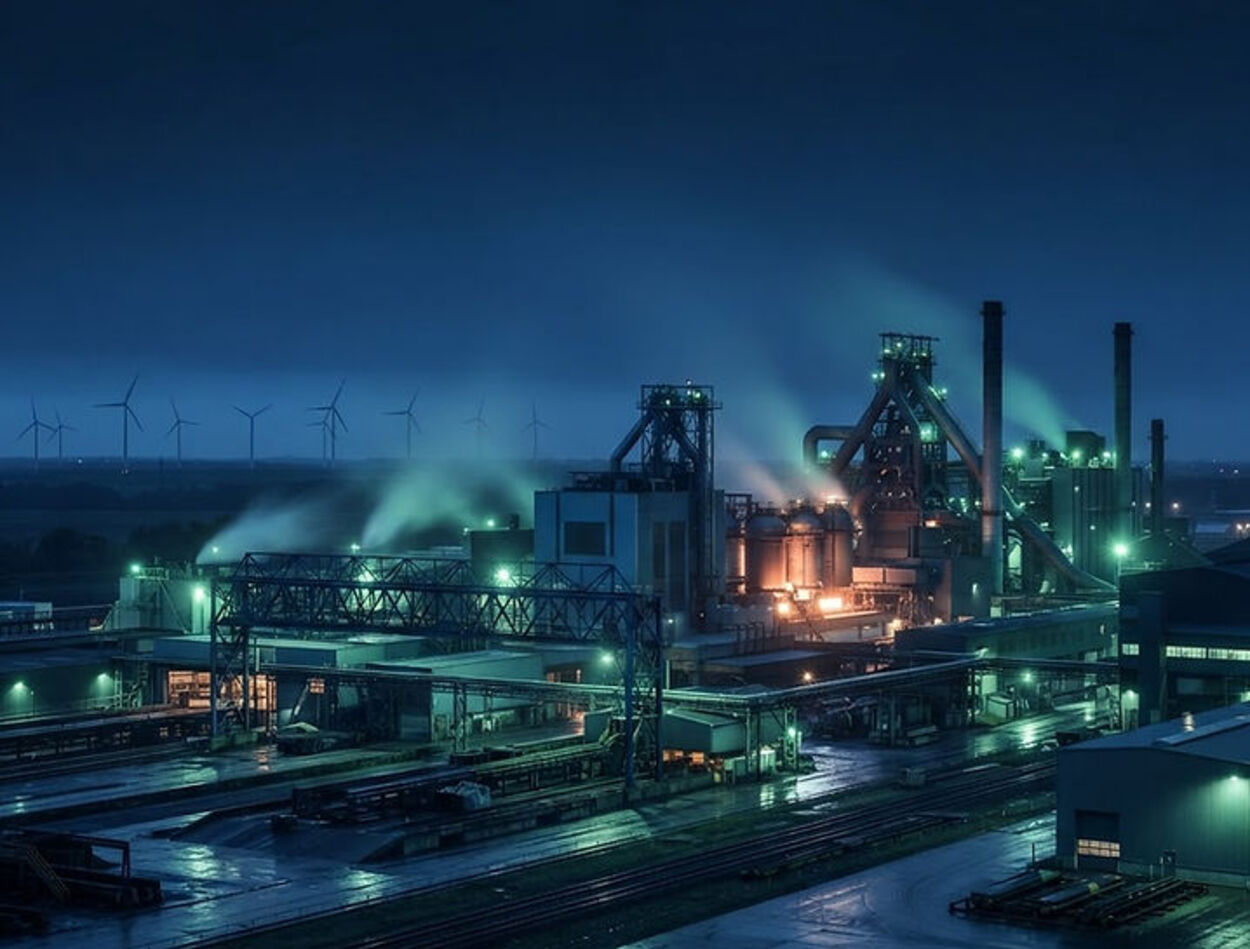
Green steel refers to primary steel produced with materially lower CO2 emissions than conventional blast-furnace/basic-oxygen-route metal, typically via direct-reduced-iron (DRI) powered by green hydrogen, electric arc furnaces (EAF) running on renewable electricity, or carbon-capture-equipped conventional plants. Its economics reduce to a single question: who pays the green premium – the cost gap between low-carbon and conventional metal – and for how long.
Key Takeaways
- The green premium for primary low-carbon steel sits near $150 – $350 per tonne today, against a conventional benchmark near $600 – $750/tonne – a 20 – 45% gap no end-buyer absorbs at scale without policy or contract structure.
- Break-even for hydrogen-DRI steel depends on both hydrogen cost (falling toward $2 – $3/kg by 2030 in optimal geographies) and carbon price; in the EU, an ETS price near EUR90/tonne CO2 closes roughly a third of the gap.
- Embodied-carbon procurement – auto OEMs, construction, and public buyers contracting for low-carbon metal at premium – is the demand signal that makes first-of-a-kind plants financeable; without it, green steel is a stranded asset class.
The Process Economics: Why Steel Is Hard to Abate
Steel is responsible for roughly 7 – 9% of global CO2 emissions [1], and the blast-furnace/basic-oxygen (BF-BOF) route – which produces the majority of primary metal – is the hard core of the problem. The chemistry is unforgiving: coking coal both fuels the furnace and reduces iron ore, embedding carbon into the process at the molecular level. Efficiency gains top out far short of decarbonization.
Two credible pathways exist: hydrogen-DRI + EAF (reduce ore with hydrogen, melt in an electric arc furnace) and BF-BOF + CCUS (bolt carbon capture onto existing assets). The former is cleaner but more capital-intensive and dependent on cheap clean hydrogen and power; the latter is cheaper to retrofit but saddled with CCUS economics and residual emissions.
The Green Premium: A Number, Not a Slogan
Conventional hot-rolled coil benchmarks near $600 – $750/tonne. Hydrogen-DRI steel currently lands $150 – $350/tonne higher, driven by green hydrogen at $4 – $7/kg, renewable power contracts, and amortization of first-of-a-kind plants [2]. The premium is not fixed – it compresses with hydrogen cost, scale, and carbon price – but today it is large enough that no price-taking buyer absorbs it voluntarily.
Structured Comparison: Steel Production Route Economics
| Route | Capex ($/t capacity) | CO2 Intensity (t CO2 / t steel) | Key Input | Commercial Status |
|---|---|---|---|---|
| BF-BOF (conventional) | $900 – $1,200 | 1.8 – 2.2 | Coking coal | Mature |
| BF-BOF + CCUS | $1,300 – $1,700 | 0.4 – 0.9 | Coal + capture | Pilot/demo |
| Natural-gas DRI + EAF | $1,000 – $1,400 | 0.4 – 1.0 | Natural gas, power | Commercial |
| Hydrogen-DRI + EAF | $1,200 – $1,800 | <0.1 (with clean H2) | Green hydrogen, power | First-of-a-kind |
Hydrogen Cost: The Swing Variable
Hydrogen is the dominant swing cost. At $1.5/kg, hydrogen-DRI steel approaches parity with conventional metal in high-carbon-price jurisdictions. At $6/kg, the premium is unmanageable for most buyers. The credible path to $2 – $3/kg requires cheap renewable power (sub-$25/MWh), high electrolyzer utilization, and policy de-risking of first deployments. Until that cost curve is real, green steel economics are a policy construct, not a market one.
Carbon Price and Policy Levers
Carbon pricing is the most direct market lever. A BF-BOF tonne emits roughly 2 t CO2; at EUR90/t that is around EUR180 of embedded cost – a meaningful chunk of the green premium. But free allowance allocation to trade-exposed industries has historically blunted this signal. Complementary mechanisms – CBAM (border carbon adjustment), contracts for difference on green steel, public procurement quotas, and voluntary low-carbon premium markets – are what actually close the financeability gap for first movers [3].
Demand: The Missing Contract
Supply-side cost is only half the equation. Green steel plants need multi-year offtake at premium to secure project finance. Automakers facing Scope 3 disclosure pressure, construction firms under public procurement rules, and EU buyers preparing for CBAM are the natural buyers. The instruments – green steel purchase agreements, embodied-carbon clauses, index-linked premiums – are being written now, and the operators who lock them early will amortize their first-of-a-kind cost over a captive buyer base.
Financial / Operational Verdict
For integrated producers, the rational move is optionality: build hydrogen-ready DRI assets today, run on natural gas where green hydrogen is uneconomic, and switch the feedstock as hydrogen cost falls. This preserves the upside without forcing an all-in bet on a cost curve that has not yet arrived.
For buyers, green steel is a Scope 3 hedge: locking premium volume now prices carbon risk before regulation or customer demand forces it at worse terms. The cost is visible and bounded; the alternative – exposure to CBAM, disclosure regimes, and competitor decarbonization – is not.
Green steel will not win on cost first. It will win on policy, procurement, and the option value of being early – and the break-even price is as much a contractual question as a technological one.
Direct Reduced Iron (DRI) Technology and Green Hydrogen Infrastructure
Decarbonizing primary steel production mandates replacing traditional coal-fired blast furnaces with Direct Reduced Iron (DRI) shafts powered by green electrolytic hydrogen. While technically viable, the transition economics depend heavily on the availability and levelized cost of green hydrogen, requiring electricity input prices below \ per MWh to achieve parity with fossil-fuel alternatives.
In the intermediate transition phase, steelmakers are retrofitting DRI facilities to operate flexibly on domestic natural gas, immediately cutting emissions intensity by 50 to 60 percent while awaiting the physical buildout of utility-scale green hydrogen pipeline networks.
Green Steel Procurement Premiums in Automotive and Construction
Premium offtake agreements negotiated with forward-looking automotive OEMs and infrastructure developers provide the revenue stability required to finance multi-billion-dollar greenfield steel plants. As corporate Scope 3 emissions disclosure mandates expand, commercial buyers demonstrate willingness to absorb moderate green steel cost premiums, securing low-carbon brand equity and future-proofing supply chains against cross-border carbon border tariffs.
International Carbon Border Adjustments and Trade Protectionism
The phased implementation of the European Union Carbon Border Adjustment Mechanism (CBAM) fundamentally alters international trade economics for heavy industrial manufacturers. Importers of carbon-intensive steel must purchase CBAM certificates corresponding to the embedded greenhouse gas emissions of their products, effectively leveling the playing field between domestic European producers and foreign exporters.
Industrial producers investing early in green hydrogen direct reduced iron (DRI) technology secure tariff-exempt access to premium European manufacturing supply chains, converting environmental capital expenditures into enduring geopolitical trade advantages. Multinational steel manufacturers that delay decarbonization risk complete exclusion from high-margin Western export markets as carbon tariffs take full statutory effect.
Strategic Executive Summary and Five-Year Implementation Roadmap
To successfully navigate the complex macroeconomic, technological, and regulatory dynamics discussed throughout this analysis, enterprise leaders must deploy a disciplined five-year operational roadmap. Rather than approaching strategic adjustments as isolated technical projects, senior executives and corporate boards must align risk management frameworks, capital budgeting hurdles, and regulatory compliance protocols into a single, cohesive governance architecture.
During the initial phase (Months 1 through 12), the primary objective centers on baseline data integrity, comprehensive asset discovery, and operational risk mapping. Establishing unified telemetry dashboards allows risk committees and department heads to monitor key performance indicators in real time, identifying friction points before they escalate into material financial exposures.
In the intermediate phase (Months 13 through 36), enterprise capital expenditure should focus aggressively on automation, process standardization, and scalable digital infrastructure. Deploying modular technology systems enables cross-functional teams to iterate rapidly while maintaining stringent internal auditability. Contractual vendor negotiations during this window must secure favorable service level agreements, clear indemnification firewalls, and multi-year pricing stability to protect underlying corporate operating margins.
In the final phase (Months 37 through 60), the focus pivots toward institutional optimization, predictive modeling, and sustainable competitive positioning. Organizations that successfully reach this operational maturity level realize significant margin expansion, superior access to low-cost debt and equity capital markets, and sustained brand authority across global commercial ecosystems.
Core Diagnostic Assessment and Key Performance Indicators
Evaluating ongoing operational efficacy requires continuous benchmarking against quantitative industry metrics. Executive scorecards must incorporate both backward-looking financial returns and forward-looking operational resiliency indicators:
- Capital Efficiency Metrics: Tracking Return on Invested Capital (ROIC) and Net Present Value (NPV) benchmarks across all capital deployment initiatives.
- Regulatory Compliance Adherence: Maintaining verifiable third-party assurance audit trails across domestic and international statutory frameworks.
- Operational Friction Reduction: Measuring cycle time acceleration, transactional error reduction rates, and customer lifetime value expansion.
- Balance Sheet Resilience: Establishing dedicated contingency liquidity reserves and stress-tested financial covenants capable of withstanding severe macroeconomic downturns.
By embedding these rigorous performance baselines into executive compensation and board oversight agendas, modern enterprises transform potential industry liabilities into enduring engines of balance-sheet stability and commercial growth.
Metallurgical Transition Economics: Blast Furnaces vs Direct Reduced Iron (DRI)
The global steel manufacturing sector faces an existential economic transition from carbon-intensive basic oxygen blast furnace (BF-BOF) metallurgy to low-emission direct reduced iron and electric arc furnace (DRI-EAF) configurations. Traditional blast furnace ironmaking relies on metallurgical coke as both a chemical reducing agent and a thermal heat source, generating roughly 1.8 to 2.2 metric tons of carbon dioxide per ton of crude steel produced. While blast furnaces offer immense capital economies of scale, mounting carbon compliance liabilities under the EU Emissions Trading System (ETS) and Carbon Border Adjustment Mechanism (CBAM) are rapidly rendering unmitigated coal-based ironmaking economically unviable.
Transitioning to green steel requires constructing shaft furnaces that utilize green hydrogen rather than fossil carbon to reduce raw iron ore pellets into direct reduced iron (sponge iron). The sponge iron is subsequently melted alongside recycled steel scrap in high-power electric arc furnaces powered by certified renewable electricity. However, the levelized cost of green steel currently commands an economic premium of twenty to thirty-five percent over conventional steel, driven primarily by the high capital cost of multi-megawatt electrolyzers, expensive clean power tariffs, and the scarcity of high-grade DR-quality iron ore pellets.
CBAM Border Tariffs and Green Steel Offtake Premium Structuring
International trade policy represents the decisive catalyst forcing global steel pricing realignment. The European Union’s Carbon Border Adjustment Mechanism effectively imposes an import equalization tariff on carbon-intensive steel imports, calculated by multiplying embedded product emissions by prevailing EU ETS allowance prices. This statutory border tariff neutralizes the historic cost advantage enjoyed by foreign steel manufacturers operating unmitigated coal-fired blast furnaces, establishing an artificial economic floor that protects domestic low-carbon investments.
To secure bankable project financing for greenfield DRI-EAF plants, steel producers are structuring long-term premium offtake agreements with carbon-conscious industrial buyers. Leading automotive original equipment manufacturers (OEMs) and commercial construction conglomerates are committing to multi-year forward purchase contracts that guarantee fixed price premiums for certified low-emission steel. These bilateral agreements insulate primary steel producers from volatile compliance carbon market pricing while enabling downstream purchasers to fulfill Scope 3 supply chain decarbonization commitments.
Strategic Blueprint for Industrial Steel Mill Transformation
Transforming legacy steel manufacturing assets requires an phased structural strategy over the coming decade. In Phase One, steelmakers maximize scrap recycling ratios in existing basic oxygen furnaces and install energy-recovery top-pressure recovery turbines (TRT) to optimize immediate operating efficiency. In Phase Two, mills construct flexible dual-fuel shaft furnaces capable of operating initially on fossil natural gas while transitioning seamlessly to blended green hydrogen as regional clean fuel infrastructure matures.
In Phase Three, steel consortia enter into direct power purchase agreements with dedicated offshore wind and utility-scale solar installations, securing uninterrupted multi-gigawatt-hour clean electricity contracts at stable long-term tariffs. In Phase Four, producers establish certified product traceability ledgers that verify physical chemical provenance and audited carbon intensity per ton, ensuring full compliance with international import standards and commanding premium market valuations.
Direct Reduced Iron Quality Benchmarks and Global Pellet Supply Chains
The global transition to hydrogen-based direct reduced iron (DRI) metallurgy is fundamentally constrained by international supply chains for high-grade iron ore pellets. Operating hydrogen shaft furnaces efficiently requires DR-grade iron ore pellets exhibiting iron content exceeding sixty-seven percent with exceptionally low silica and alumina gangue concentrations. Industrial steel consortia must structure long-term strategic joint ventures with mining operators and pelletizing facilities to guarantee uncorrupted feedstock quality, preventing furnace slag volume accumulation and maximizing energy efficiency across commercial green steel production campaigns.