


What Is AI Data Center Economics?
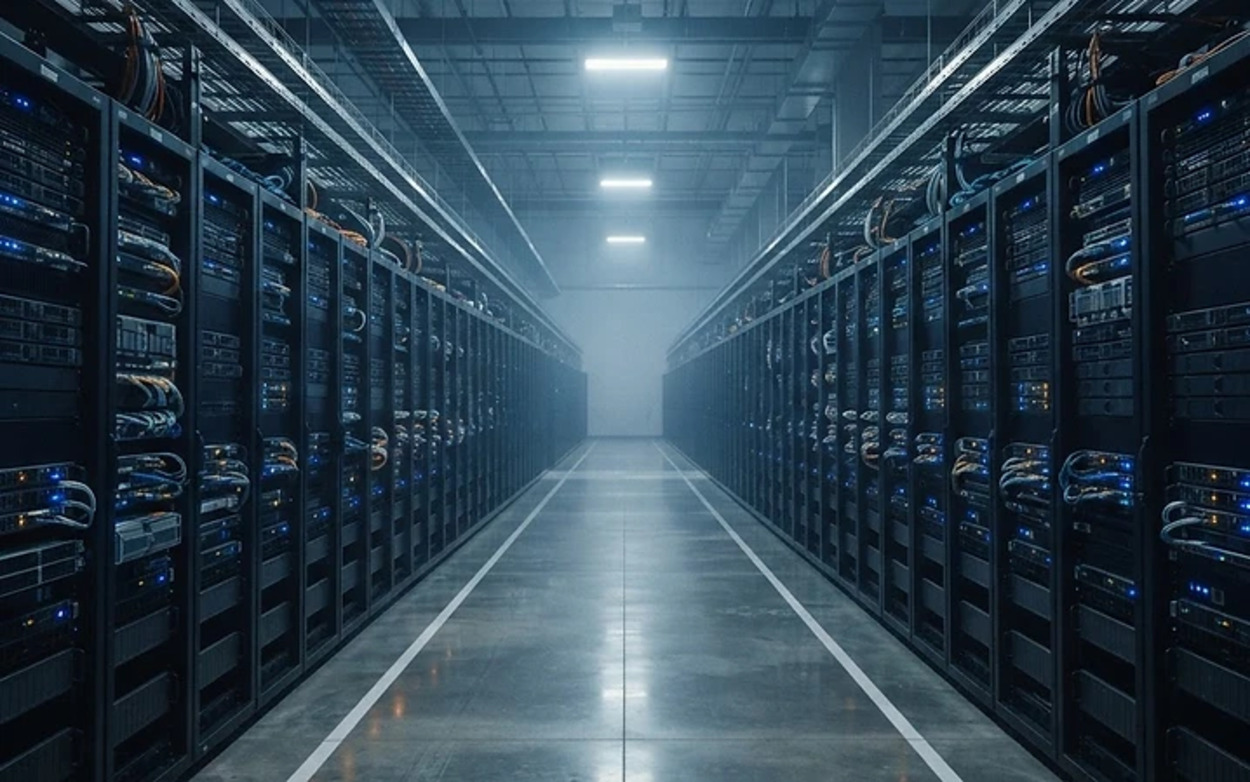
AI data center economics is the financial analysis of building, operating, and monetizing hyperscale facilities purpose-built for GPU-accelerated training and inference workloads. The discipline diverges from traditional colocation economics because the cost stack is dominated by power procurement and GPU capex amortization rather than by real estate and cross-connect revenue [1].
Key Takeaways
The Capital Stack
A 100 MW facility built for H-class GPU clusters carries the following capital intensity:
- Site and shell: $150–$200 million;
- Power infrastructure (substations, transformers, switchgear): $300–$450 million;
- Cooling systems (liquid and rear-door heat exchangers): $120–$180 million;
- GPU and server hardware: $600–$900 million [2].
The hardware line item depreciates over 3–4 years — far shorter than the 15-year real-estate amortization — creating a duration mismatch that defines the risk profile. An operator underutilizing capacity for 12 months can impair 25–30% of the hardware’s book value before a single workload migrates.
Power: The New Binding Constraint
Compute demand is growing faster than grid interconnection capacity. In primary markets (Northern Virginia, Phoenix, Dublin), queue times for >50 MW connections have extended to 4–7 years [3]. This scarcity has repriced power in two ways:
- Capacity payments for firm power now add $8–$15/MWh to base energy costs;
- Behind-the-meter generation — typically gas peakers or solar-plus-storage — is deployed at a 20–35% premium to grid tariffs.
The effective blended power cost for a hyperscaler in a constrained market has risen from $0.03/kWh in 2021 to $0.055–$0.075/kWh in 2026, eroding the unit economics of inference workloads where power is 60–70% of cost.
ROI and Utilization Thresholds
The profitability of an AI facility is a function of utilization, power cost, and compute pricing. A representative model:
| Utilization | Power Cost ($/kWh) | Implied GPU Hour Rate | Annual ROI |
|---|---|---|---|
| 95% | $0.04 | $1.10 | 22% |
| 85% | $0.06 | $1.40 | 11% |
| 70% | $0.07 | $1.65 | 3% |
| 55% | $0.08 | $2.10 | Negative |
The table demonstrates the operating leverage of the model: a 15-point utilization decline combined with a 2-cent power-cost increase converts a 22% return into a loss-making asset [4]. This is why hyperscalers commit to 10–15 year power purchase agreements and multi-year tenant commitments before breaking ground.
The Strategic Verdict
AI data center economics reward scale, power access, and contracted utilization above all else. Operators without firm power commitments or anchor tenants face a structurally negative carry. For institutional investors, the asset class offers inflation-linked, long-duration cash flows — but only when underwritten against verified power interconnection and utilization floors of 80% or higher.