


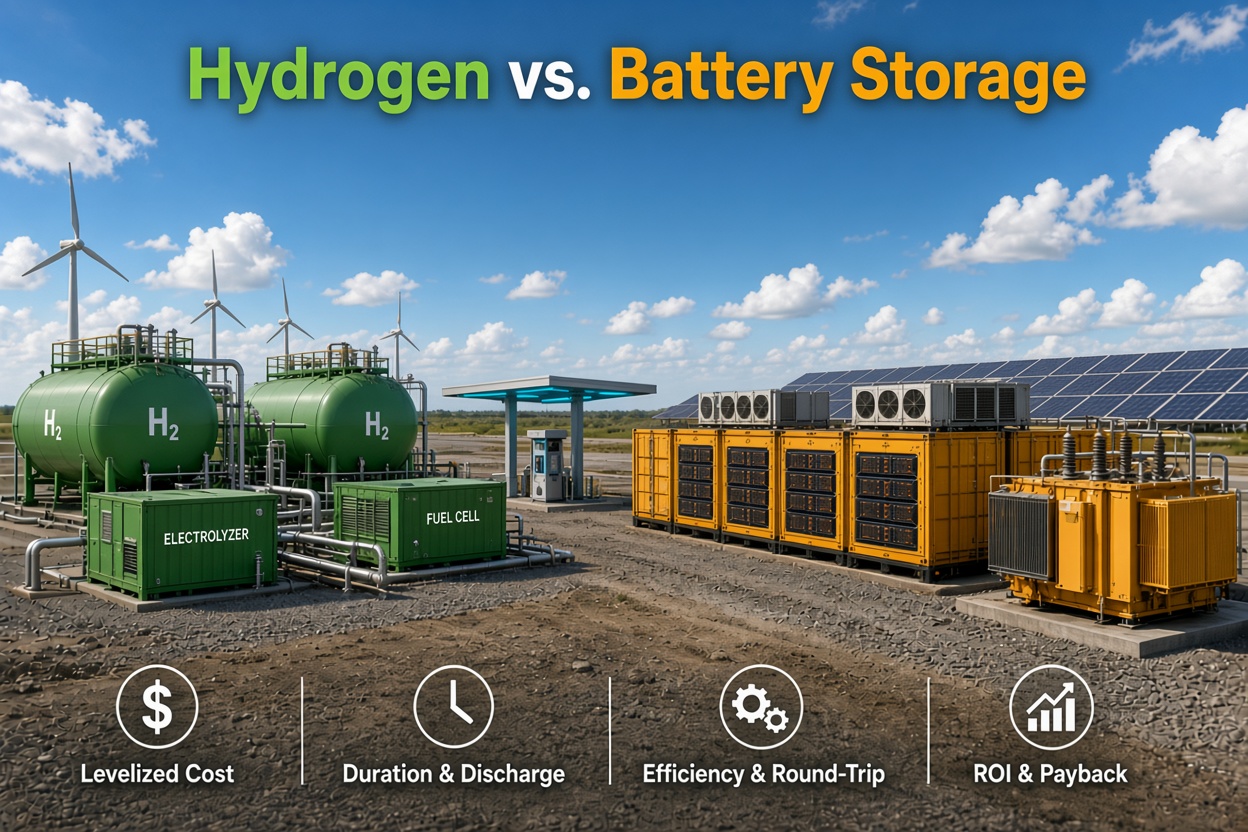
Grid-scale hydrogen storage and battery energy storage systems (BESS) are the two principal technologies competing to firm renewable generation at utility scale. The choice between them is not a question of superiority but of duration: batteries win on cost and round-trip efficiency for short dispatch windows, hydrogen wins on energy density and decoupled storage duration for multi-day and seasonal balancing.
Key Takeaways
- Round-trip efficiency favors batteries decisively (85–95% vs. 30–40% for hydrogen), making BESS the default for sub-8-hour storage.
- Hydrogen’s structural advantage is duration: tank-based storage scales linearly with vessel size, not power capacity, enabling weekly to seasonal energy shifting batteries cannot economically serve.
- Levelized cost of storage (LCOS) crossover occurs near the 12–16 hour mark today, with hydrogen becoming the lower-cost technology as storage duration extends beyond a single day.
The Duration Problem
Renewable grids produce energy when the wind blows and the sun shines, not when demand peaks. Short-duration storage — smoothing intra-day mismatches, frequency regulation, peak shaving — is the domain of lithium-ion BESS. Long-duration storage — multi-day lulls, seasonal surplus absorption, winter peaking — is the domain where electrochemical storage breaks down economically and hydrogen’s decoupled power-to-energy ratio becomes decisive.
A battery’s cost scales with both power (inverters, converters) and energy (cell capacity). A hydrogen system’s cost decouples: electrolyzers determine power input, storage tanks determine energy held, fuel cells or turbines determine power output. This decoupling is the core of the duration economics.
Efficiency: The Unforgiving Number
The most cited argument against hydrogen is efficiency. Converting electricity to hydrogen via electrolysis, storing, then reconverting to power destroys 60–70% of the input energy. Batteries lose only 5–15%.
For short, frequent cycles, this efficiency gap is fatal to hydrogen’s economics. For long, infrequent cycles, the relevant metric shifts from efficiency to cost per kWh of stored energy delivered when dispatched — and here the calculus inverts.
Structured Comparison: Grid-Scale Storage Economics
| Metric | Lithium-Ion BESS | Hydrogen (Electrolysis + Storage + Fuel Cell) | Directional Advantage |
|---|---|---|---|
| Round-Trip Efficiency | 85–95% | 30–40% | Battery |
| Capex ($/kW power) | $1,200–$1,800 | $1,800–$3,500 | Battery |
| Capex ($/kWh storage) | $250–$400 | $5–$15 (tank) | Hydrogen |
| Optimal Duration | 1–8 hours | 10h–seasonal | Duration-dependent |
| Degradation | Calendar + cycling | Minimal (tank) | Hydrogen |
| Siting Flexibility | Grid-tied | Geology-dependent (salt cavern) | Battery |
| LCOS Crossover | ~12–16 hours today | ~12–16 hours today | Boundary |
Capex Decomposition: Power vs. Energy
This is the analytical heart of the comparison. A 4-hour BESS at $1,500/kW and $350/kWh costs roughly $2,900/kW installed. Doubling duration to 8 hours nearly doubles the storage cost with little change to power-side capex.
A hydrogen system at the same power rating sees storage cost barely move when duration doubles — tanks are cheap relative to electrochemical cells. The crossover where hydrogen undercuts battery LCOS occurs once duration stretches long enough that the battery’s energy-side cost overwhelms its efficiency advantage [1].
The Electrolyzer Bottleneck
Hydrogen’s economics depend on cheap, surplus electricity. Electrolyzers are capital-intensive and must run at high capacity factors to amortize. Yet the very scenario that creates cheap hydrogen — surplus renewables — is intermittent. This tension forces operators to choose between high utilization (undercutting the economics of surplus power) and low-cost input (undercutting electrolyzer amortization). Green hydrogen produced from genuinely curtailed renewables remains structurally expensive today, with production costs of $4–$7/kg, against a blue and grey hydrogen benchmark of $1.50–$2.50/kg [2].
Policy and the Value of Firmness
Pure market arbitrage undervalues both technologies. The real economic case for long-duration storage is resource adequacy — keeping the lights on during multi-day renewable droughts. Capacity markets, reliability payments, and increasingly firm capacity accreditation are the mechanisms that monetize this value. Without them, hydrogen storage is uneconomic against combustion peakers. With them, its option value becomes material.
Financial / Operational Verdict
For dispatch windows under 8 hours, lithium-ion BESS is the unambiguous economic winner on both capex and efficiency. Operators should deploy batteries aggressively for frequency response, solar shifting, and peak management.
For multi-day and seasonal duration, hydrogen — paired with geological storage and dispatched as firm capacity — is the only technology that scales economically. Its near-term economics depend heavily on policy support and capacity market design, not pure energy arbitrage.
The rational institutional posture is layered: batteries for the hours we understand, hydrogen (or other long-duration technologies) for the hours we have not yet priced. The grid of 2030 will not be one storage technology but a duration-ordered stack, each layer earning its return on the timescale it serves best.