


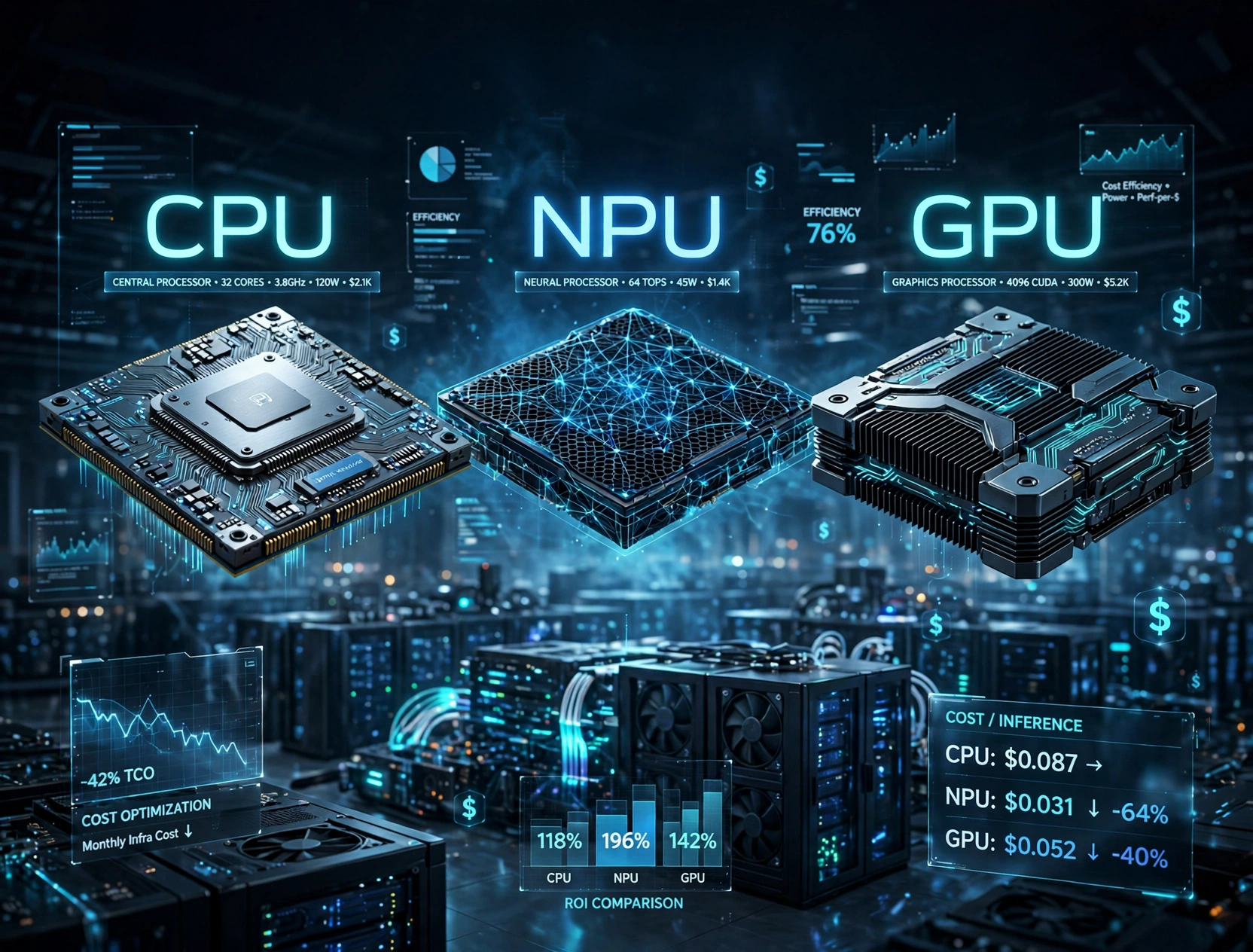
The commercial scaling of Artificial Intelligence (AI) and Large Language Models (LLMs) has shifted the primary bottleneck of enterprise IT from software development to hardware procurement. Chief Information Officers (CIOs) and enterprise architects are now forced to navigate the complex financial economics of compute infrastructure. Understanding the distinct architectural efficiencies and cost profiles of Central Processing Units (CPUs), Graphics Processing Units (GPUs), and Neural Processing Units (NPUs) is critical to avoiding catastrophic capital misallocation in AI deployments.
Key Takeaways
The Architecture of AI Economics
Historically, enterprise workloads relied on the sequential processing power of CPUs. However, the matrix multiplication inherent in deep learning requires massive parallelization. GPUs, originally designed for rendering graphics, inherently possess thousands of smaller cores perfectly suited for this task. Consequently, GPU clusters have become the industry standard for model training [1].
| ⚠️ Strategic Misallocation Alert Enterprises treating AI hardware as a monolithic expenditure are currently overspending by 40% on energy-intensive GPU inference. The market transition toward dedicated NPU silicon for constant, low-latency AI tasks is not optional; it is a financial necessity for sustained ROI. |
The financial friction emerges during the inference phase—when the AI model is actually deployed to generate predictions or content. Using premium GPUs for basic inference tasks is a severe misallocation of resources. NPUs, which are silicon explicitly designed to accelerate neural network operations, provide a vastly superior cost-to-performance ratio for continuous, low-latency AI tasks.
CapEx vs. OpEx: The Hardware Matrix
To determine the most efficient infrastructure path, enterprises must evaluate hardware not just on raw performance (TFLOPS), but on Performance-per-Watt and Total Cost of Ownership (TCO).
| Hardware Architecture | Optimal Workload | Relative CapEx (Acquisition) | Power Efficiency (OpEx) | 3-Year TCO Profile |
| CPU (Enterprise Tier) | Database management, sequential logic | Low ($) | Moderate | Highly predictable, lowest baseline. |
| GPU (e.g., H100 series) | LLM Training, massive parallel compute | Extremely High ($$$) | Very Low (High power draw) | Escalates rapidly due to cooling/energy. |
| NPU (AI Accelerators) | Model Inference, Edge AI execution | Moderate ($$) | Extremely High | Optimal for continuous, deployed AI. |
Deploying a hybrid infrastructure—utilizing cloud GPUs strictly for periodic model training and on-premise NPUs for daily inference—can reduce data center energy OpEx by up to 60% while extending the lifecycle of the hardware stack [2].
Navigating the Silicon Supply Chain
Beyond direct financial modeling, executives must price in supply chain risks. Premium data center GPUs currently suffer from severe market scarcity, driving up acquisition costs and delaying enterprise integration timelines. Conversely, CPUs and integrated NPUs benefit from stabilized, mature supply chains. Structuring an AI strategy that minimizes reliance on hyper-scarce GPU components provides a distinct operational advantage and reduces lead times for project deployment.
CFO’s Operational VerdictDo not let infrastructure bottleneck your P&L.